
Watching how small wounds on the reef may become defended algae patches
How does an aatuti farm begin?
Banded scalyfins, Parma polylepis, are known locally on Norfolk Island as aatuti, and by some swimmers, rather hilariously, as the ‘bastard bitey fish’!
If you swim here often, you know them. They are bold, territorial little fish with no hesitation about telling you when you are too close. They defend patches of algae, chase other fish away, and crop their patch like a tiny underwater paddock.
They are algae farmers.
But I have been wondering about something more basic. How does that ‘farm’ begin?
Established aatuti farms are easy to recognise. They usually look like dark or pale algal patches on coral or reef surface, often with a grumpy aatuti nearby. But what came before that? Was there always a patch of algae there? Did the fish make it? Did it begin with injury? Or did the fish take over after the coral surface had already started to change?
Over the past year, I have been following several patches from what seems like tiny scrapes to fully fledged farms, which may show part of that story.
First, the bit I can’t pin down
How those first marks appeared is the part I cannot pin down.
In the examples below, the first photo in each sequence shows a cluster of small white marks on living coral. They look like fresh tissue-loss scars. But I cannot say what made them. They may have been fish bites. They may have been abrasions. They may have been localised disease, or some other kind of tissue damage. Still photos cannot identify the culprit.
At first, I wondered if parrotfish were involved, mainly because much of our parrotfish population hangs around this area and another spot about 40 metres away. That was only a possibility. Parrotfish graze hard reef surfaces and can leave pale bite marks, but the published evidence makes me careful with that idea. In one study that followed more than 2,000 parrotfish bite scars, most scars on living coral healed back over within a year. So while parrotfish may make some of the marks we see on coral, a bite mark does not automatically become the start of a long-term algal farm.
The more interesting question is what happens when wounds like these don’t heal.
Example one – from scars to farm
In March 2025, I photographed a coral with a scatter of white scars. By May, those small scars had started to join. A larger dead patch had formed, and algae was beginning to grow on the exposed skeleton. By December, the patch was broader and more clearly algal. By May and June 2026, the patch had become a dense algal mat. And there, right on it, was an adult aatuti.
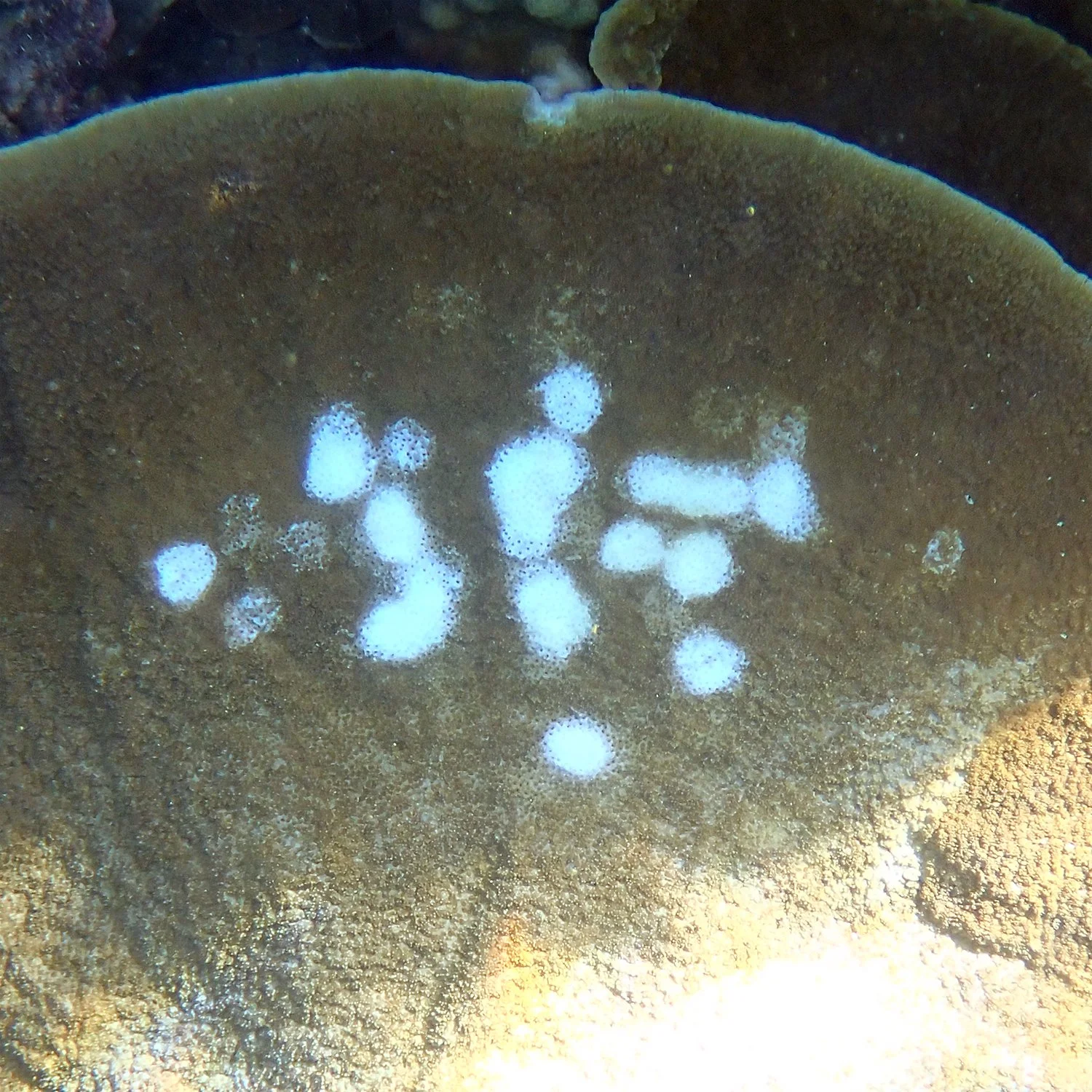
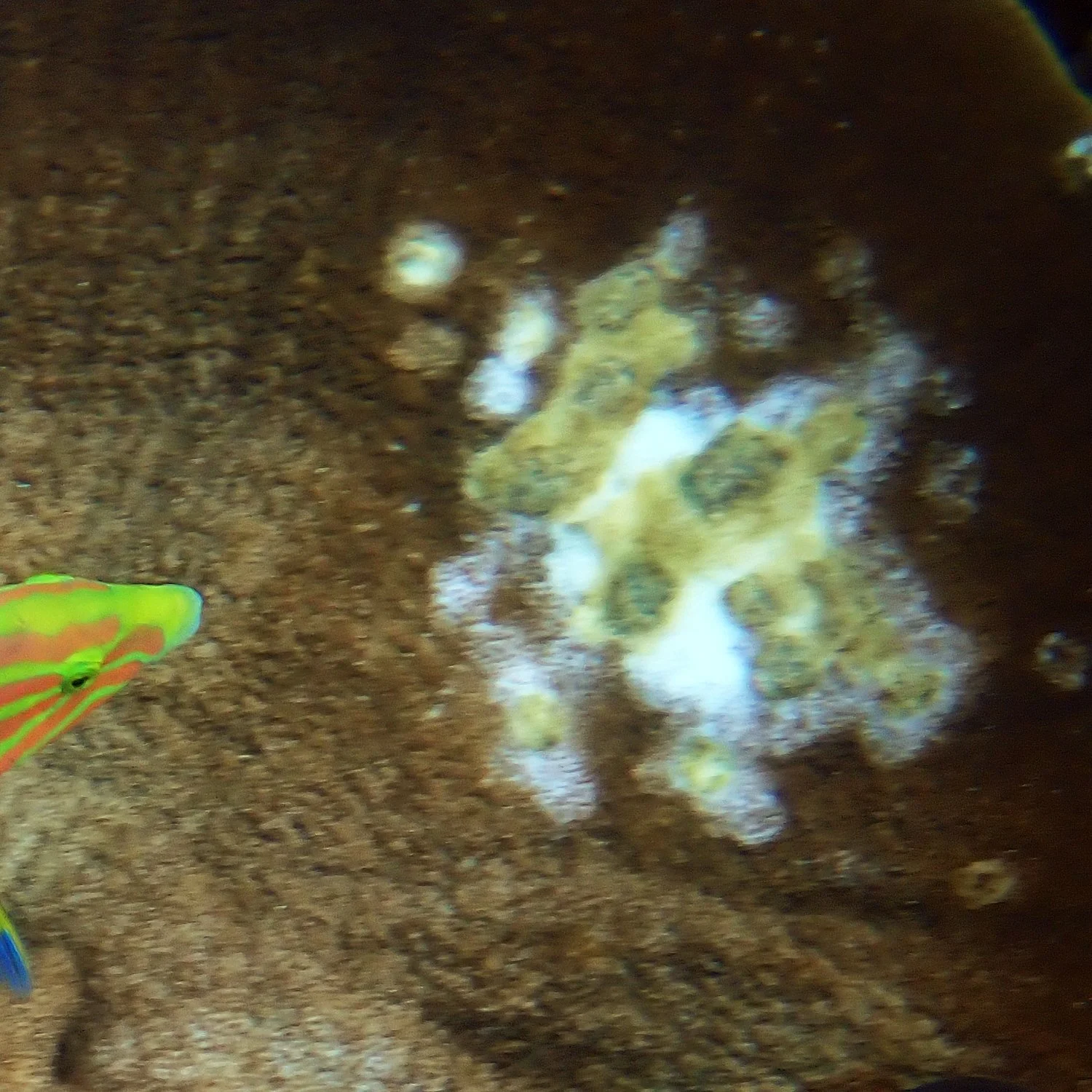
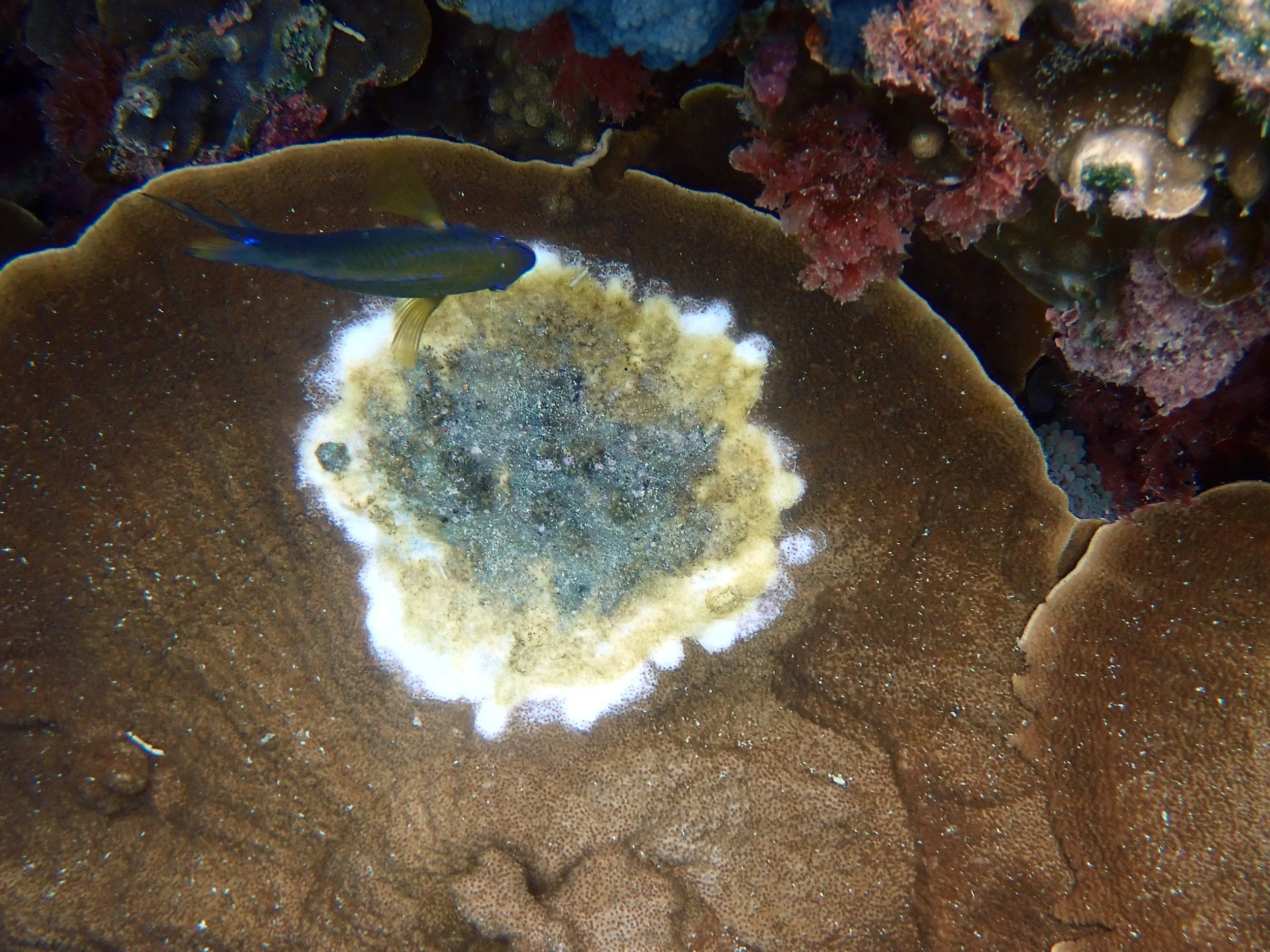
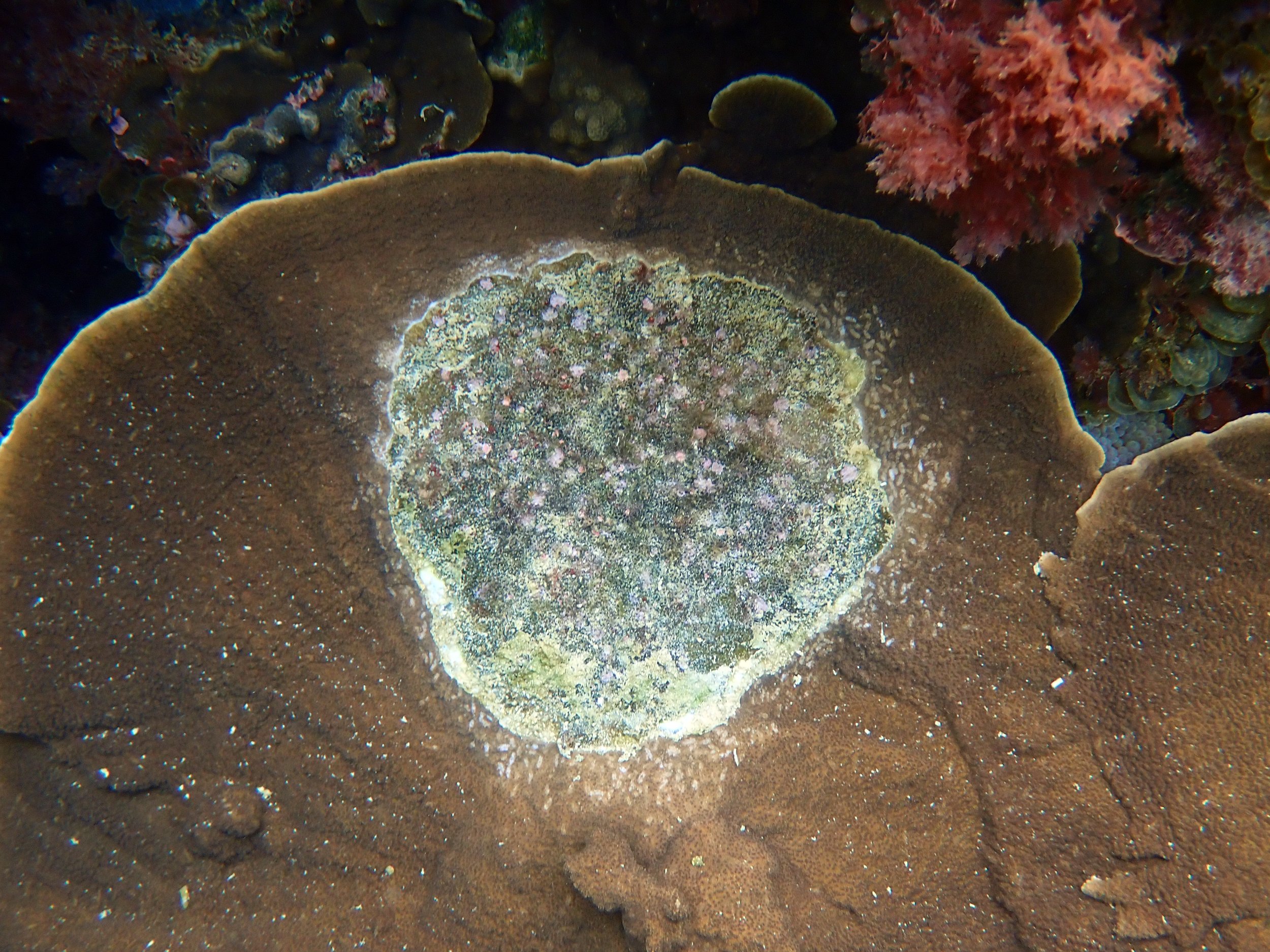
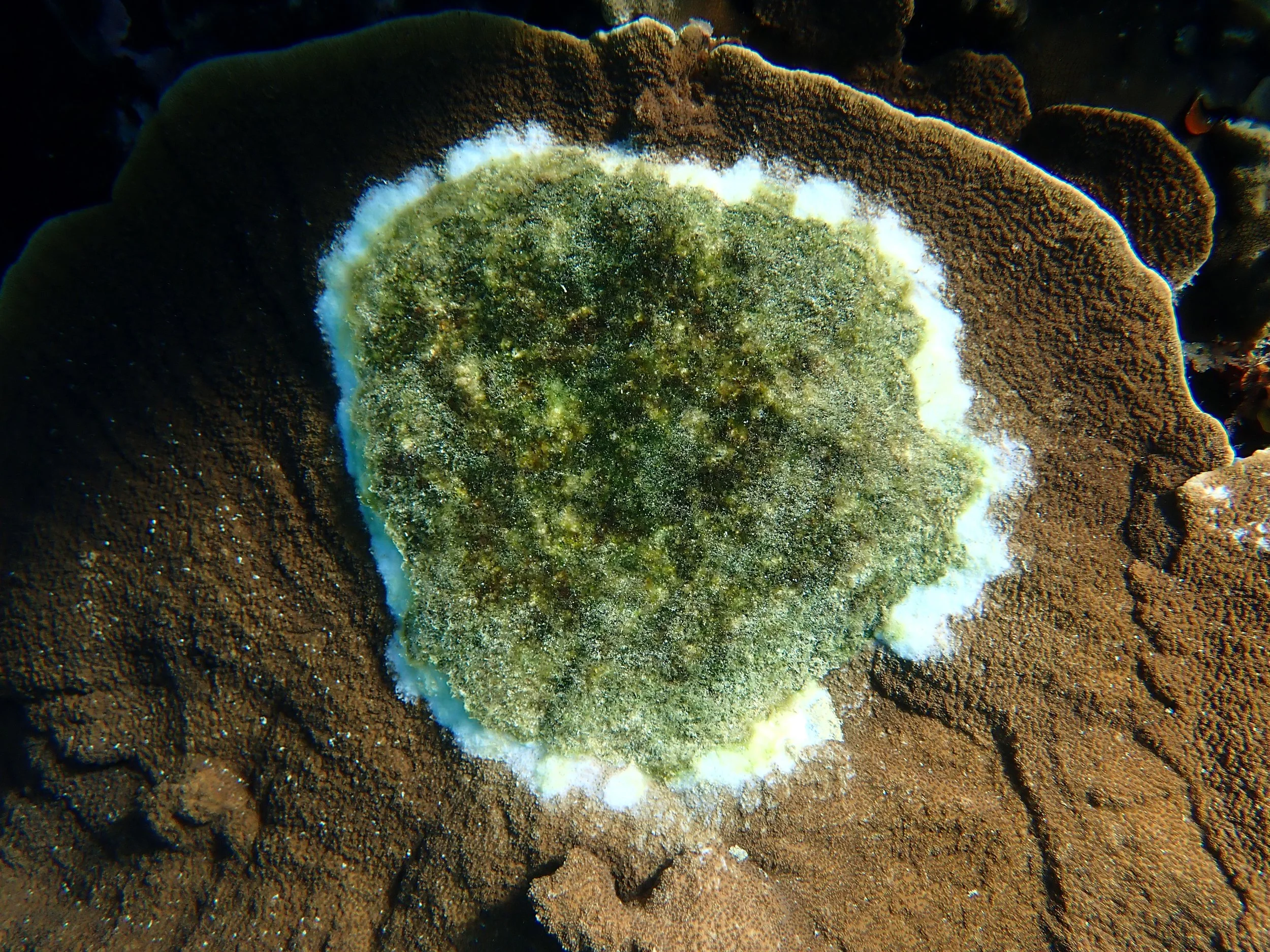
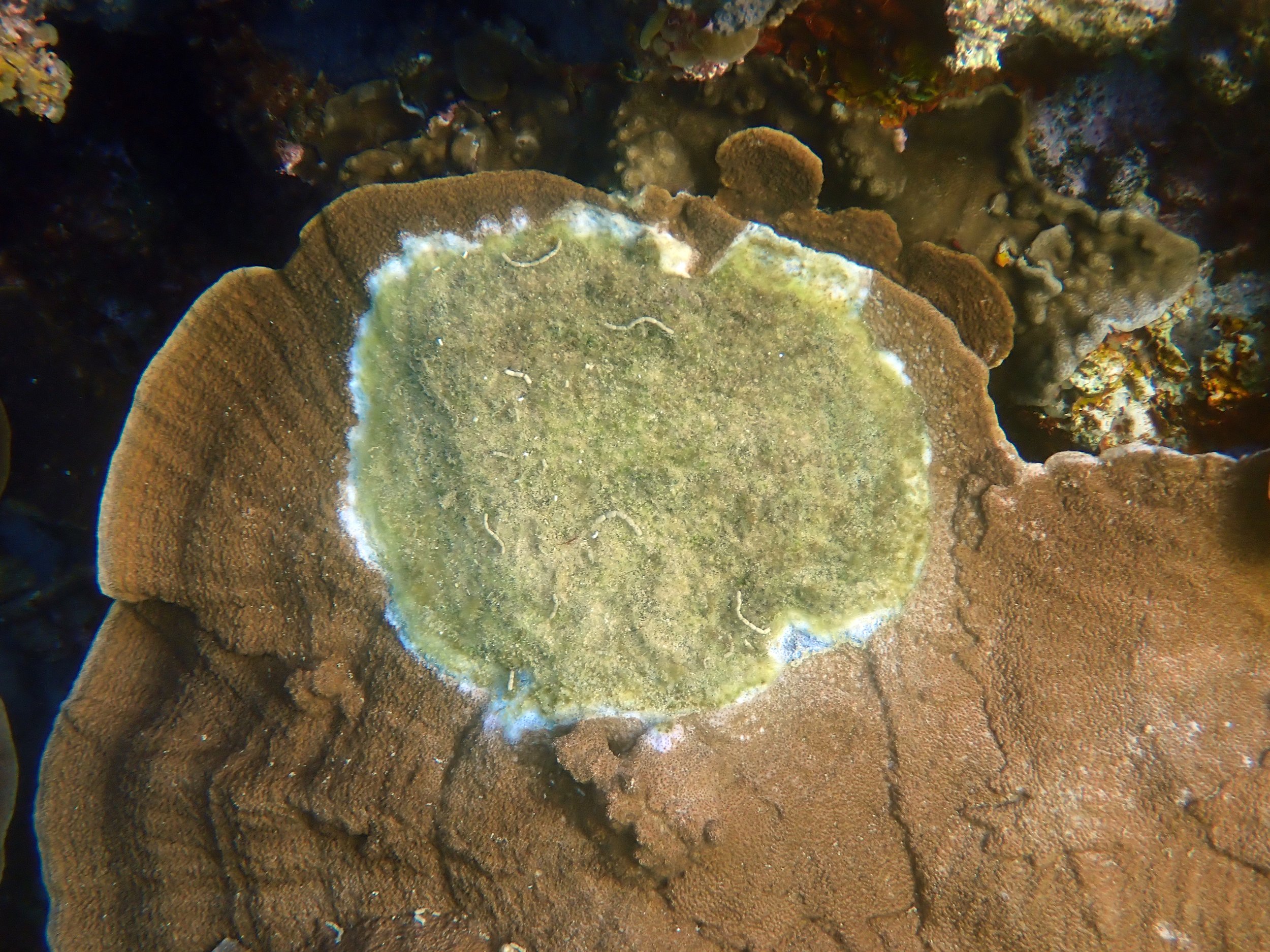
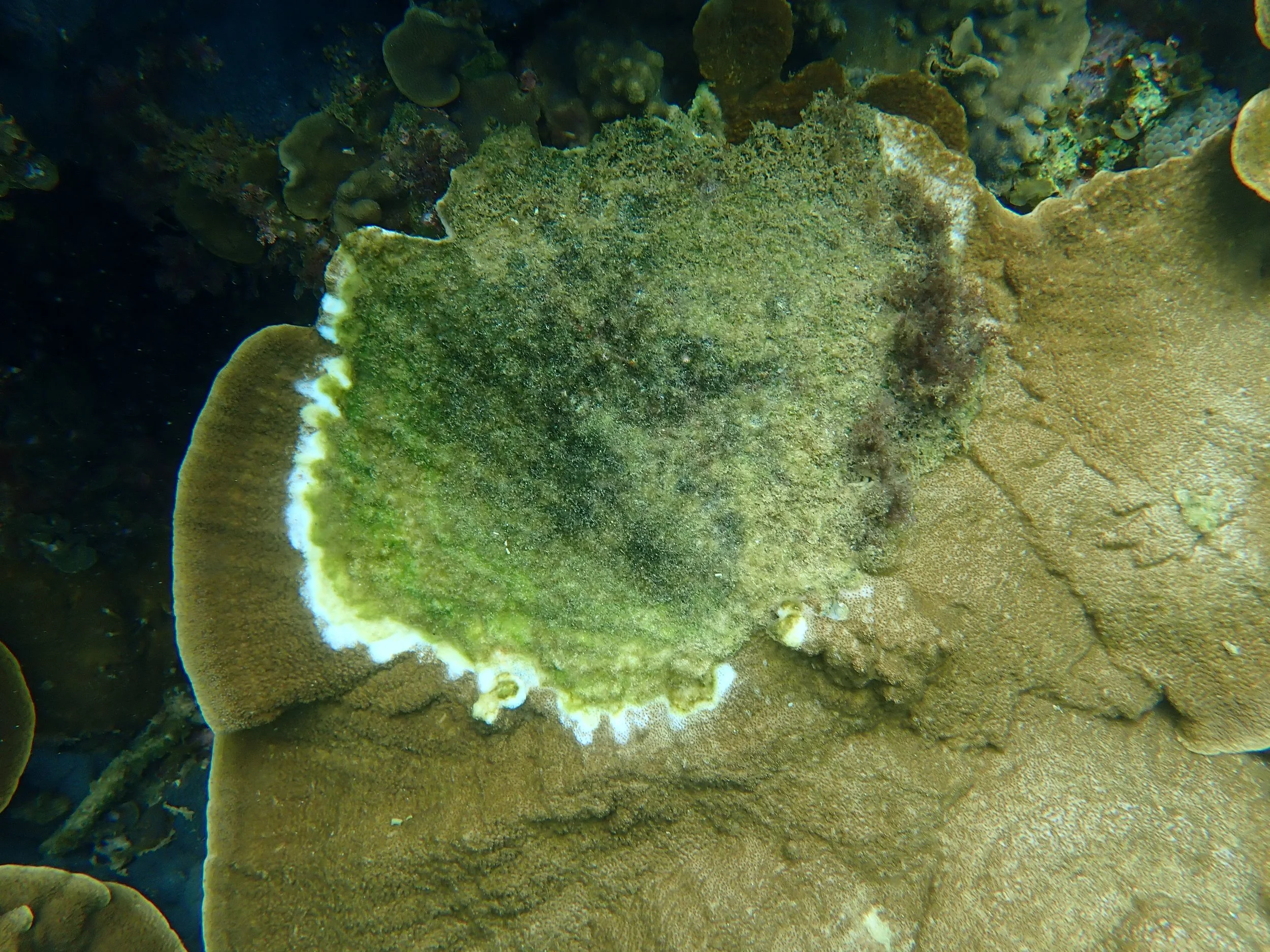
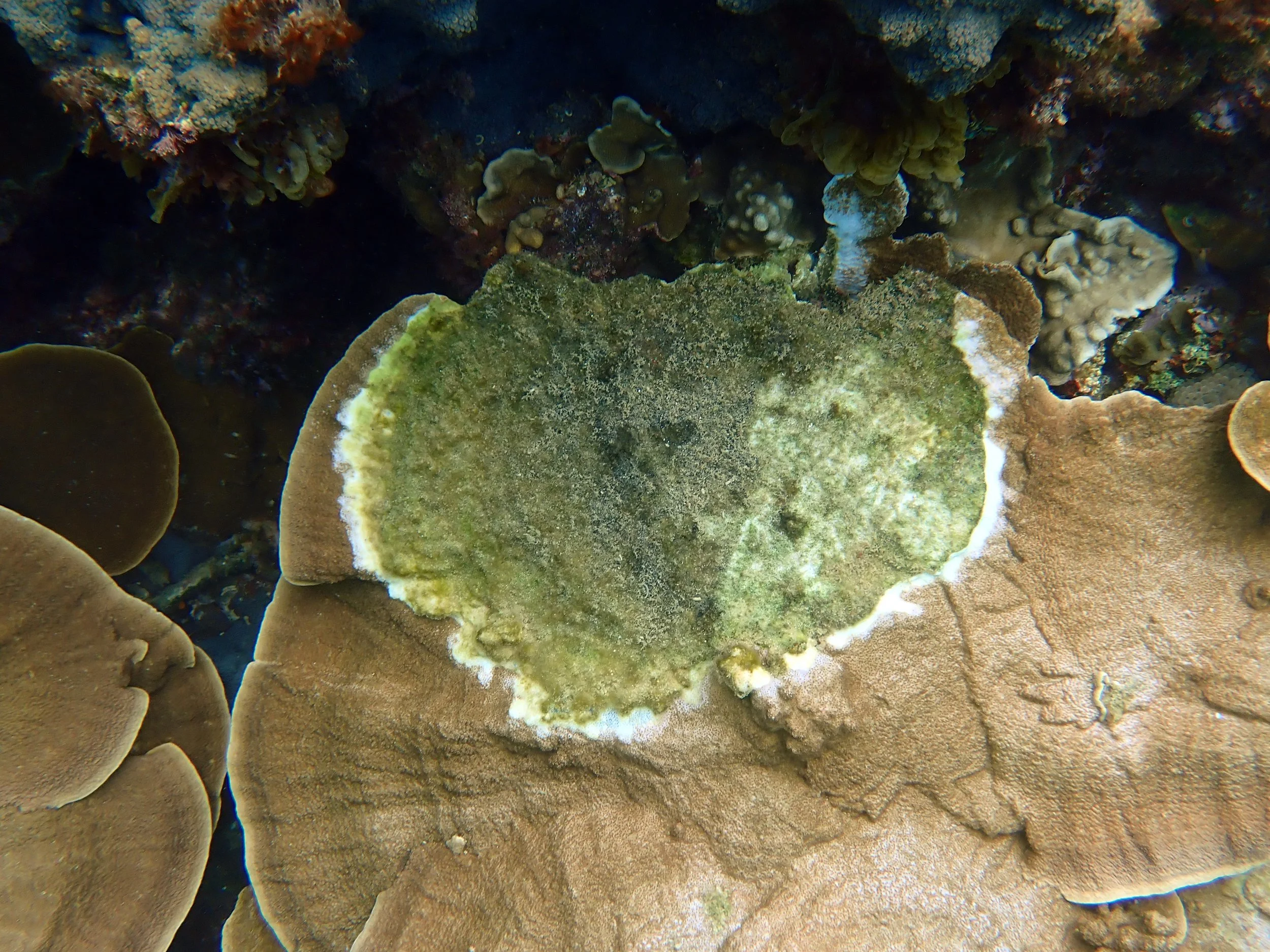
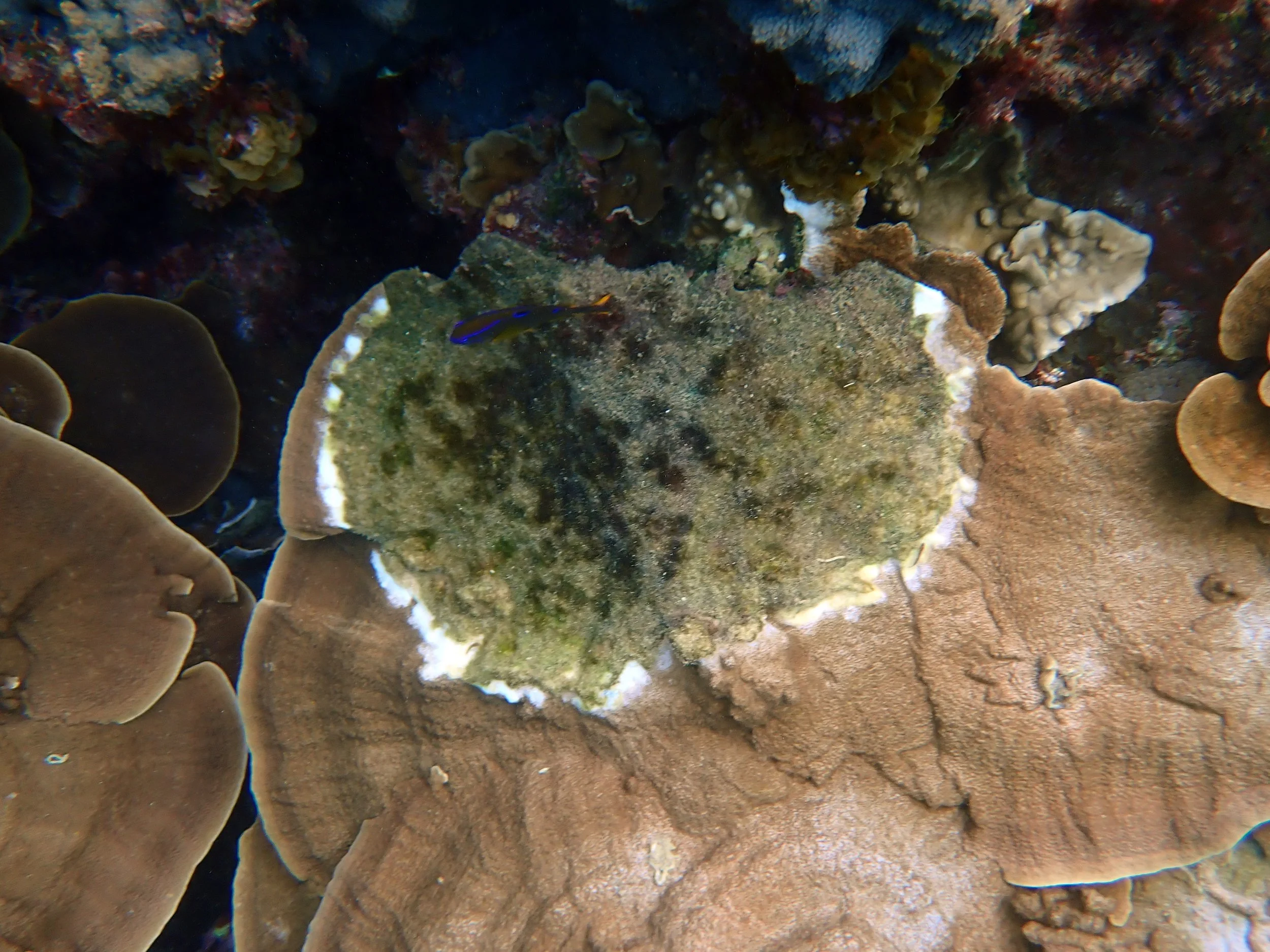
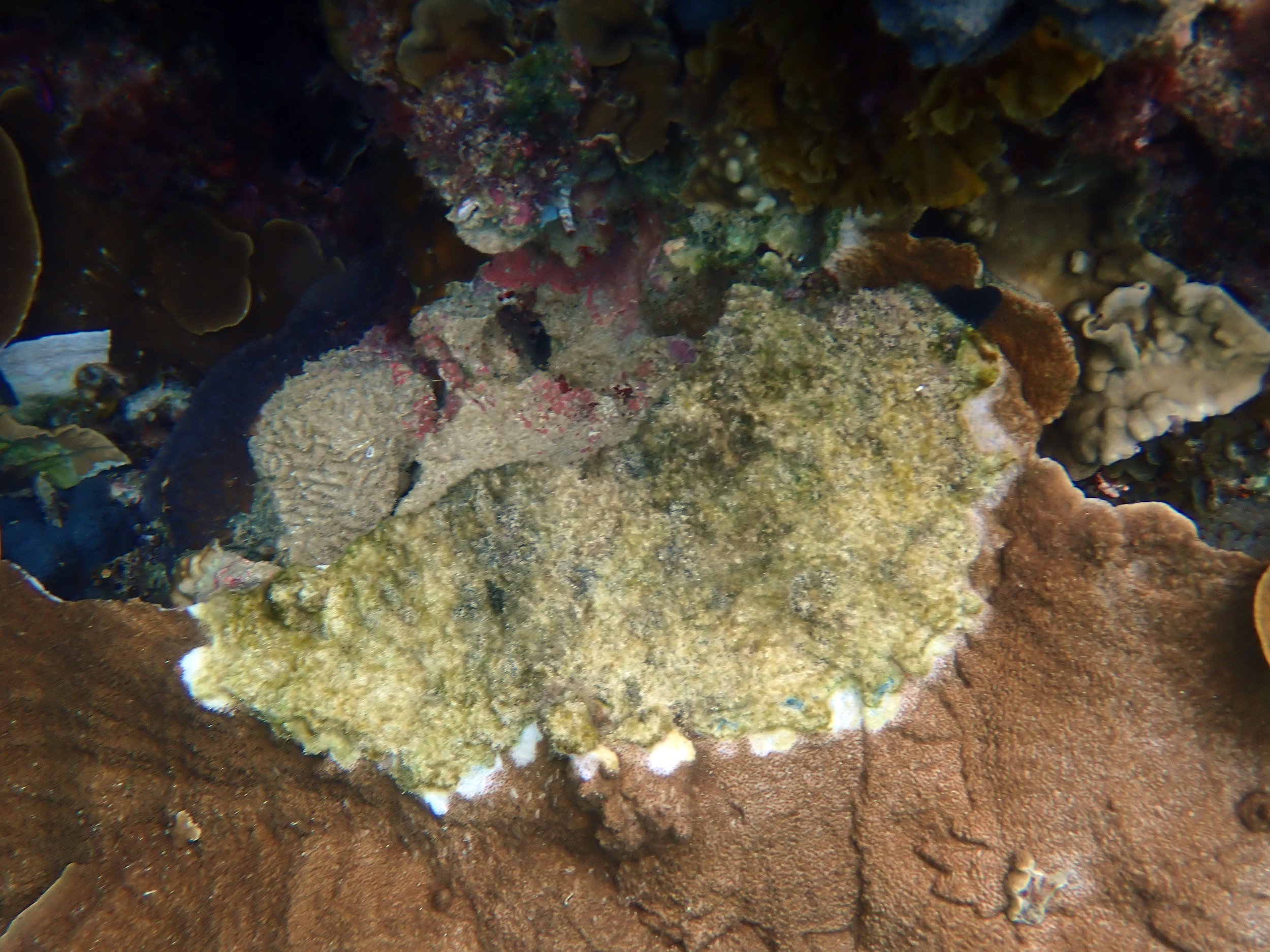
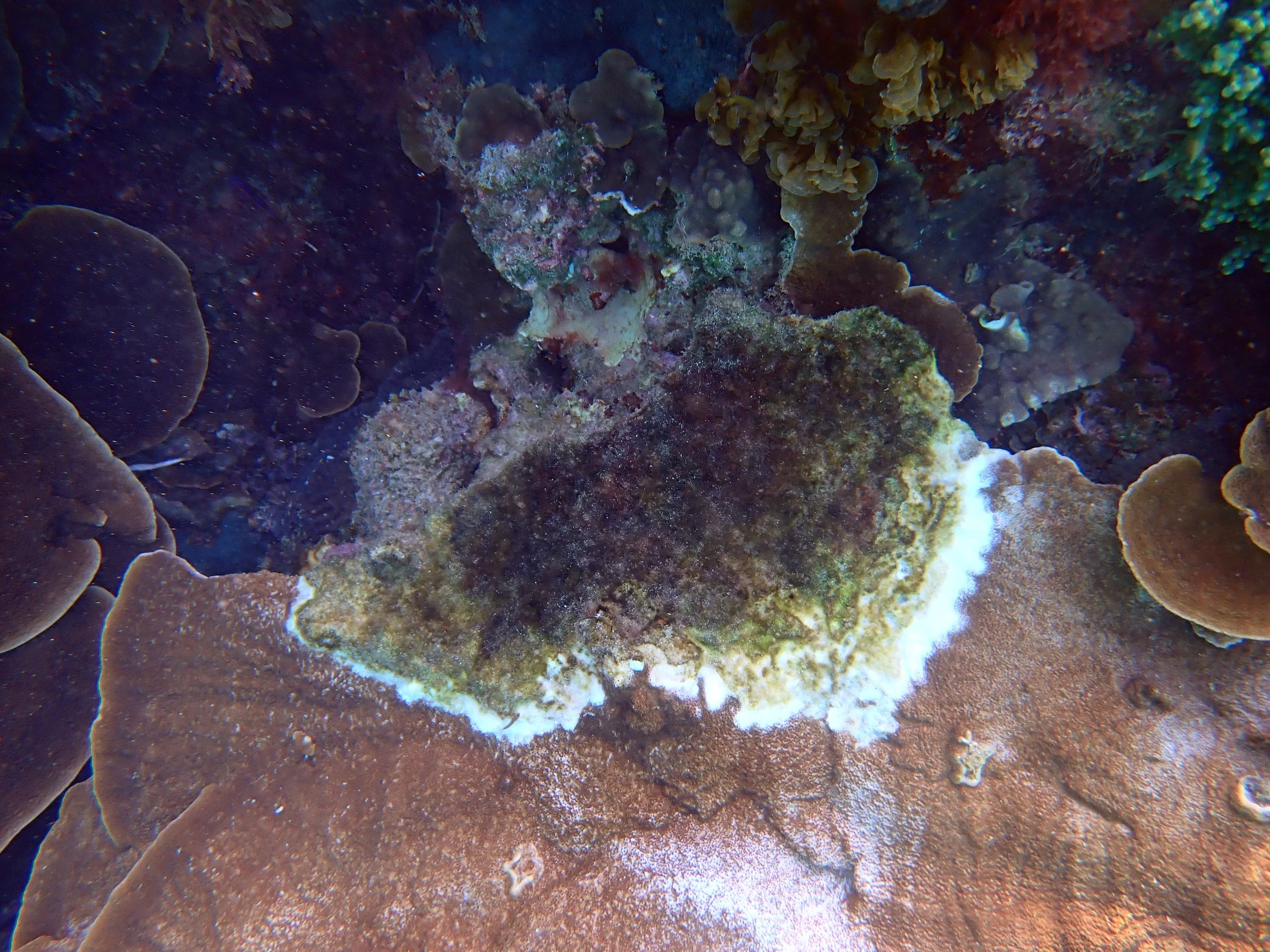
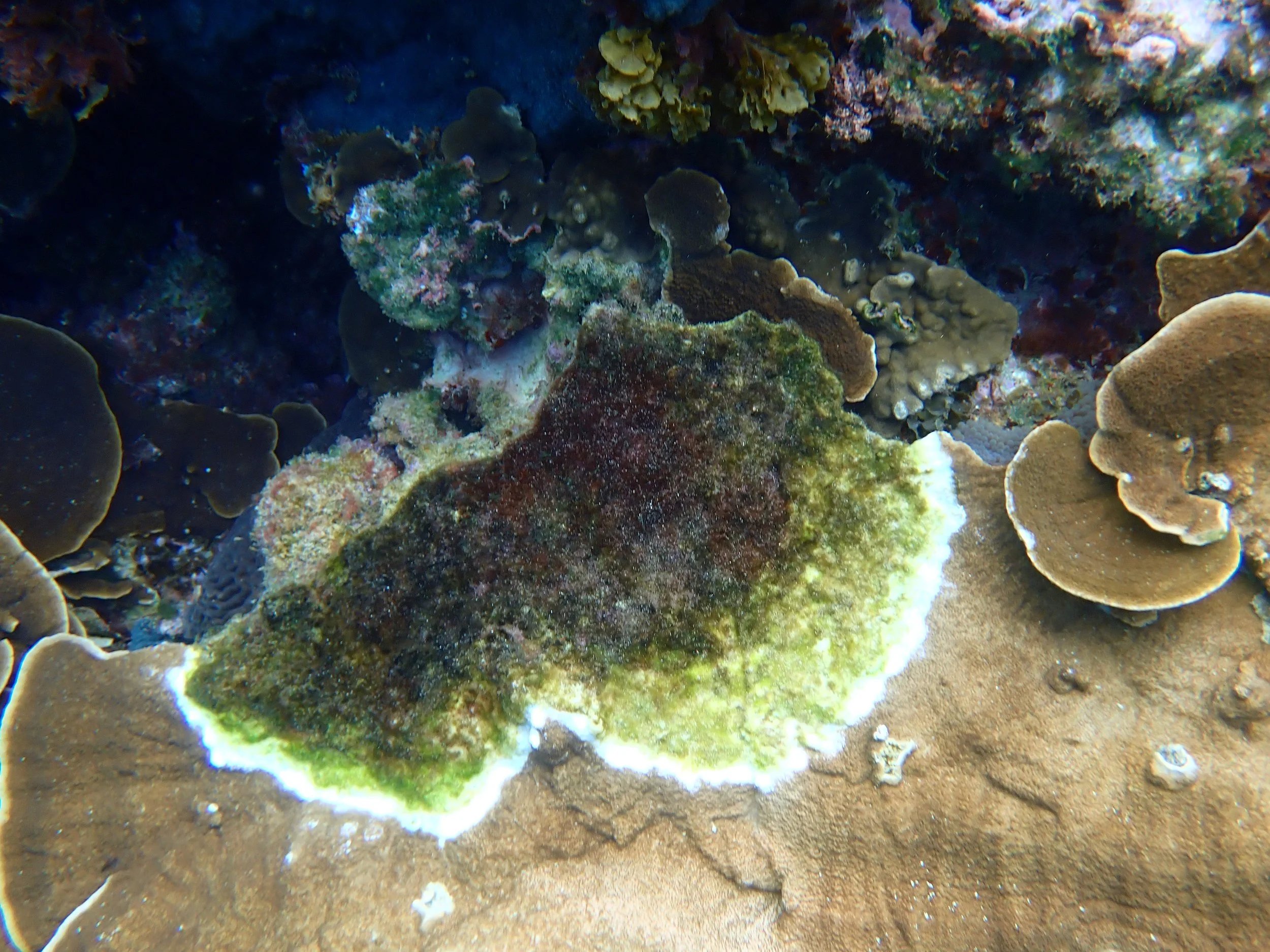
Caption: A sequence from scattered white scars to a mature algal patch. INterestingly, in July, August and early September, the active white edge of the patch was absent, and in late March 2026 an adult aatuti seemed to have claimed the patch as his own. By the beginning of April the edges of the coral had begun to break up. In the photo below, there appears to be eggs in this patch.
An aatuti has claimed the patch, 8 June 2026
I am not saying the aatuti made the first scars. I cannot show that. What I can show is the sequence: living coral, small wounds, exposed skeleton, algal growth, a larger patch, and finally an aatuti on the patch. So a farm may not begin as a farm. It may begin as a wound.
Example two – the same pattern again
A second coral showed a similar progression. In April 2025, there were scattered white marks across the living coral surface. By May, there were more. Some were still separate. Others were close enough to begin joining. By October, several of those damaged areas had become one larger pale patch, and by June 2026, that patch had turned into a dense algal mat.
[Insert image sequence 2: April 2025, May 2025, October 2025, June 2026]
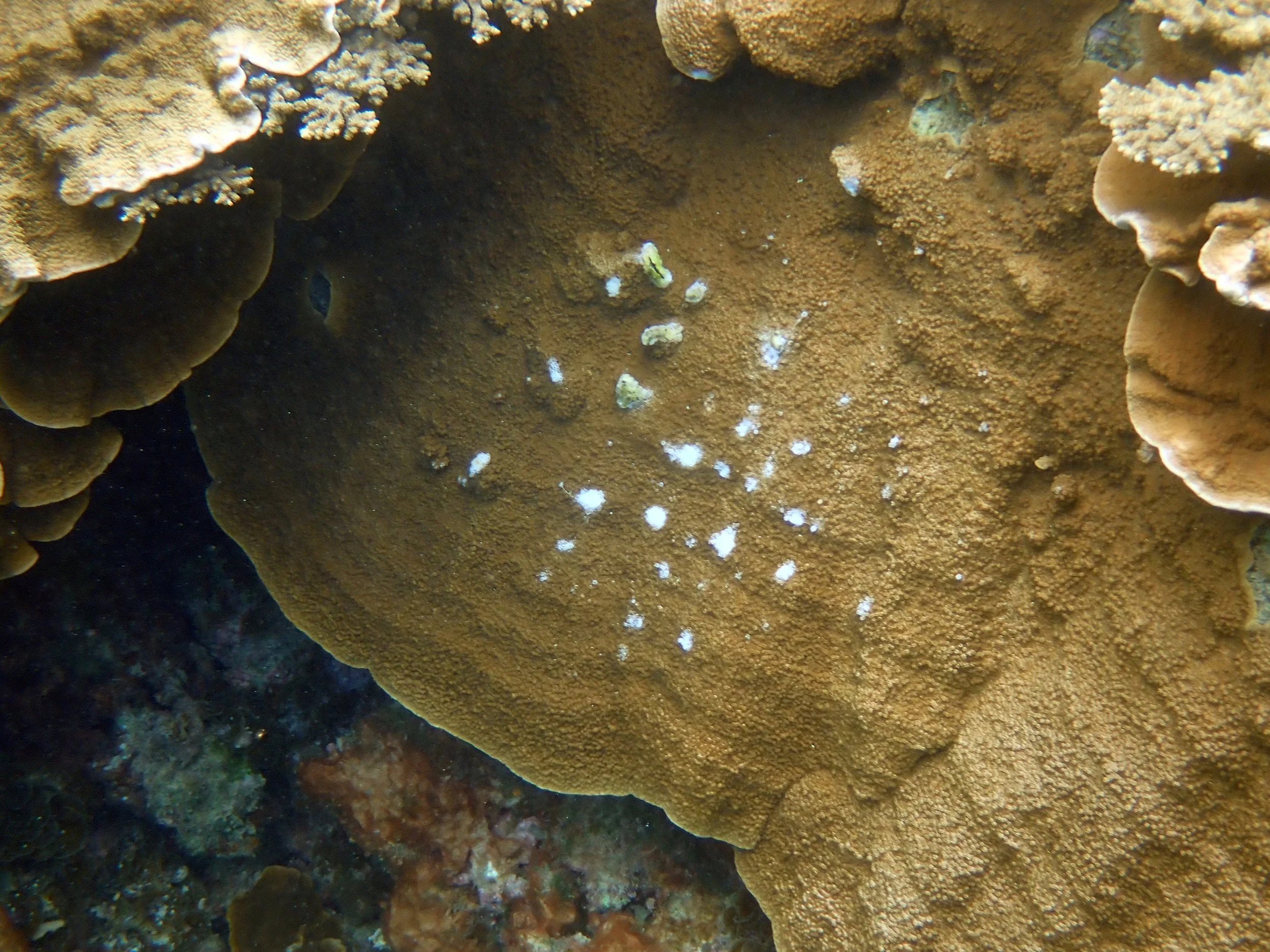
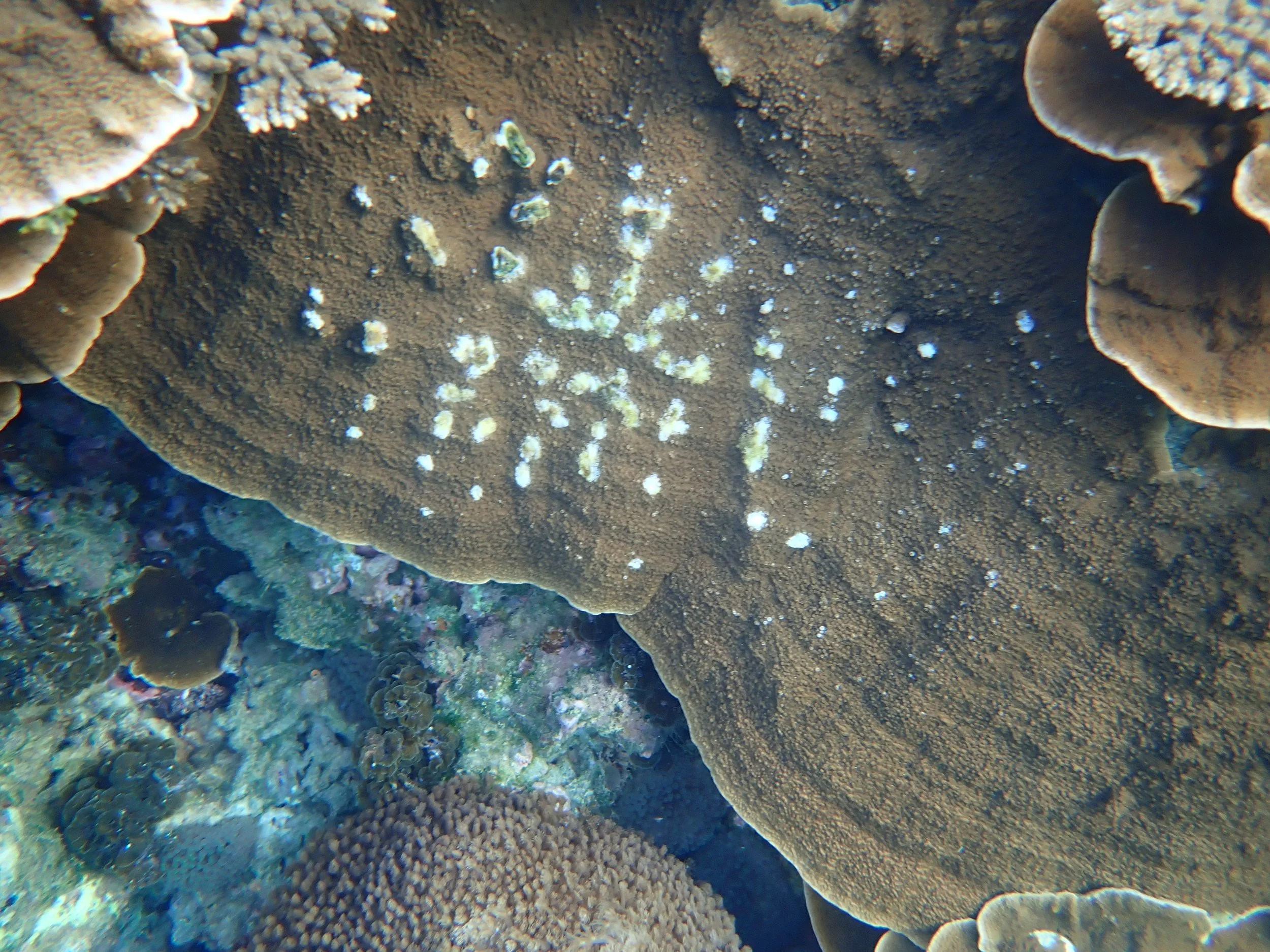
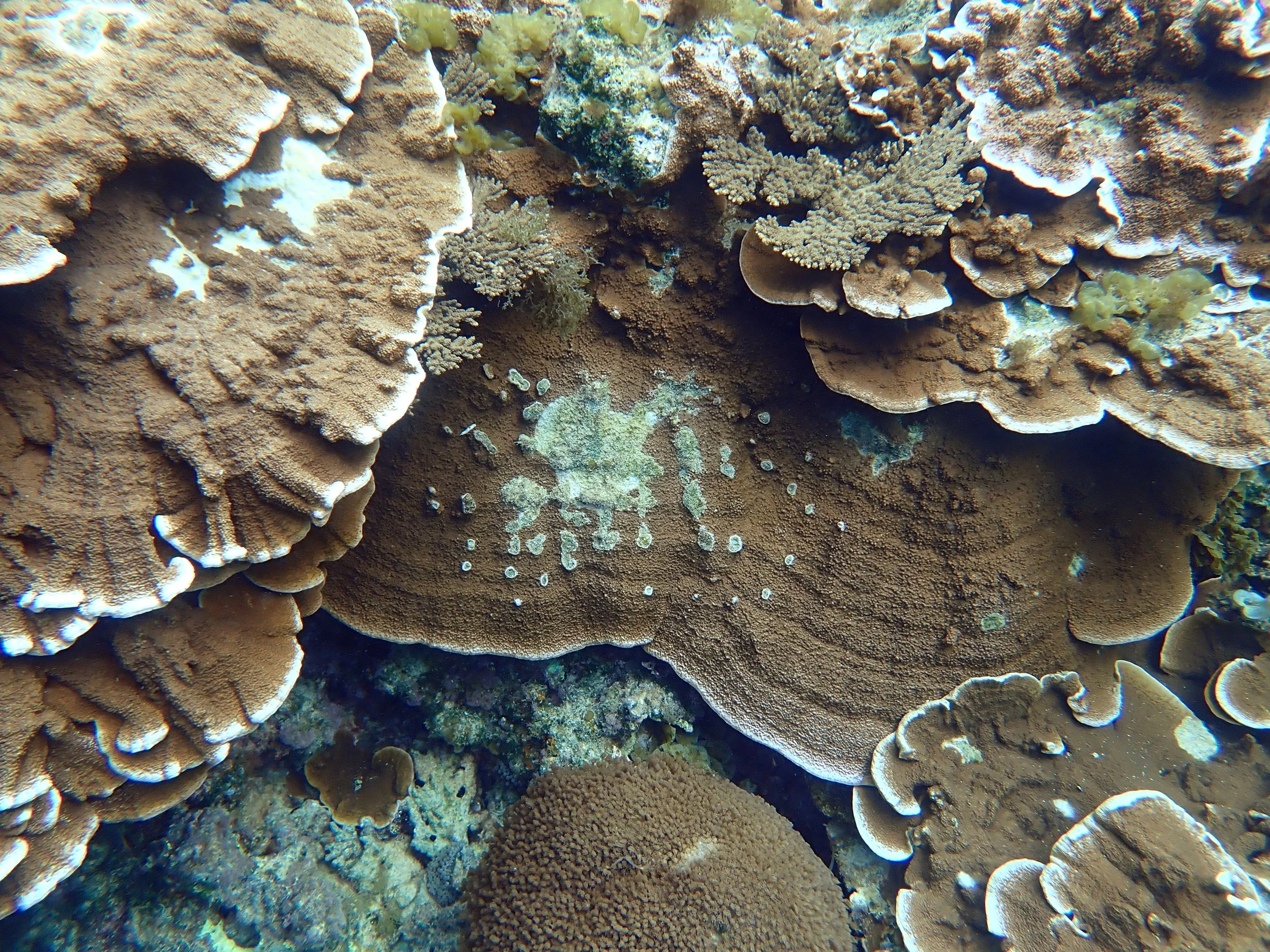
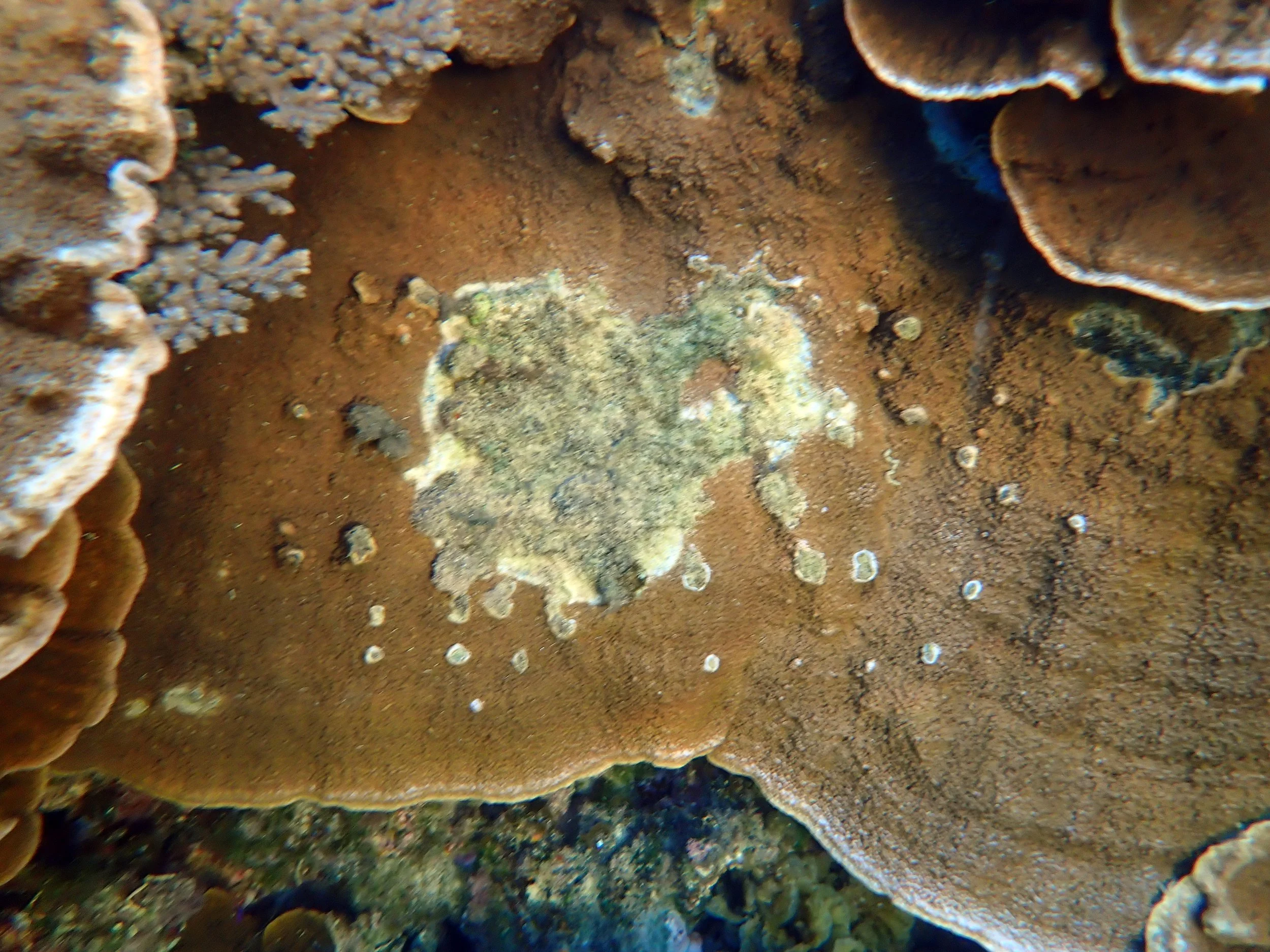
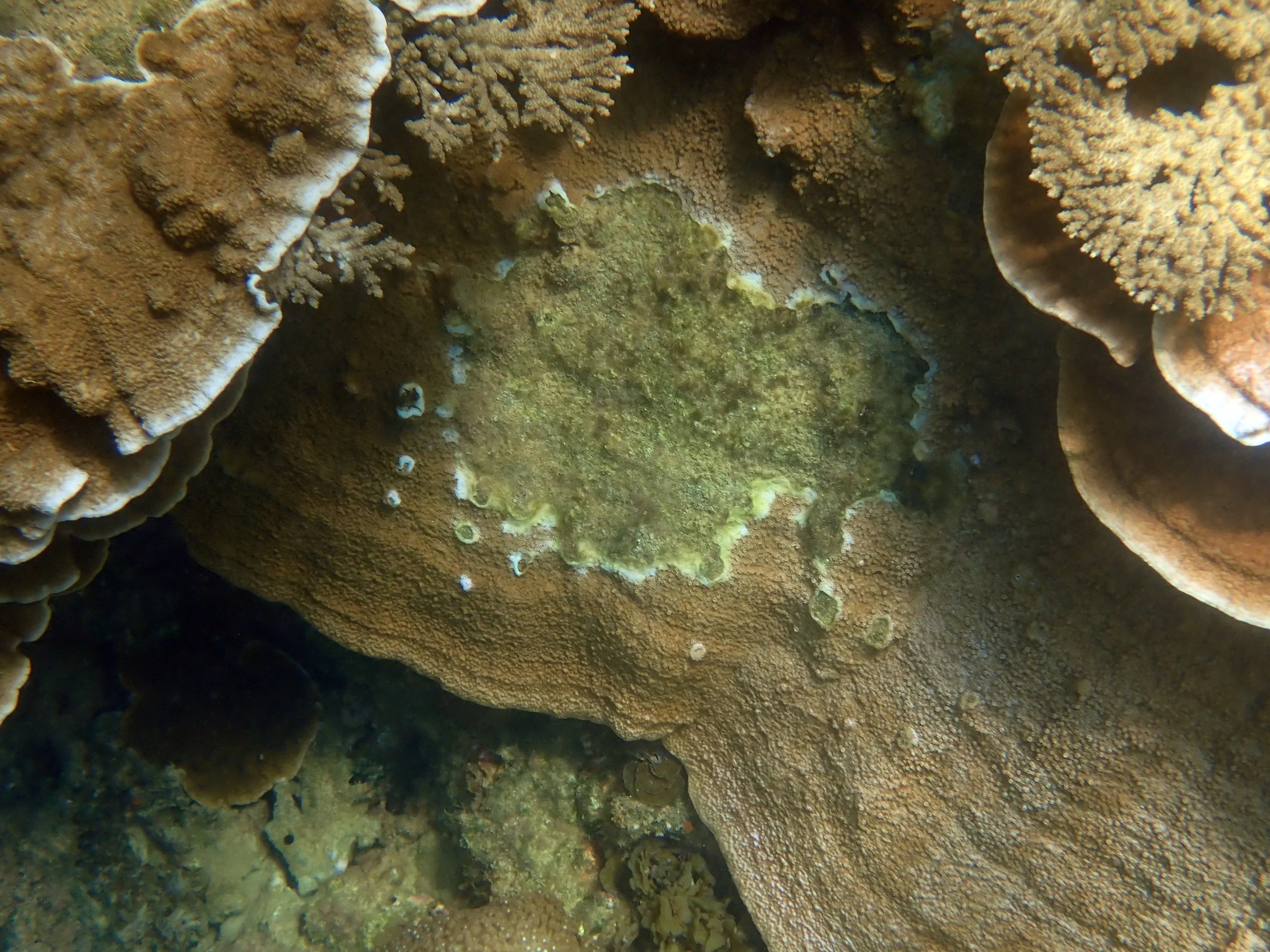
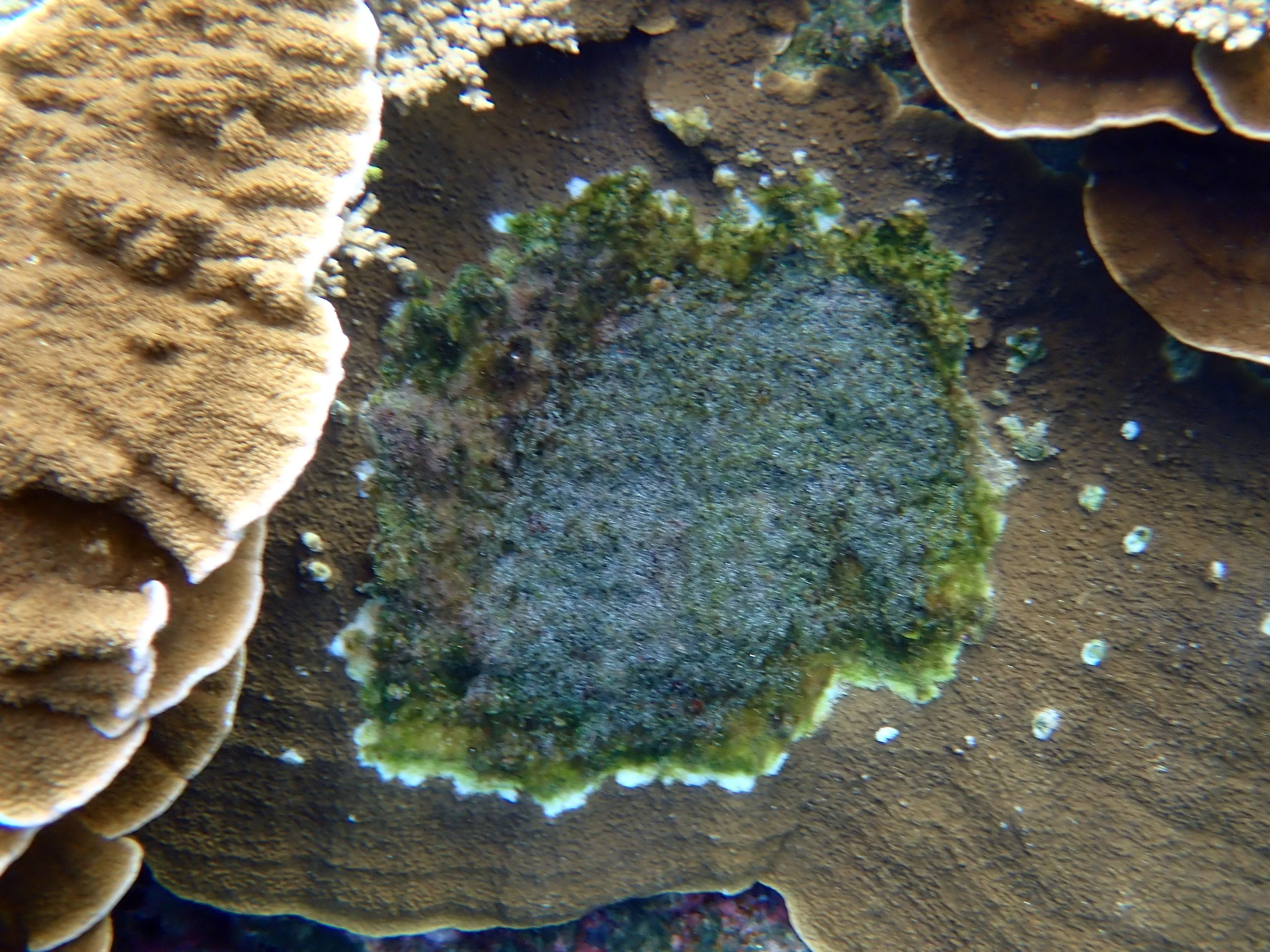
Caption: A second coral showing a similar pattern, although the original scars look quite different: small scars, coalescence, algal growth, then a larger patch with an aatuti (not shown) guarding what appears to be a new patch of eggs.
This example is useful because it shows the pattern was not a one-off occurrence.
It does not look like one neat event. It looks like a process. Small injuries appear. Some heal. Some do not. Algae takes hold where the coral tissue has been lost. At some point, that patch becomes useful to other fish and gradually the separate footholds become one larger patch.
Other fish get involved too
These developing patches are not only interesting to aatuti. On a third example, on 20 May 2026, my research cams caught a Lady Musgrave blenny nibbling at the developing algal growth. I’ve had to zoom in quite a bit to show the detail.
Look carefully, and on this same patch you can see a Doug’s eviota using the altered surface. These are tiny fish, and they are easy to miss. But they are part of the story too. Once living coral tissue is lost, algae starts growing, although it is difficult to see in this video. The surface then becomes something different. It becomes food. Shelter. Edge habitat. A place to graze, perch, hide or patrol. Before an aatuti fully takes over, other small fish may already be using the patch.
I will keep an eye on this patch to see how it evolves.
Then the edge starts to break up
An aatuti defending his eggs, Norfolk Island
I reckon the later stages of these patches are just as interesting. Returning to that first sequence (photos above) when the algal patch was already well established. By January 2026, the edge of the coral began to break up. The dead patch changed shape, the margin became more irregular, and part of the coral structure eventually broke away.
It is easy to make assumptions, so again, I need to be careful. I cannot prove from photos alone that the algal patch caused the breakage. Coral can break for many reasons. Water movement, weakening, bioerosion, old damage, boring organisms, or physical knocks may all play a part. But once coral tissue is lost, the exposed skeleton is more vulnerable. Algae, microbes, grazers and boring organisms can all start working on it. Over time, a dead patch is not just a flat stain on the surface, it can become a structurally weaker part of the coral.
Questions for another day
There are bigger questions here that I cannot answer from photographs alone.
Can a coral recover once an aatuti farm is established on its surface? Does the farm stay the same size, or does it keep expanding? Does the dead patch weaken the coral underneath? Could it change the local microbial community or increase the risk of disease at the coral edge?
The science from other reefs suggests I am not just overthinking this. Farming damselfish can maintain algal lawns, change the small-scale reef community, reduce coral growth or recruitment, and in some cases their farms have been linked with disease-associated microbes. But that does not mean every aatuti farm on Norfolk Island behaves the same way.
For now, all I can say is that these patches do not look static. They change. Edges shift. Algae thickens. Coral margins break down. Fish come and go.
So I will keep watching them.
What the science says
There are no papers that describe this exact sequence for aatuti on Norfolk Island, but there is good science around farming damselfish more generally. Studies on other farming damselfish have shown that these fish can maintain algal territories, alter the benthic community (other organisms) inside those territories, and in some cases expand across coral using small algae-covered scars as stepping stones.
That fits the broad pattern I am seeing here, although I am not claiming it is identical.
The wider reef context
It would be easy to leave this as a nice little fish story. But here on Norfolk Island the reef around it is changing. Our inshore reef is gradually becoming more algal. Recent reef-health monitoring by Ainsworth, Gaston, Leggat and colleagues has shown increasing algal cover across the lagoon sites, so these aatuti farms are not happening in isolation. They are part of a reef where algae already has more room than it used to.
That changes how I look at them.
An aatuti tending his algae patch, 26 June 2022
The same aatuti garden, 27 December 2022
13 June 2026
A single aatuti farm is small and easy to swim past. It’s also easy to dismiss as one bossy fish defending one patch of algae. But aatuti are common here, and territorial. They defend their patches hard. And if some individuals hold the same patch for months or years, these farms may be quite persistent features of the reef surface.
I have not found a published lifespan for Parma polylepis, but related scalyfins and other temperate damselfishes can live for decades. That makes me cautious about treating these farms as short-lived features of the reef. Some may be held, abandoned, reused or taken over across much longer periods than we would assume for a small fish.
I also do not know whether an aatuti keeps one farm for life, moves between farms, or takes over a patch started by another fish. I do not know whether a juvenile can grow up with a patch and later defend it as an adult.
Those are questions for another day.
On a reef where algae is already gaining ground, small, defended patches of algae deserve closer attention.
One last question – was the juvenile the same fish?
There is one question I cannot answer, but I keep coming back to it. In the early stages of the first example patch, there appears to be a juvenile banded scalyfin nearby. In the later photo, an adult aatuti is on the mature patch. Was it the same fish?
I don’t know.
It is tempting to think so. The site fits. The timing fits. Aatuti are territorial. But without some way to identify individuals, I cannot prove it. For now, this remains as another question.
Could a young aatuti begin using a small, damaged patch, then grow with it as the patch becomes a defended adult territory?
I wonder.
Selected references
Ainsworth, T. D., Heron, S. F., Lantz, C., & Leggat, W. (2021). Norfolk Island lagoonal reef ecosystem health assessment 2020–2021. Parks Australia / Sydney Institute of Marine Science.
Ainsworth, T. D., Gaston, T., Leggat, W., & Roughan, M. (2025). Norfolk Island lagoonal reef ecosystem health assessment. Parks Australia.
Casey, J. M., Ainsworth, T. D., Choat, J. H., & Connolly, S. R. (2014). Farming behaviour of reef fishes increases the prevalence of coral disease associated microbes and black band disease. Proceedings of the Royal Society B: Biological Sciences, 281(1795), 20141032. doi.org
Casey, J. M., Choat, J. H., & Connolly, S. R. (2015). Coupled dynamics of territorial damselfishes and juvenile corals on the reef crest. Coral Reefs, 34(1), 1–11. doi.org
Ceccarelli, D. M., Jones, G. P., & McCook, L. J. (2005). Effects of territorial damselfish on an algal-dominated coastal coral reef. Coral Reefs, 24(4), 606–620. doi.org
Charendoff, J. A., Edwards, C. B., Pedersen, N. E., Petrovic, V., Zgliczynski, B., Sandin, S. A., & Smith, J. E. (2023). Variability in composition of parrotfish bite scars across space and over time on a central Pacific atoll. Coral Reefs, 42(4), 905–918. doi.org
Hata, H., Takano, S., & Masuhara, H. (2020). Herbivorous damselfishes expand their territories after causing white scars on Porites corals. Scientific Reports, 10(1), 16172. doi.org