Planning for the present Kingston Pier Dredging Project began in 2020. However, it was not until November 2025, when baseline monitoring buoys were installed in the lagoon, that many community members realised the project was moving ahead. A member of the environmental Subcommittee of the Council of Elders approached me to ask what I knew about it. In response, I wrote two blog posts that summarise the proposal, the approval conditions, and evidence from comparable dredging projects elsewhere. It is important that these are read before reading this post as they contain the key documents and background information relating to the project.
Since these posts were written, there has been correspondence from a group of us, including representatives of the environmental subcommittee of the Council of Elders, requesting more information on the project from the Department of Infrastructure, Transport, Regional Development, Communications, Sport and the Arts (DITRDCSA). It is these documents that are being reproduced in this post in order that those who have an interest in the project are fully apprised of the facts to date.
I have also provided a link to the latest media release on the dredging progress provided by the DITRDCSA (see the end of this post).
It is important to note the following facts:
This proposal is being advanced at a time when reef health indicators already show there is substantial stress, which makes any sediment-generating activity in or near the reef system a matter of serious concern.
The Kingston Pier area has been dredged before, reportedly in the 1980s (date to be confirmed). The current channel-deepening proposal first emerged around 2009, but at that time the Norfolk Island Assembly were unable to fund the capital works.
In 2018–2019, after the Australian Government assumed control of Norfolk Island, the island experienced significant shipping difficulties following the retirement of the small cargo vessels that had traditionally serviced South Pacific routes. Since then, the lighterage system has changed: new barges now undertake the ship-to-shore run and the old wooden lighters have been retired.
With the expiry of the contract for the maintenance of the three Passenger Transfer Vessels (PTVs), which were originally purchased for use to disembark passengers from visiting cruise ships, at the time of writing, consideration is being given as to whether a new contract will be awarded or the PTVs retired from service.
Anecdotally, while some fishers and community members are keen for the dredging project to go ahead to enable easier and safer access to the Kingston Pier, there appears to be many more who believe the project is unnecessarily extensive in scope and that a less intrusive remediation works would make access to the pier area safe.
There are also many others who are against the idea of dredging so close to a ecologically sensitive area.
With regards to the safety issue, the example was given of the Police vessel being unable to access the pier when the tide is low, which will mean it would have to reroute to Cascade Pier on the opposite side of the island to disembark passengers, and possibly injured persons.
We have asked to see the objections to the proposal, for example from the coral reef health team and from Australian Marine Parks. As yet, these have not been forthcoming.
In order to preserve the formatting, I have included the correspondence that followed between us and the member from DITRDCSA as a PDF, here.
Concerns
For me, the central concern is not simply that dredging is proposed, but that it is moving towards implementation while fundamental questions remain unanswered. We still do not know what mitigation measures will actually be used, only what may be used, how compliance will be enforced in real time, whether coral specialists will be asked to review those protections, or why key objections to the project have not been made public.
Nor do we yet have a satisfactory explanation for the scale of the works. If this is primarily a safety project, why is it so extensive? Why has it not been revisited in light of what is now known about the condition, significance and vulnerability of the reef? And why has there been such reluctance to engage the community openly on those points?
I am publishing this correspondence because these are not trivial details. They go to the heart of whether this project is proportionate, transparent and adequately protective of one of Norfolk Island’s most important natural assets.
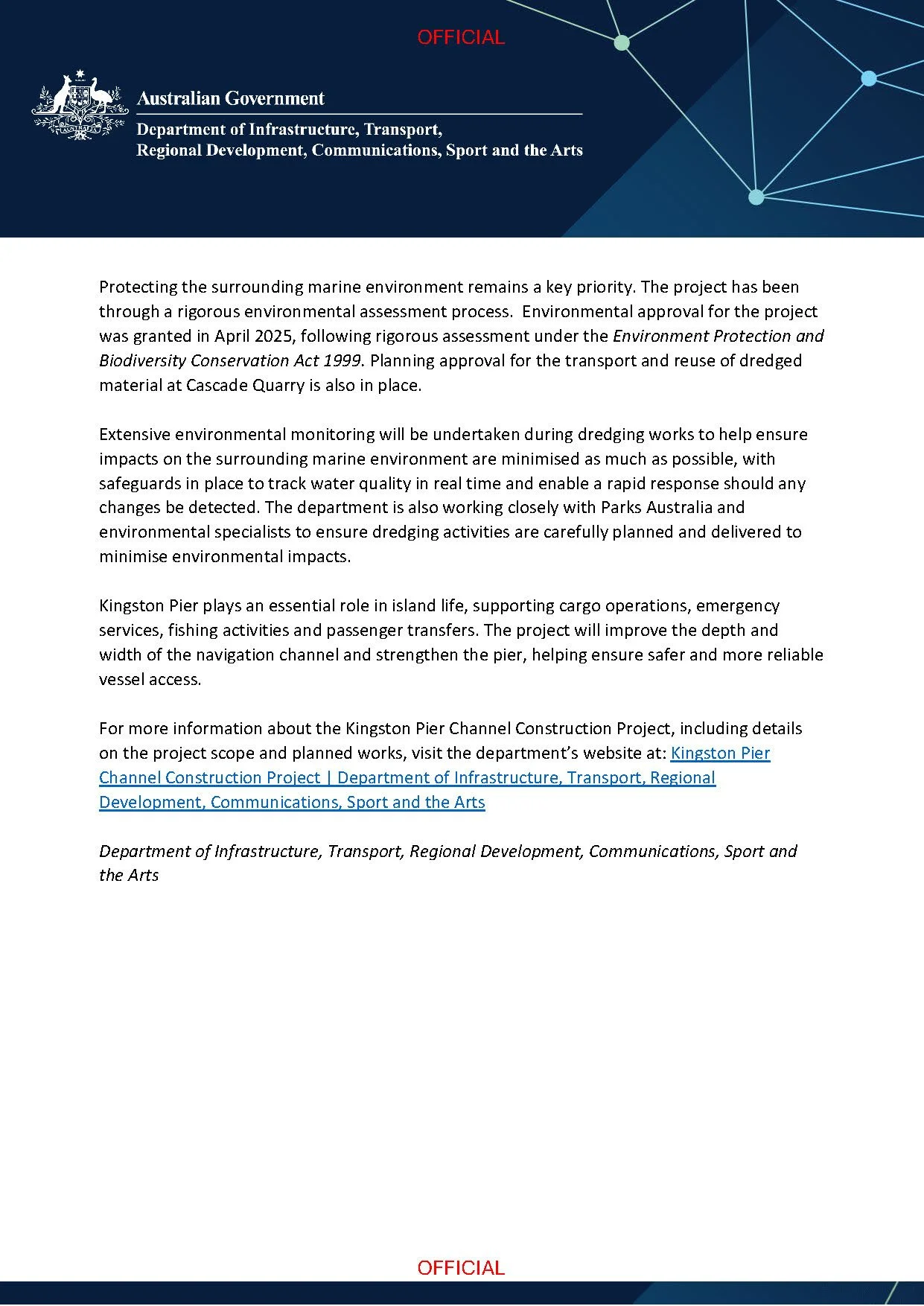
Finally, as promised above, here is the media release from 14 May 2026. This media release confirms progress, but not clarity. This release tells us one thing very clearly: the project is moving ahead. It also widens the pitch a bit. What had previously been framed largely as a safety issue is now being presented more broadly in terms of safety, reliability, cargo, emergency services, fishing and passenger transfers. What it still does not tell us is what many people most want to know. We are told there will be extensive environmental monitoring, real-time water-quality tracking and a rapid response if conditions change, but there are still no public details on the trigger values, stop-work thresholds, monitoring locations, enforcement arrangements, or the actual mitigation measures that will be used to protect the reef beside the works. The language is reassuring, but the detail is still missing. And that detail is exactly what would allow the community to judge whether these assurances are meaningful, or simply comforting words around a project that is now well on its way.