• Home
    • Algae
    • Corals
    • Eels
    • Everything Else
    • Kingston, Norfolk Island
    • Nudibranchs, Sea Slugs and Flatworms
    • Octopuses
    • Out On A Swim Index
    • Reef Fish
    • Sharks
    • Sea Anemones
    • Sea Stars
    • Sea Urchins and Sea Cucumbers
    • Turtles
    • Underwater
    • Videos
  • Out on a swim - blog
  • About
  • Contact + Subscribe
Menu

Norfolk Island's Reef

Discover a fragile paradise – Norfolk Island's beaches, lagoons and coral reef
  • Home
  • Explore
    • Algae
    • Corals
    • Eels
    • Everything Else
    • Kingston, Norfolk Island
    • Nudibranchs, Sea Slugs and Flatworms
    • Octopuses
    • Out On A Swim Index
    • Reef Fish
    • Sharks
    • Sea Anemones
    • Sea Stars
    • Sea Urchins and Sea Cucumbers
    • Turtles
    • Underwater
    • Videos
  • Out on a swim - blog
  • About
  • Contact + Subscribe

Out on A Swim

‘Out on a swim’ is a coral reef blog that tells the stories of the characters who live under the waves and what has caught my eye when ‘out on a swim’ in the lagoons of Norfolk Island. It is also a record of the difficulties Norfolk Island’s reef faces, like many others around the world, as a result of the poor water quality that has been allowed to flow onto it.

This page shows the most recent blog posts. For the complete catalogue, visit the ‘Out on a swim index’ page.

This blog is rated in the Top 20 Coral Reef Blogs in the world.

No results found

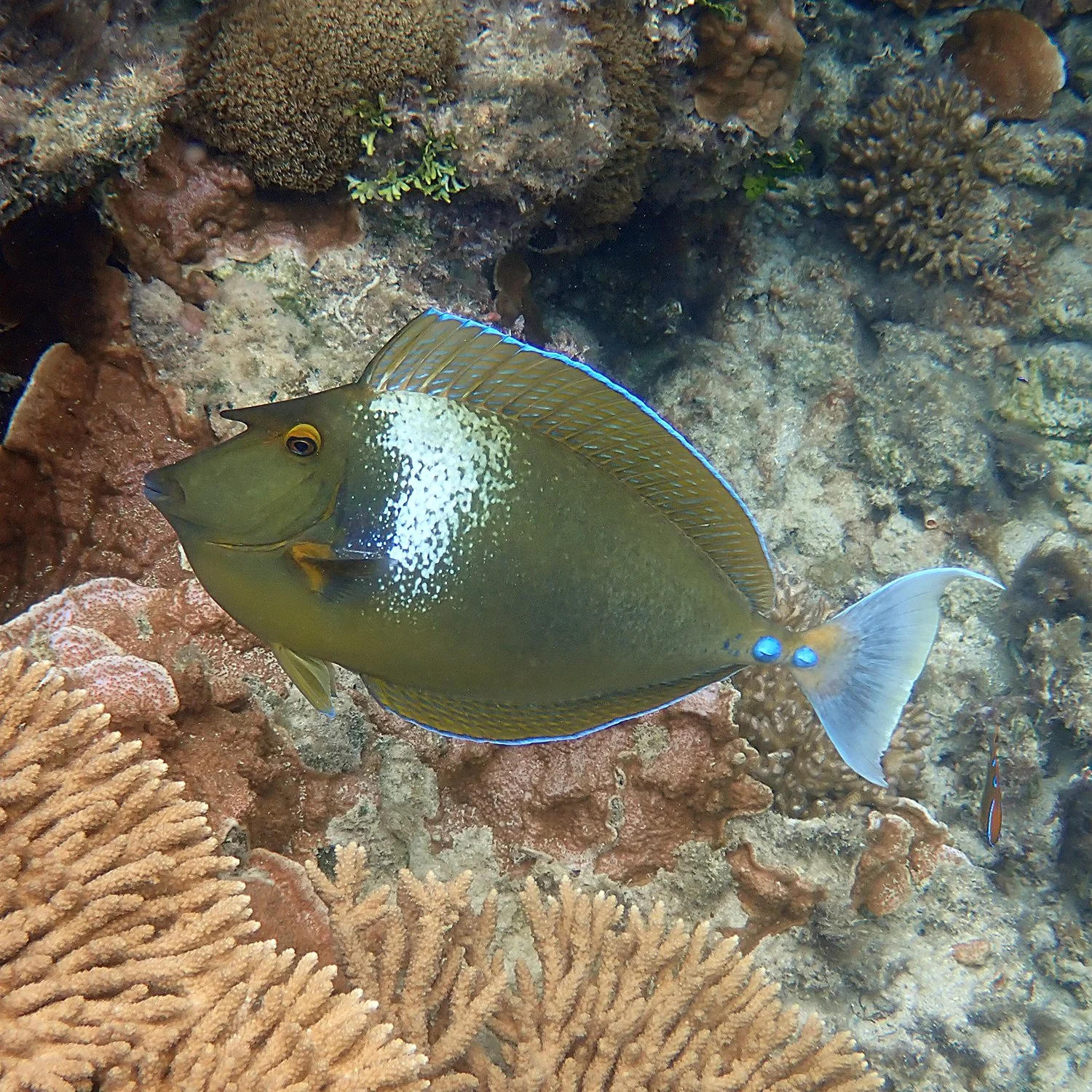
Bluespine unicornfish, Naso unicornis. Note the two scalpels at the base of its tail. These fish have been found to live to at least 50 years old. Norfolk Island

How surgeonfishes got their name

June 14, 2026

Some reef fish get by on colour. Some get by on attitude. Surgeonfish have both, plus a hidden weapon.

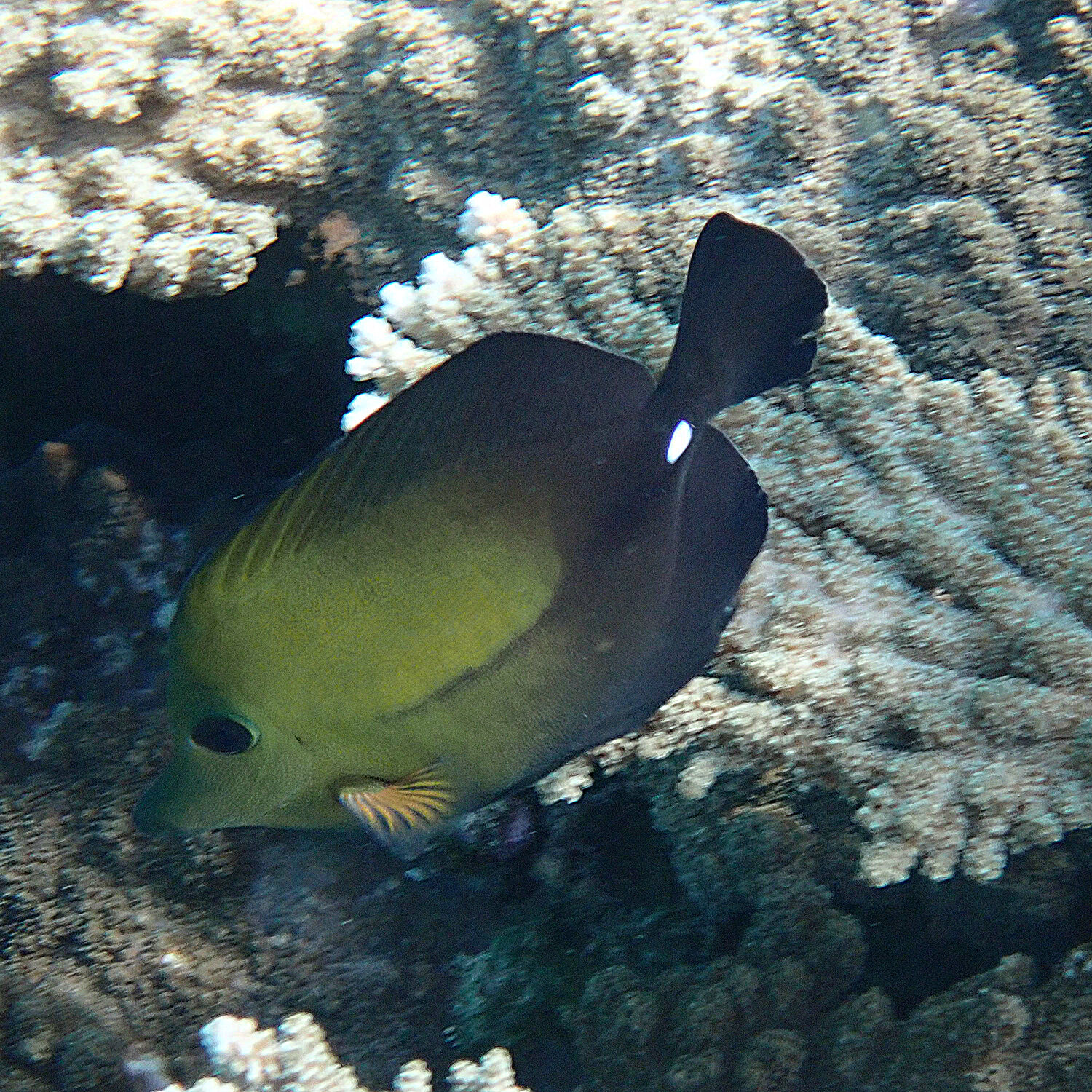
Surgeonfish, tangs and unicornfish all belong to the family Acanthuridae. On our reef, that family includes the pencil surgeonfish, bluespine unicornfish, spotted sawtail and convict surgeonfish. As an aside, I have also recorded a brown tang and a Pacific sailfin tang here, although those are not fish I see every day.

The family name refers to the sharp spine or spines near the base of the tail, on the narrow part known as the caudal peduncle. At first glance, these can look like tiny white, blue or dark marks. Look more closely, though, and you can see why surgeonfish have that name.

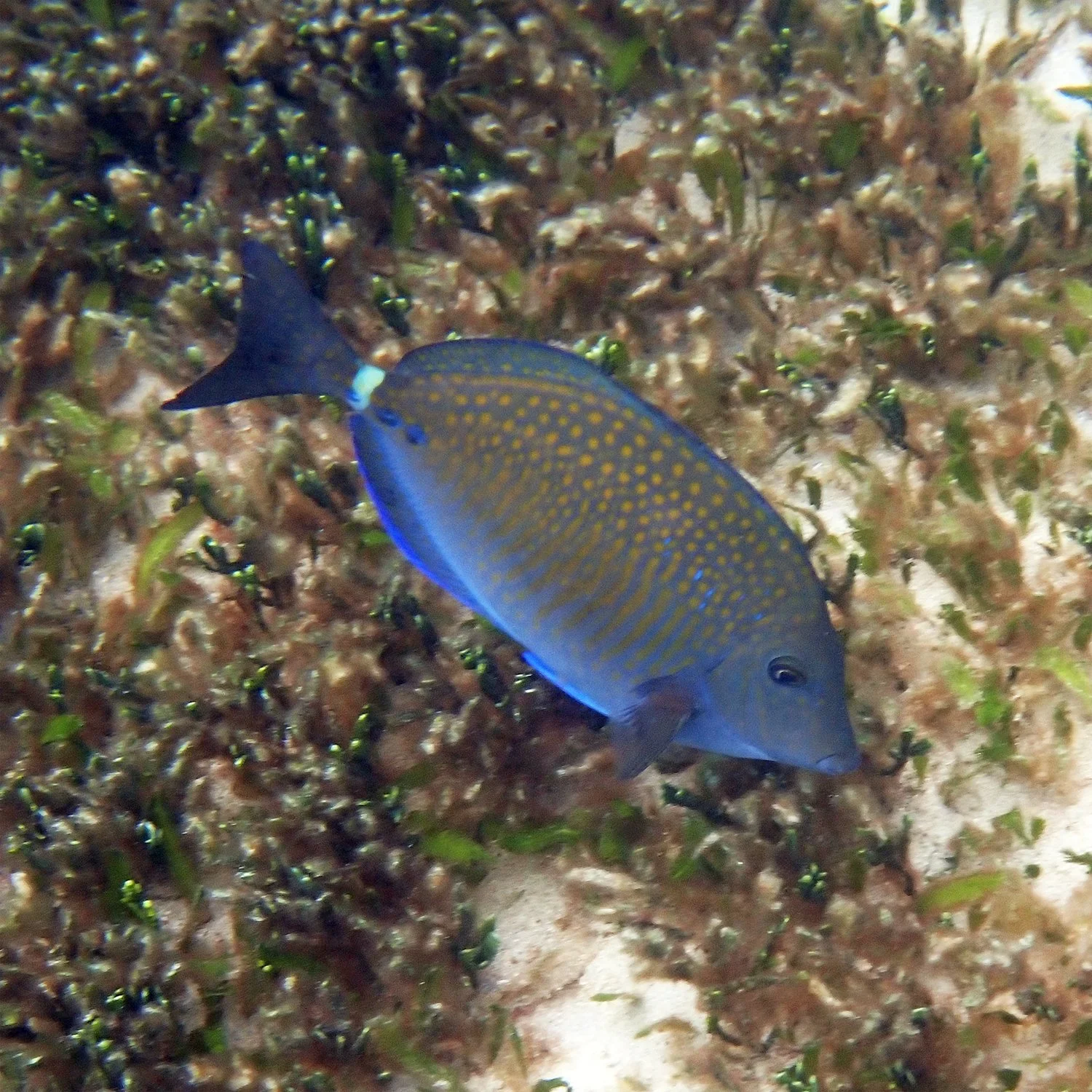
In the pencil surgeonfish, Acanthurus dussumieri, there is a single scalpel on each side (see the white scalpel at the base of its tail in the photo below). In the bluespine unicornfish, Naso unicornis, there are two on each side, showing as those lovely blue spots near the tail (see the image below). They are not there for decoration. If the fish needs to defend itself, a sharp sideways flick of the tail can make those small blades very effective.

Pencil surgeonfish, Acanthurus dussumieri, Norfolk Island
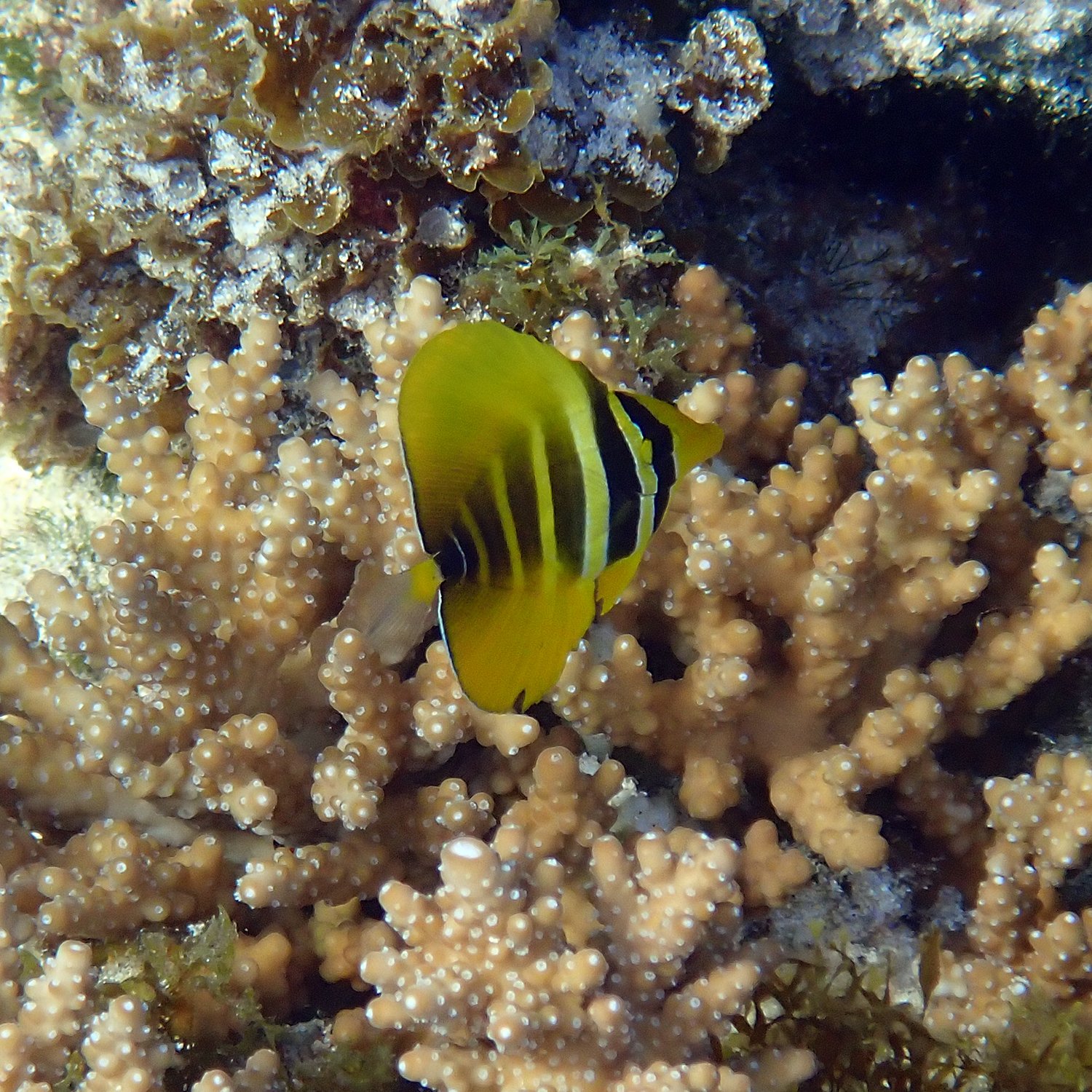
View fullsize Pacific sailfin tang
Pacific sailfin tang
View fullsize Brown tang
Brown tang
View fullsize Spotted sawtail
Spotted sawtail
View fullsize Dusky surgeonfish
Dusky surgeonfish

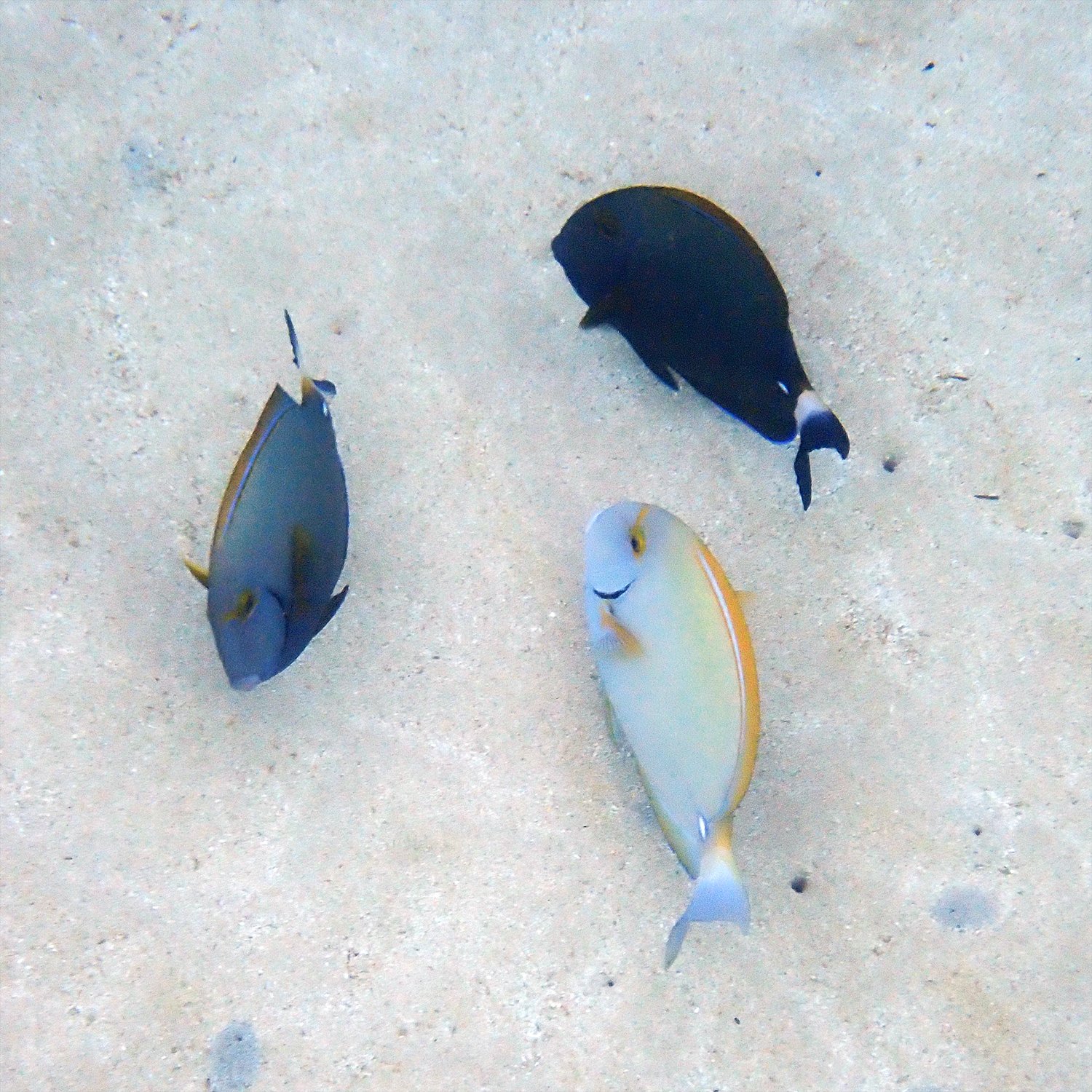
I have been trying to get decent photos of these scalpels for some time. Pencil surgeonfish are quite dark fish and can be hard to photograph well, especially in early morning light. Pencil surgeonfish can also look surprisingly different from one swim to the next. Sometimes they appear quite pale and silvery-brown; at other times they look much darker, with the fine pale lines standing out more clearly. I have not found a species-specific explanation for this in the literature, but many fishes can change colour rapidly through pigment cells in the skin, often in response to stress, light, background, social behaviour or general arousal. So when I see a pencil surgeonfish shift from pale to dark, I am probably seeing a mix of real colour change, body angle and the usual underwater tricks of light. The numbers of these fish wax and wane, and right now we have the most I think I have ever seen: a school of anything between eight and fourteen, and a few others dotted around the place, including quite a few juveniles, which tend to be solo.

The bluespine unicornfish’s scalpels

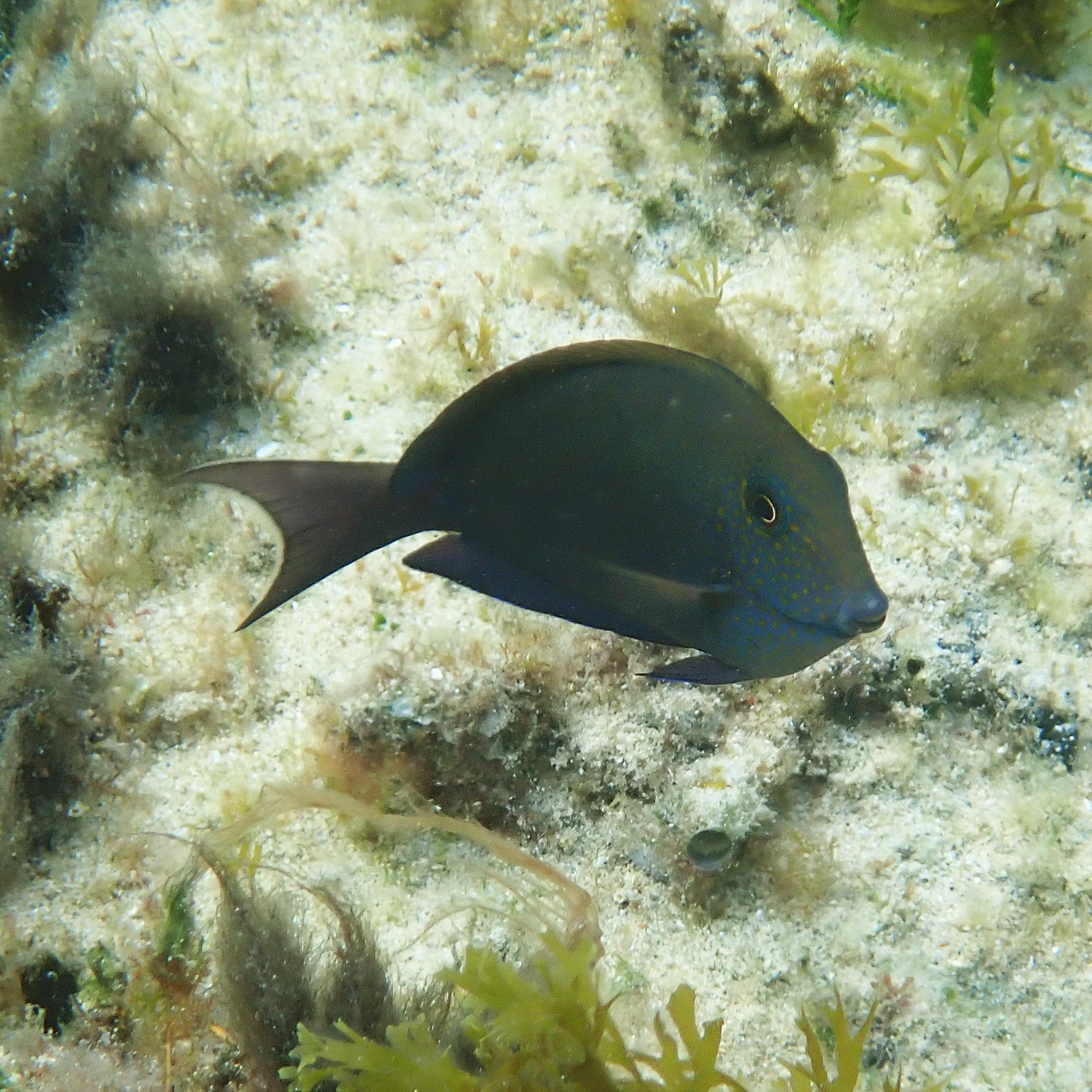
The bluespine unicornfish are a different sort of character altogether. They are show ponies. They pose, turn, peek over coral, and sometimes charge forward in what feels very much like a game of ‘call my bluff’. The adults have that slightly haughty, assessing look, as though they have already formed an opinion of you. The bluespine unicornfish can also shift colour, although in my experience not as dramatically as the pencil surgeonfish. Sometimes the change is subtle – a deepening of the body colour, a shift in tone, or a more obvious contrast around the head and flanks. In unicornfish, rapid colour changes have been linked with social and reproductive displays, although light, background, stress and general fish mood can also affect how they appear underwater.

They are called unicornfish because of the horn-like bump between the eyes, known as a rostral protuberance. The young ones do not have it yet, which makes the little bubbas especially endearing. I have watched their numbers inside the lagoon change over the past few years as well. At one stage there were several adults. Later, that seemed to drop to one. Then came the baby boom in 2024 (a drought year), when I counted 24 tiny bluespine unicornfish scattered along the reef in a single swim. Some of those little fish stayed for a while, but currently I only know of one, which is on the cusp of adulthood.

The age of these fish also changes how I look at them. Bluespine unicornfish are not short-lived little reef extras. Studies in Hawaii have aged them at more than 50 years old, using their ear bones, known as otoliths. So when a large adult unicornfish turns sideways and gives you that assessing look, it may genuinely be an old fish, not just a big one.

The fact that these fish are algae grazers is an important part of this story.

Many surgeonfish and unicornfish browse on algae, and on our reef that is a very useful job. Algae belongs on a reef. It is part of the system. But when it grows too thickly, or starts spreading over the spaces where corals might otherwise grow, it can shift the balance. It can cover hard surfaces, crowd living corals, trap sediment, and reduce the clean settlement space needed by coral larvae and other reef life.
View fullsize Bluespine unicornfish
Bluespine unicornfish
View fullsize Bluespine unicornfish
Bluespine unicornfish
View fullsize Pencil surgeonfish
Pencil surgeonfish

The photographs above demonstrate just some of the colour changes in bluespine unicornfish and pencil surgeonfish

Anyone who swims regularly in Emily and Slaughter Bays knows we have plenty of algae. Sometimes we have it by the bucketload. That is one of the reasons I always look for these fish as I swim. The same goes for the other members of this family when they appear. Convict surgeonfish, spotted sawtails, tangs and unicornfish are not all doing exactly the same thing in exactly the same way. Different species graze differently, feed in different places, and target different kinds of algal growth. Taken together, though, they are part of the reef’s grazing clean-up crew.

A very haughty bluespine unicornfish, Norfolk Island

They are not a magic fix. Herbivorous fish cannot undo poor water quality, nutrient inputs, sediment, freshwater stress or repeated disturbance. No fish can graze its way out of all that. But take away too many grazers from a small reef already carrying a heavy algal load, and the algae gets one less check on its spread.

That is why I get excited when I see young bluespine unicornfish in the lagoon. And, in fact, I saw my first tiny baby bluespine just a few days ago. The little ones do not have their horns yet, but they already have the look. Some are now old enough for their tiny scalpels to be visible as small blue marks near the tail. They are beautiful, ridiculous, haughty little things, and they are already part of the grazing crew.

So yes, today’s photos show the scalpels, which make them fascinating in their own right. But the fish carrying them are doing something more useful than looking pretty for the camera. On our algae-rich little reef, every grazer counts.

Convict surgeonfish, Acanthurus triostegus, Norfolk Island

A new baby bluespine unicornfish. We had a baby boom in 2024, which was a drought year on Norfolk Island

A juvenile bluespine unicornfish. Its horn has not yet formed. Norfolk Island

In Fish, Fish species Tags surgeonfish, Bluespine unicornfish, convict surgeonfish, pencil surgeonfish, Fish, Norfolk Island, reef fish
A shrimp storm →
Featured
How surgeonfishes got their name
June 14, 2026
How surgeonfishes got their name
June 14, 2026

Surgeonfish are named for the sharp little scalpels near their tails, but on Norfolk’s reef their more useful work happens at the other end. Pencil surgeonfish, bluespine unicornfish and their relatives help browse algae across the reef – a small daily job that becomes very valuable on an algae-rich lagoon reef like ours.

June 14, 2026
A shrimp storm
May 28, 2026
A shrimp storm
May 28, 2026

While setting my research cams last week, I swam into what looked like an underwater snowstorm. It appeared to be the aftermath of a mass moulting event, with large numbers of tiny, translucent shrimp-like exoskeletons drifting together near the surface.

May 28, 2026
Kingston dredging: what happens when a reef does not fit the framework
May 28, 2026
Kingston dredging: what happens when a reef does not fit the framework
May 28, 2026

This correspondence with DCCEEW is about more than one dredging proposal. It is about what happens when an ecologically distinctive place is assessed through standard tools that do not always make its most important values easy to see. I am publishing it here because that is something we need to be aware of, both on Norfolk Island and more broadly in Australia.

May 28, 2026
Kingston dredging: the project advances, the questions remain
May 24, 2026
Kingston dredging: the project advances, the questions remain
May 24, 2026

Kingston dredging is edging closer, and the paper trail is growing. This post brings together earlier correspondence with the Department and the latest media release so readers can see what has been asked, what has been answered, and what still remains unclear about the project, its rationale, and the protections proposed for the reef.

May 24, 2026
The lime-green coral in Slaughter Bay – a 40-year paper trail
May 17, 2026
The lime-green coral in Slaughter Bay – a 40-year paper trail
May 17, 2026

Green Mountain – the name I give this coral in my database – is a coral I’ve photographed for years as I swim past. Then I found its backstory in the Norfolk Island National Parks archives: a rough map, reused paper, a note in the margin – ‘still thriving’. That’s how baselines begin.

May 17, 2026
What Norfolk Island’s reef tells us about environmental blind spots
April 5, 2026
What Norfolk Island’s reef tells us about environmental blind spots
April 5, 2026

The Kingston dredging proposal on Norfolk Island raises a bigger question than dredging alone: how well do standard environmental assessment tools capture the real significance of a remote and unusual reef system like Norfolk Island’s?

April 5, 2026
Hammer coral time!
March 30, 2026
Hammer coral time!
March 30, 2026

Hammer corals have unique tentacles that are large, fleshy, and tubular; these terminate in a ‘T’-shaped, hammer-head or anchor. Beneath all these softly waving tentacles is an extraordinary skeleton structure, which helps define them as a large polyp stony coral.

March 30, 2026
Norfolk Island’s fishes: drifters, residents and the ones still missing
March 24, 2026
Norfolk Island’s fishes: drifters, residents and the ones still missing
March 24, 2026

Norfolk Island’s fish fauna reflects both connection and isolation. Some species may arrive from elsewhere as drifting larvae, some populations appear to persist locally, and some fishes known from islands on either side of Norfolk have still not been recorded here. This post looks at what old survey work, regional checklists and genetic studies suggest about that more complicated picture.

March 24, 2026
18 Jun 2025 (20)_crop.jpg
March 7, 2026
Alveopora or flowerpot coral – how to tell the difference
March 7, 2026

They look alike at first glance, but Alveopora and flowerpot corals are not the same. The easiest way to tell them apart is to count the tentacles.

March 7, 2026
Norfolk’s lagoonal reef – the 2025 report, in plain English
February 27, 2026
Norfolk’s lagoonal reef – the 2025 report, in plain English
February 27, 2026

We now have the 2025 Norfolk Island reef health report, so I’m taking the opportunity to translate it into plain English here. Sadly, it’s more of the same story in Emily and Slaughter Bays – a reef that can cope with some stress, but is being asked to cope with too much, too often.

February 27, 2026

Latest Posts

© 2026 All rights reserved.