• Home
    • Algae
    • Corals
    • Eels
    • Everything Else
    • Kingston, Norfolk Island
    • Nudibranchs, Sea Slugs and Flatworms
    • Octopuses
    • Out On A Swim Index
    • Reef Fish
    • Sharks
    • Sea Anemones
    • Sea Stars
    • Sea Urchins and Sea Cucumbers
    • Turtles
    • Underwater
    • Videos
  • Out on a swim - blog
  • About
  • Contact + Subscribe
Menu

Norfolk Island's Reef

Discover a fragile paradise – Norfolk Island's beaches, lagoons and coral reef
  • Home
  • Explore
    • Algae
    • Corals
    • Eels
    • Everything Else
    • Kingston, Norfolk Island
    • Nudibranchs, Sea Slugs and Flatworms
    • Octopuses
    • Out On A Swim Index
    • Reef Fish
    • Sharks
    • Sea Anemones
    • Sea Stars
    • Sea Urchins and Sea Cucumbers
    • Turtles
    • Underwater
    • Videos
  • Out on a swim - blog
  • About
  • Contact + Subscribe

Out on A Swim

‘Out on a swim’ is a coral reef blog that tells the stories of the characters who live under the waves and what has caught my eye when ‘out on a swim’ in the lagoons of Norfolk Island. It is also a record of the difficulties Norfolk Island’s reef faces, like many others around the world, as a result of the poor water quality that has been allowed to flow onto it.

This page shows the most recent blog posts. For the complete catalogue, visit the ‘Out on a swim index’ page.

This blog is rated in the Top 20 Coral Reef Blogs in the world.

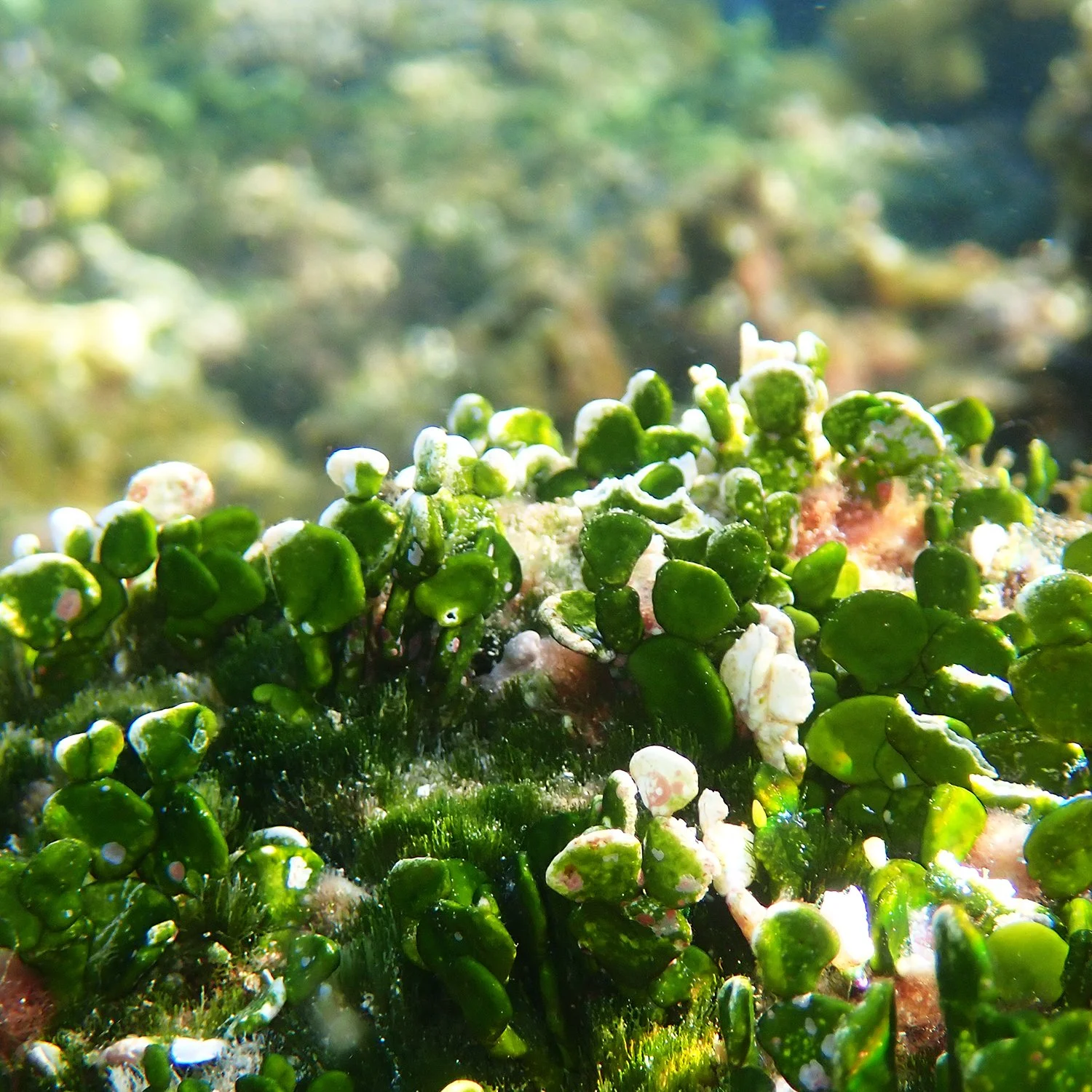
Halimeda with a bright green segment at/near dawn – chloroplasts concentrated in the new growth

Halimeda’s night shift – why this reef algae changes colour

February 20, 2026

This lovely looking algae is from the genus Halimeda. It actually has a calcium carbonate skeleton (CaCO₃) within its tissues, which is made by removing carbon dioxide from the water, and is a major contributor to reef sediments..

One of the clever bits is how it grows. Those little flat plates are known as thalli. New segments develop from small tufts that grow out from the end of a segment. It begins this process in the afternoon, forming a new soft, uncalcified segment overnight. This new segment is initially white, but by dawn it is bright green. A few hours after dawn it is whitish green, having already begun to calcify. Once grown and established, these little thalli become almost white after dark. And then green again each morning. This is because the green chloroplasts relocate out of harms way of the surface-scraping grazers when they are most likely to be active. Genius!

One small nuance to consider: while CaCO₃ production stores carbon in solid form, calcification can also release CO₂ to seawater – so its ‘carbon sink’ role isn’t straightforward and depends on local conditions and whether the carbonate is ultimately buried or exported.

View fullsize 16 Nov 2024 (218)_crop.jpg
View fullsize 14 Sep 2025 (124)_crop.jpg

Above: images of Halimeda with a pale/white new segments showing typical of overnight growth


References

Doney, S. C., Fabry, V. J., Feely, R. A., & Kleypas, J. A. (2009). Ocean acidification: the other CO2 problem. Annual Review of Marine Science, 1, 169. https://doi.org/10.1146/annurev.marine.010908.163834

Hopley, D. (Ed.). (2011). Encyclopedia of modern coral reefs : structure, form and process (1st ed. 2011.). Springer. https://doi.org/10.1007/978-90-481-2639-2

Howard, J. L., Creed, J. C., Aguiar, M. V. P., & Fouqurean, J. W. (2018). CO₂ released by carbonate sediment production in some coastal areas may offset the benefits of seagrass “Blue Carbon” storage. Limnology and Oceanography, 63(1), 160–172. https://doi.org/10.1002/lno.10621

In Algae Tags algae, Calcium carbonate, coralline algae, Halimeda, carbon sink
Reef real estate – a bubble-tip’s six-year stand-off →
Featured
Halimeda’s night shift – why this reef algae changes colour
Feb 20, 2026
Halimeda’s night shift – why this reef algae changes colour
Feb 20, 2026

Halimeda is a calcareous green reef alga that forms new segments overnight, shifts from white to bright green by dawn, then pales again as calcification begins. A quick look at one of the reef’s smartest algae.

Feb 20, 2026
Reef real estate – a bubble-tip’s six-year stand-off
Jan 11, 2026
Reef real estate – a bubble-tip’s six-year stand-off
Jan 11, 2026

Reef space is finite, and nothing ‘shares’ it politely. This short photo essay follows one bubble-tip anemone on Norfolk Island’s lagoonal reef as it holds a crater surrounded by Montipora. The coral builds a rim; the anemone holds the centre. Six years apart, and the argument continues.

Jan 11, 2026
A year in review – 2025 on Norfolk Island's reef
Dec 28, 2025
A year in review – 2025 on Norfolk Island's reef
Dec 28, 2025

Norfolk Island’s reef in 2025 – a year in review. From NOAA bleaching alerts and the UN Ocean Conference ‘Warning Signs’ series to post-drought coral recovery and a wet winter revealed in long-term rainfall records, this post captures the wins, losses, and shifting baselines beneath the lagoon. Includes reef photos, highlights from Reef Relief, and standout stories from 2025 – from coral health and disease to boxfish biomimicry, sea urchins, nudibranchs, and heat-stress signals in anemones.

Dec 28, 2025
Herbicides, heritage, and an inshore reef: what happens when land management meets lagoon health
Dec 15, 2025
Herbicides, heritage, and an inshore reef: what happens when land management meets lagoon health
Dec 15, 2025

Herbicide use near Emily, Slaughter and Cemetery Bays raises questions about inshore reef health, heritage land management, and environmental protection on Norfolk Island.

Dec 15, 2025
Signs of bleaching – 8 December 2025
Dec 8, 2025
Signs of bleaching – 8 December 2025
Dec 8, 2025

I took these photographs this morning, Monday, 8 December 2025. A few warm days of settled weather, little cloud cover and low tides in the hottest part of the day have led to some early bleaching on our reef. Bleaching doesn’t always mean death for our corals, but it is concerning to have this so early in the summer season. Fingers crossed the conditions don’t last and the reef can recover.

Dec 8, 2025
Nature is my teacher
Dec 3, 2025
Nature is my teacher
Dec 3, 2025

This is a thank-you note. Five years after my first Out on a swim post – written with zero marine science quals and a head full of questions – I’m still in the water, now as a PhD candidate, because an extraordinary mix of locals, volunteers, researchers and public servants decided to share what they knew. This is the story of how nature – and a very patient community – became my teachers.

Dec 3, 2025
Reef grief: what dredging has done to other reefs
Nov 30, 2025
Reef grief: what dredging has done to other reefs
Nov 30, 2025

From Miami to Fiji, from Dubai to tiny village harbours on atolls, dredging near coral reefs has left a long trail of scars – even on ‘small’ projects. This follow-up to last week’s Kingston post walks through real examples of what happened elsewhere, and what that should make us think about before we dig up our own reef.

Nov 30, 2025
To dredge or not to dredge? The Kingston Pier channel project
Nov 20, 2025
To dredge or not to dredge? The Kingston Pier channel project
Nov 20, 2025

How much risk are we really taking with the planned dredging at Kingston Pier – and how much protection do our corals actually have on paper? This piece walks through what the federal approval does and doesn’t guarantee, explains why sediment and light matter so much to the reef, and asks the hard questions we need answered before we trade a deeper channel for a shallower future.

Nov 20, 2025
A coral reef out of balance
Nov 8, 2025
A coral reef out of balance
Nov 8, 2025

After the long dry spell, the lagoon was crystal clear and full of life. But with the return of the rains, something else has returned too – the brown, filamentous mats of Lyngbya. It’s not seaweed, it’s a cyanobacterium, and when it takes hold it smothers coral and rubble alike. The reef’s way of showing us that every drop of water, from tank to tide, is connected.

Nov 8, 2025
Aglow among the spines
Oct 25, 2025
Aglow among the spines
Oct 25, 2025

Ever seen a sea urchin that seems to glow blue from the shadows? That’s Diadema savignyi showing off its reef shimmer. Beautiful, a little spiky, and definitely not to be messed with.

Oct 25, 2025

Latest Posts

© 2026 All rights reserved.