
Why the Kingston dredging proposal may have needed a more rigorous assessment
Most people are unlikely to spend much time thinking about the difference between a Public Environment Report (PER) and an Environmental Impact Statement (EIS). On paper, both are formal assessment pathways under the EPBC system. But the distinction between these two processes is important. In the case of the Kingston dredging proposal, the Department assessed the project through a Public Environment Report, or PER, rather than requiring an Environmental Impact Statement, or EIS.
The Department’s current guidance says it uses a PER, where it needs a narrower and less encompassing scope than an EIS. It also says the choice of assessment method depends on how extensive the likely impacts are, how complex the action is, and the comments received.
That is where Norfolk Island becomes interesting.
Back in 2023, before I was a PhD candidate, I wrote from a place of frustration and instinct about a problem I could see but could not yet fully articulate:
how can protections work properly if we do not know what is there
or if what is there is not well recognised by the systems meant to assess risk?
Looking back, the wording was more emotional than I would use now, but the questions were sound. That article can be found here: Tiptoeing through the government silos.
Then there is the Protected Matters Search Tool, or PMST, which is often used in PERs and EISs. This is the Australian Government’s online screening tool under the EPBC framework. It is designed to help identify protected matters that may occur in or near a project area, so it can help shape environmental referrals, risk screening and assessment at an early stage. In other words, it is one of the tools used to help frame what ‘matters’ may need attention in all kinds of proposals – such as the Norfolk Island’s Kingston dredging project. The Department of Climate Change, Energy, the Environment and Water (DCCEEW) makes clear that any PMST information is indicative only and not exhaustive. The PMST is an issue, linked to the type of assessment that is called for by the which is is really another version of the same problem.
To the west of Kingston Pier, the site of the planned dredging, Norfolk Island
Looking from Point Hunter towards Kingston Pier, down the length of the inshore reef and lagoon of Emily and Slaughter Bays, Norfolk Island
The Kingston Pier proposal was not beside some isolated and anonymous stretch of coastline. The PER itself says the most accessible reefs in the Norfolk Island coral reef ecosystem include Emily Bay and Slaughter Bay, and that the Slaughter Bay reef is the reef most proximate to the proposed works. It also says those reefs were already under particular stress from bleaching, inshore pollution, declining water quality associated with high rainfall and land-based runoff, and a coral disease outbreak.
The same report describes Norfolk’s coral communities as one of the southern-most coral assemblages in the world, one of the few known examples of a transitional algae and coral assemblage, and a unique association of tropical and temperate species of global biodiversity value. It also says they are vulnerable to disturbance.
But here is the problem. The report also admits that ‘few systematic surveys, and no long-term monitoring of biodiversity, has occurred for the shallow water reef habitats around Norfolk Island’. It says coral spawning dates are based on anecdotal evidence from local reports and that no dedicated studies have been undertaken to determine the full duration of the spawning season or which species are involved each time. It also says the wave and dredge plume models were not verified with local wave and current measurement data because those data were not available.
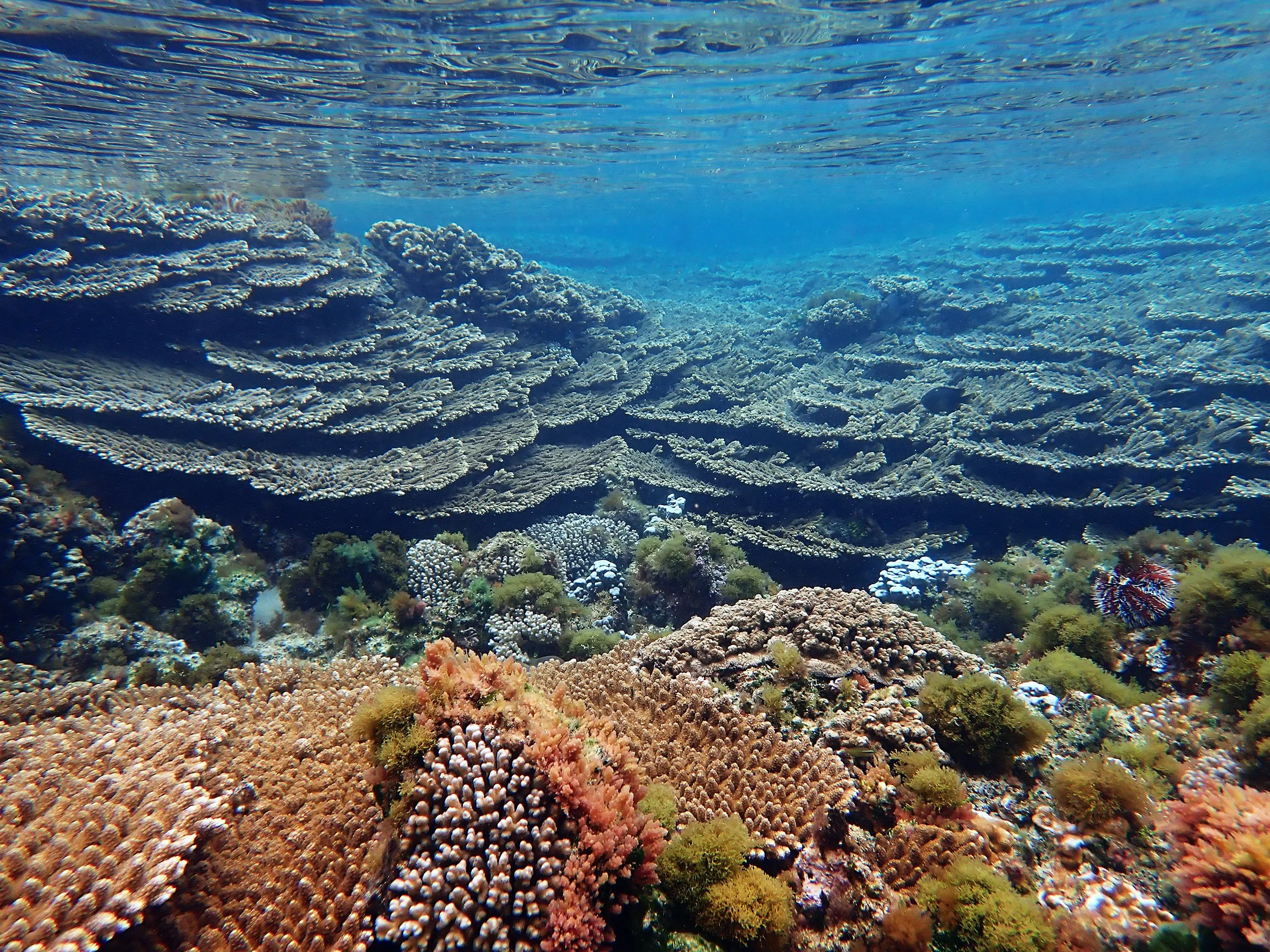
Norfolk Island’s inshore coral reef
That is not the language that you would use with a well-understood ecosystem. It is the language used when there are gaps and uncertainty. We have barely scratched the surface of our knowledge gaps, so perhaps being uncertain is a wise postion for Advisian to take in its PER to the Department of Infrastructure, Transport, Regional Development, Communications, Sport and the Arts (DITRDCSA) regarding the Kingston dredging project.
More recently, that line of thought was sharpened by a note circulated by coral reef researcher Dr Jennie Mallela to Australian Coral Reef Society members; she raised concerns about PMST outputs for Christmas Island and the possibility that reef habitats and benthic species were not being clearly captured there either. That prompted me to look more closely at what the tool was actually showing for Norfolk Island.
As I noted above, DCCEEW says PMST information is not exhaustive. This is an important point, especially in remote territories. When I ran PMST reports for Norfolk Island generally, for the Kingston / Emily Bay / Slaughter Bay area, and for a wider marine buffer, the reports clearly returned the standard protected-matters categories. What they did not clearly surface were things such as shallow reef habitat near the project area, benthic reef communities, Norfolk-specific reef distinctiveness, or the ecological significance of the project-adjacent reef itself.
That points to a deeper problem. PMST is built to surface matters recognised under the EPBC framework. That is useful as far as it goes, but it also means the tool gives greatest visibility to what is already formally listed, mapped or categorised. If a species, habitat or assemblage is not well captured in that framework, it can become much less visible in the assessment process. That does not make it unimportant. It simply means the administrative lens is narrower than the ecology. A species does not become unimportant because it is not EPBC-listed, and a reef system does not cease to be distinctive simply because its uniqueness is not well expressed in the categories being searched. PMST is useful for surfacing listed and mapped protected matters, but it is much less effective at conveying the full significance of a benthic reef system whose importance lies in habitat, local assemblages, ecological condition, and place-specific vulnerability.
To be fair, the Kingston PER did not rely on PMST alone. It drew on broader reef science as well. But that is almost the point. If a place has to be explained through layers of supplementary ecological evidence because the standard protected-matters frame does not tell the whole story, then perhaps the assessment rung was too low for the place.
That does not mean that an EIS was legally required. The Department’s own guidance does not set out a simple and obvious test of that kind. But it does support a narrower and, in my view, stronger argument: for a remote, shallow, already stressed, ecologically distinctive reef system with limited long-term monitoring and admitted uncertainty, there was a credible case for a more intensive assessment pathway than the PER that was used.
Norfolk Island is exactly the sort of place where what matters most ecologically is not always what shows up most clearly administratively. That is why the distinction between a PER and an EIS deserves more scrutiny than it usually gets.
An as yet undescribed species of Eviota, possibly a new endemic species for Norfolk Island