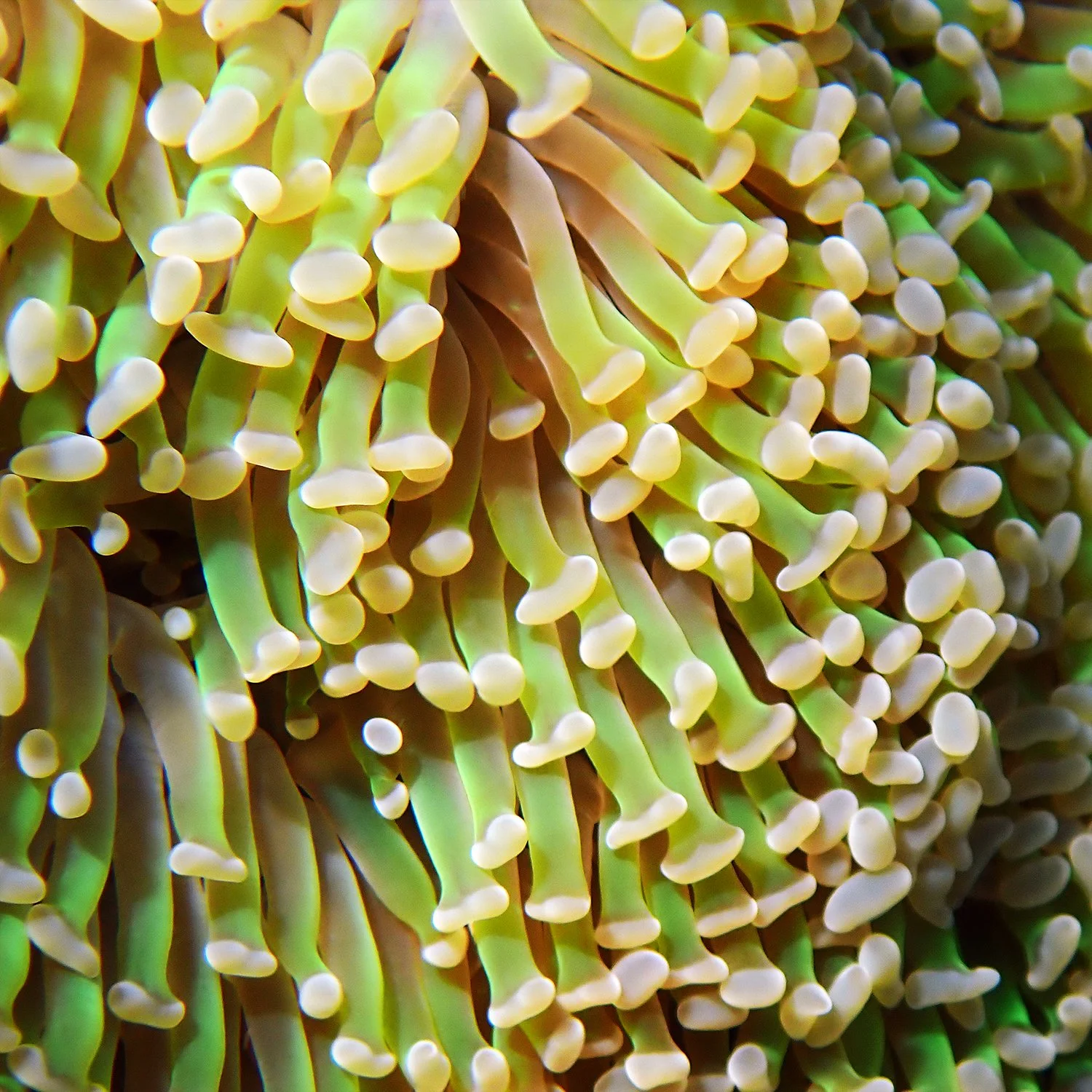
I was looking through some of my photos of hammer corals the other day and found myself pausing for longer than expected. They are such eye-catching corals when you see them in the water, all those flowing, fleshy tentacles moving about, but close-up some of these photos tell a more interesting story.
In the image, above, the tentacles are partly withdrawn and the skeleton is showing, which is why I like this photo. It strips away the softness a bit. It becomes very obvious that the hammer coral is a hard coral, built on a solid limestone framework.
At certain times of year corals are full of activity that is completely hidden unless you happen to catch them at the right moment. Hammer corals reproduce both sexually through spawning and asexually through budding and head splitting – where polyps split or grow new heads at the base (budding) to form colonies. An example of sexual reproduction can be seen in the photo, below. This was taken just before spawning, and you can actually see the pink gametes quite clearly inside the tentacles. Amazing!
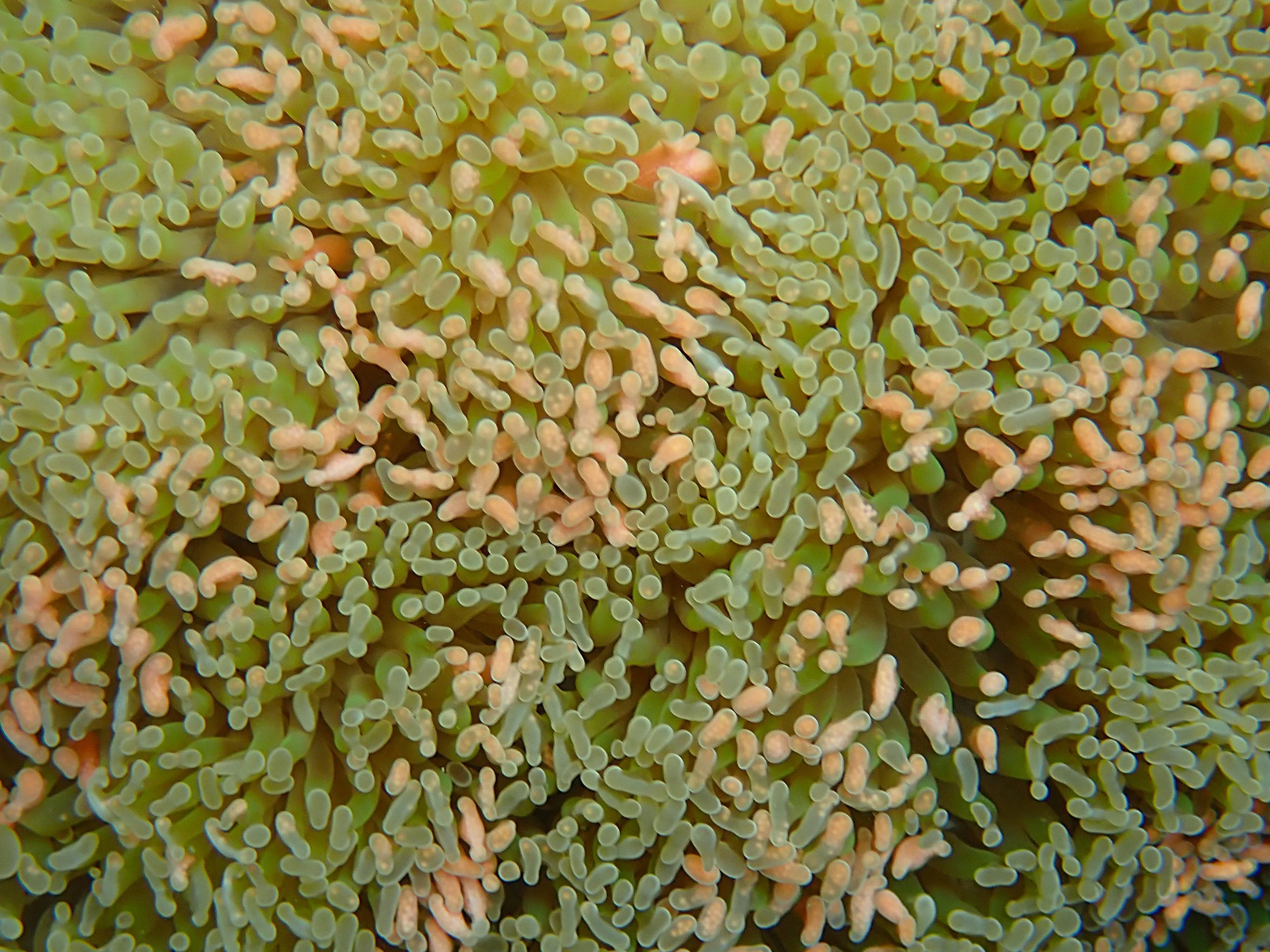
A hammer coral with developing gametes, photographed 9 January 2021. The next full moon was on 28 January.
A hammer coral beginning to bleach
For all their beauty, hammer corals can be quite combative. They may extend long sweeper tentacles to sting nearby corals and hold onto space on the reef. I look at these in the brain coral, Paragoniastrea australensis, in more depth here While you were sleeping ... and here War of the coral worlds!
Hammer corals are primarily photosynthetic, obtaining their energy from light via symbiotic zooxanthellae, although they will feed on plankton, particularly at night time. Those zooxanthellae give them their colour and they will expel these when they are stressed, resulting in bleaching (photo, right).
Then there is the question of whether all hammer corals are the same. Looking at my last two photos, below, for example, makes me wonder. The tips are quite different in shape, and I suspect I may be looking at different species, or at least different forms. Or maybe I’m not! Part of the difficulty is that ‘hammer coral’ is not one neat, single thing. These corals are now generally placed in the genus Fimbriaphyllia, and the name ‘hammer coral’ is most often used for Fimbriaphyllia ancora and Fimbriaphyllia paraancora. That may be what I am seeing in these last two photos, though it could also be natural variation. I would not want to identify them with certainty from tentacle shape alone. In this group, colony form and skeleton can be just as important as the fleshy parts we notice first.
I enjoy looking back through older images. A photo that once seemed to be just a nice coral shot starts to reveal many other things – structure, reproduction, variation, behaviour – especially when compared with other images in my database. Certainly, the reef does not give everything away at first glance.