
In Greek mythology, Doris is a sea goddess who represents the fertility of the ocean – the goddess of the rich fishing grounds found where fresh water mingles with the brine. It seems an apt name for our little green sea turtle (Chelonia mydas), found, as she was, where the freshwater stream mixes with the salty waters of Emily Bay, hiding under a coral ledge, sick, weak and underweight.
I often see a turtle or two when out on my swims. It is such a joy to creep up quietly and watch as they snooze, which they seem to do a fair bit, or to see them swimming by, bobbing up for air every now and then. And it is a triumph if I manage to get a half-decent photograph. Swimming with a turtle before starting your working day is such a privilege – and a heart gladdening sight.
So I was concerned when very early one morning I saw one of our turtles swimming in a desultorily way, as if she was struggling to gain any traction. Plus, she was covered in an unsightly algal growth. Algae growing on a turtle’s shell is not normally something that would concern me, but this seemed to be over her eyes and her flippers as well. I took the best photos I could in the overcast, early morning light and carried on with my swim. That was on 29 August 2022.
I posted about her plight on my Facebook page and over the next few days kept a look out for her. But sadly, nothing. It seemed she had gone to ground, or worse, died. While I searched I was contacted by Cairns-based turtle rehabilitation expert Jennie Gilbert who told us that Doris looked very sick in those first photographs, but if we could get some better ones she would be able to offer a provisional diagnosis.
I kept searching for Doris, with no luck. Hannah Taylor, Norfolk Island’s Australian Marine Parks’s officer, came out with me as well so we could do a more thorough square search together with two pairs of eyes on the job. But again, nothing.
Then, on 10 September, thanks to a sharp-eyed swimmer who asked me about a sick-looking turtle she’d seen that morning, Hannah, our Norfolk Island National Park and Botanic Garden manager Nigel Greenup and I went back in for another search that afternoon to try and see if we could get a closer look at her, and hopefully get some better images.
This time we were lucky in that it was an extraordinarily low spring tide and Hannah quickly spotted Doris. Nigel, who is an authorised ranger under the Commonwealth EPBC Act and a trained and experienced turtle and cetacean rescuer, gently raised her to the surface so I could grab the photos we needed, including of her underside, which would tell us more about her condition. I sent these to the Cairns Turtle Rehabilitation Centre so Jennie could take a look and let us know what she thought was the problem.


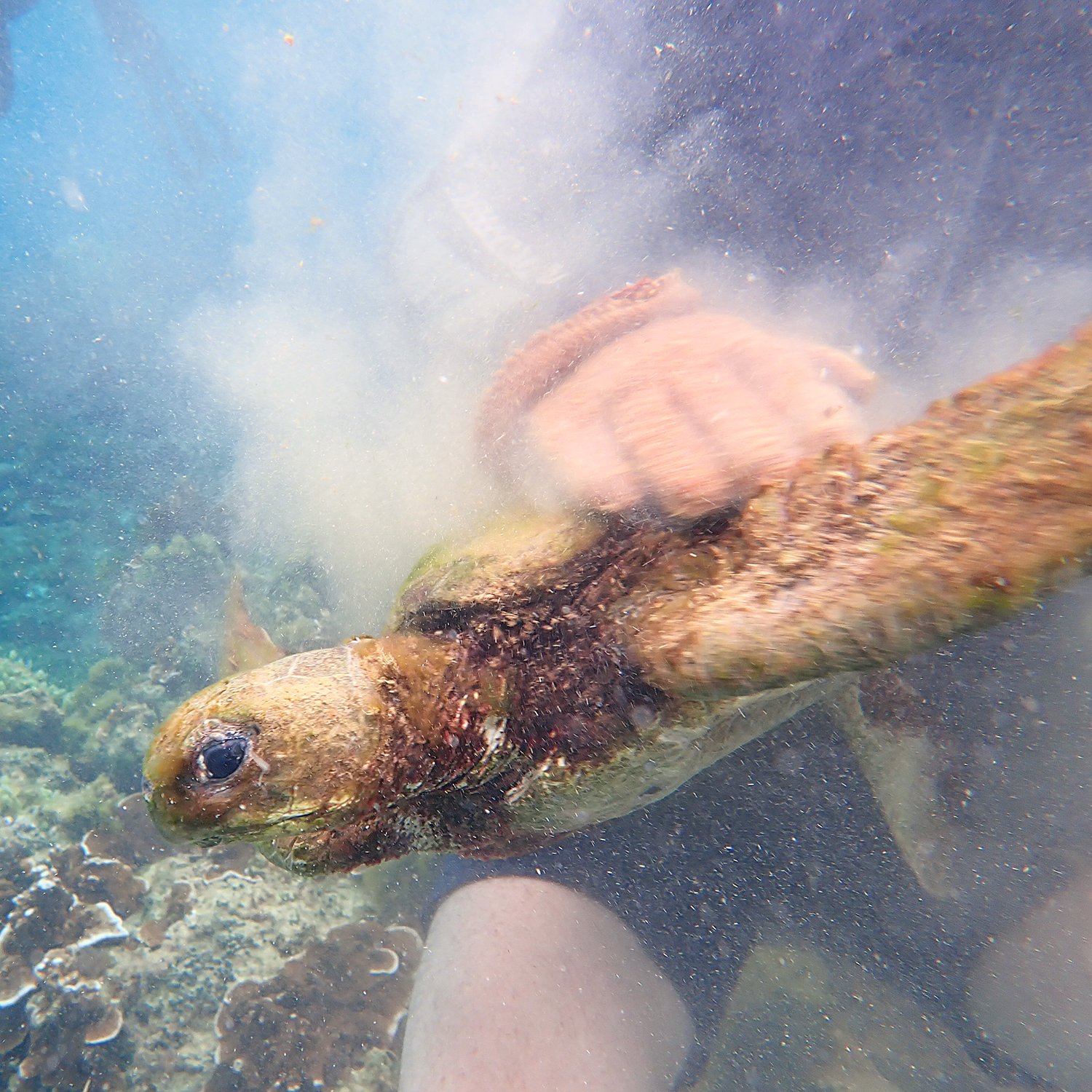

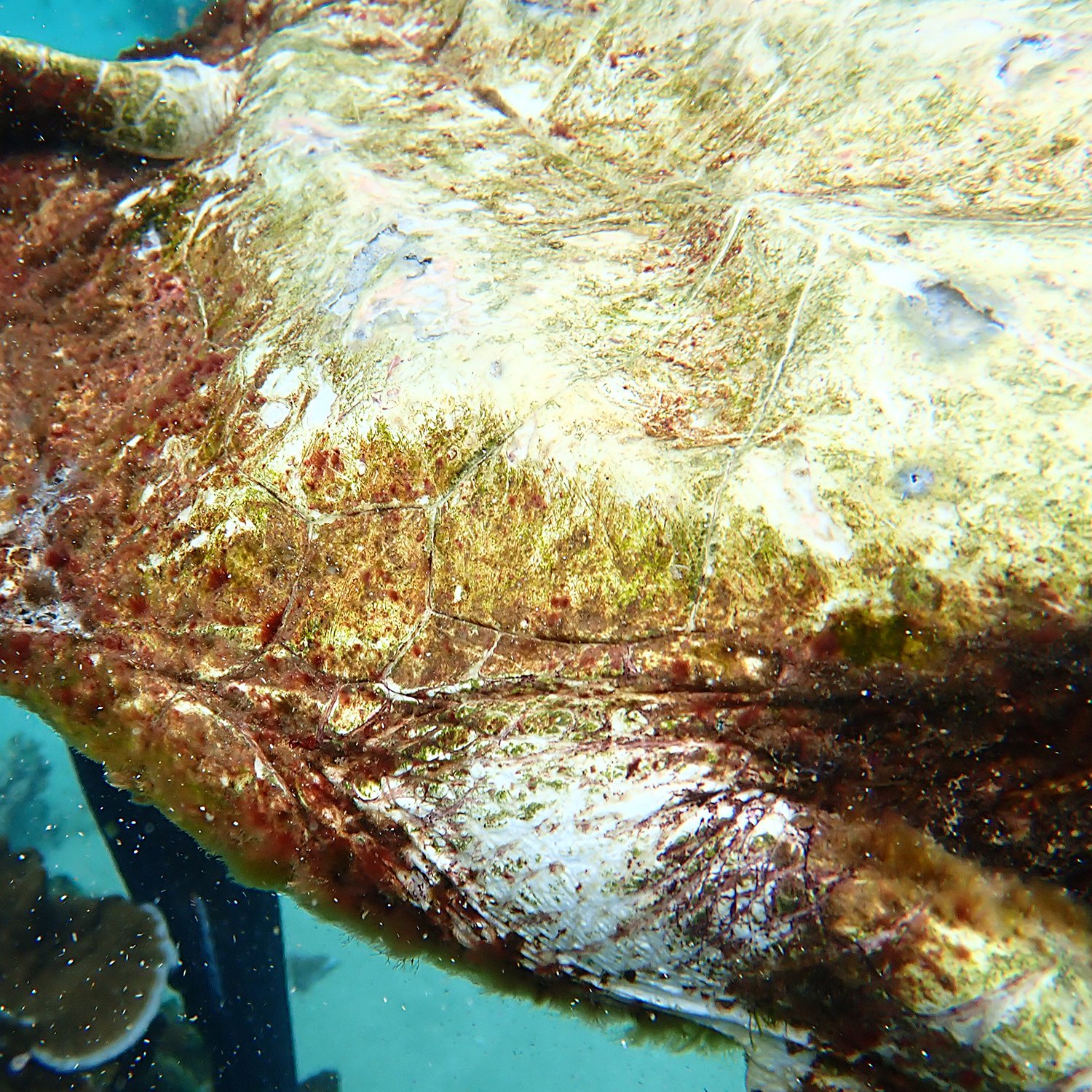
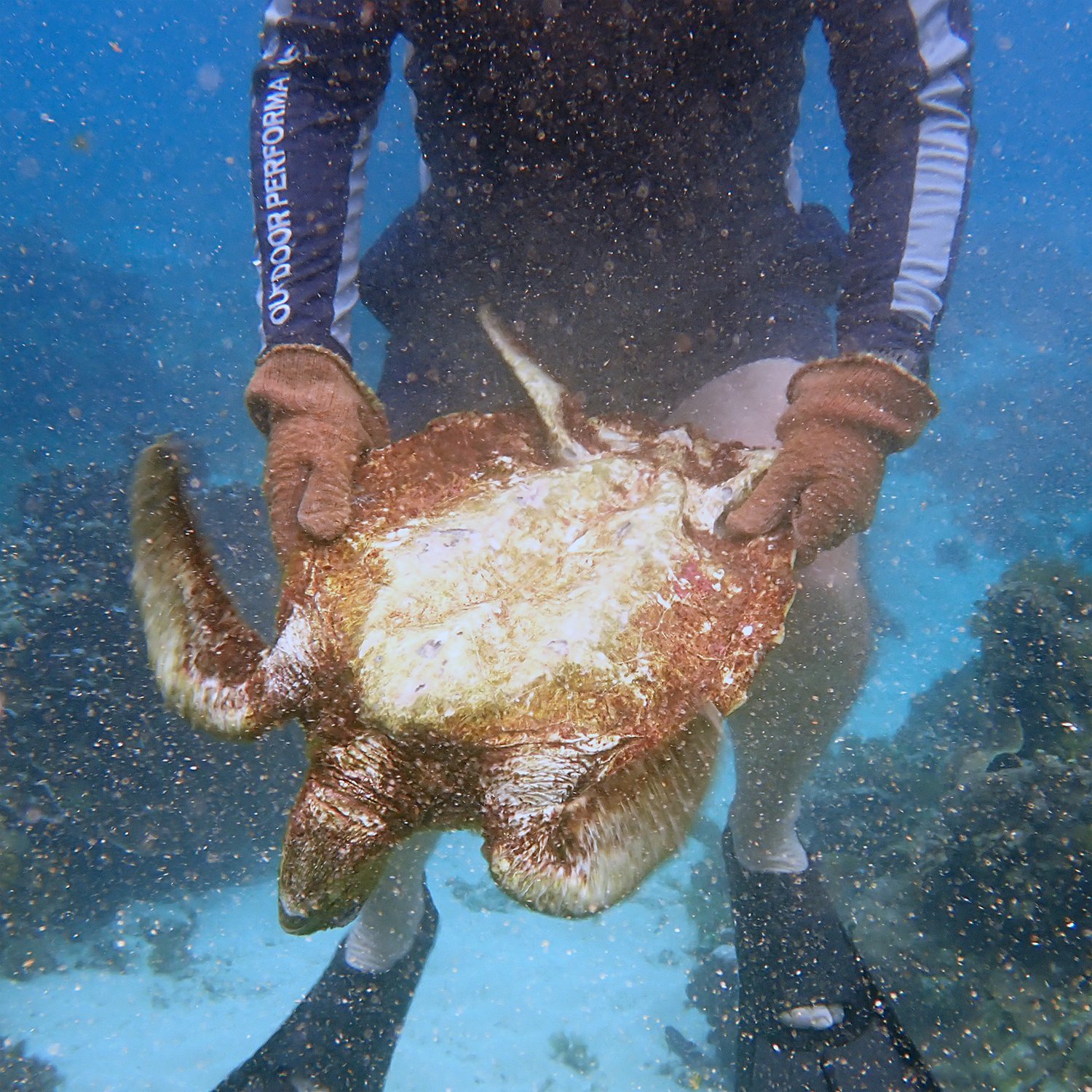
While he had hold of her, Nigel, who was wearing gloves to prevent him causing her any further harm, cleaned off some of the algal growth before letting her go.
After reviewing the images, Jennie came back to us and said that Doris was very sick indeed. Doris was underweight and, Jennie suspected, she was suffering from brevetoxin poisoning, which turtles can get from ingesting certain types of algae. Turtles who are underweight have a hollowed-out belly, or plastron. Her shell looked soft and damaged on one side, and, of course, there was all that algae growing on her.
This immediately put us in a dilemma. Green sea turtles are listed as endangered by the IUCN Red List. We had no facilities to nurse and rehabilitate a sick turtle on the island, but fortunately we did have Nigel and former Parks manager Mark Hallam here, both with some expertise who were willing to help, and we had the support of Jennie from the turtle rehabilitation centre in Cairns. Consideration was given to sending Doris back to Australia for care, but we were told that the stress may just prove too much for her. So with the decision made to keep her on-island, Hannah swung into action coordinating everything Doris would need for her recovery. I placed a call out to members of the community for help with some food supplies, and to source a tank big enough to hold her comfortably without cramping her. I also put out a call further afield to find someone travelling from Cairns to the island in the next week who could help us by bringing some tins of a product called Recovery, which she would need to get her match fit again. These were donated by the Cairns Turtle Rehabilitation Centre.
The response was amazing. What a community we live in, but also what a wonderful community of people who follow my Facebook page and who had followed Doris’s story. I can’t thank everyone enough.
Doris, safe and about to be given some TLC in her new temporary home
We quickly found a local islander, Aaron Graham, travelling back from Cairns that day. The Parks staff found and prepped the two tanks, and organised for them to be filled with the optimal ratio of clean sea water to fresh to give her the best environment possible. Matt King was even able to source some fish tank heaters. Food was delivered by supportive locals. Jamie Donaldson headed off to catch some fresh fish for her. And Jennie was ready and waiting in Cairns with her excellent advice. With the tanks located safely at the Parks office property where she could be closely monitored, Operation Doris was ready to launch.
Two days later, on 12 September, the three of us arrived at Emily Bay. The plan was for Hannah and Nigel to bring her ashore, wrap her in a wet towel and carry her to the car to make the journey back to her new temporary home. We knew exactly where we would find her – she had taken to hiding under a particular coral ledge – and we were right, that is where she was. In the end, Operation Doris probably took less than 15 minutes to execute. And thanks to Hannah’s amazing planning it was seamless.


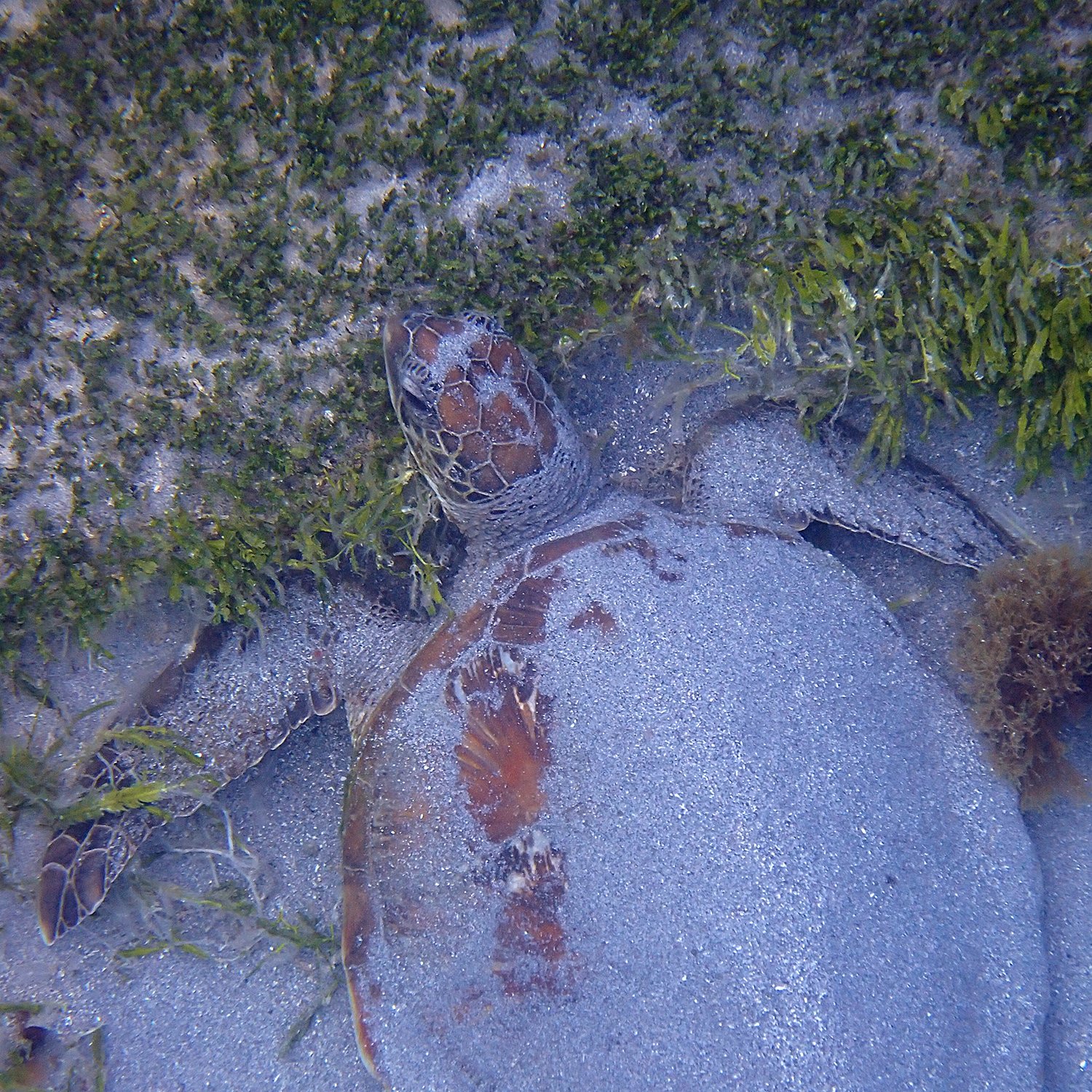
Above are a few photographs of turtles in our bay. One is much darker than the other two. It is difficult to say exactly because her shell was in such a state, but I think the image bottom left is Doris in April 2021.
Special thanks for caring go to: Hannah Taylor, Nigel Greenup, Jennie Gilbert, Candice Snell, Aaron Graham, Jamie Donaldson, Matt King, Mark Hallam, and everyone else who has been involved – there are just so many who have called Hannah and me. I am so very grateful.
Candice Snell, our local vet, under instructions from Jennie, started Doris’s treatment that evening, and she has already begun to respond. Candice is another local who has given generously and willingly of her time, and like the Park’s staff, I can’t thank her, like them, enough.
I think both Hannah and I have had a quiet cry over poor Doris’s plight; it isn’t nice to see an animal in such distress, especially as it was more than likely caused by we humans neglecting her environment. Today, 14 September, Doris had her first nibble of kingfish shashimi, courtesy of Jamie – a promising sign. Meanwhile, we await her blood test results to tell us exactly what it was that made her sick. She will stay under the watchful eye of Hannah and the Park’s staff until, hopefully, she is well enough to be returned to the bay.
Postscript: I have long tried to work out if we have two or three resident turtles in our bays or even more. But now, with Doris out of the picture, I can confirm there are definitely three. I saw two this morning while out on my swim, and that really does gladden my heart.