
When you snorkel in Kingston’s lagoon, you often pass over patches of bright green Caulerpa. Some forms are made up of soft, feathery fronds that sway in the water and, from above, can look a lot like a little seagrass meadow. This is the form commonly known as feather Caulerpa. While they are often mistakenly called seagrass, they are not. It is an easy mistake to make because some of our Caulerpa species look remarkably plant-like, particularly when they spread across the bottom in dense green patches.
Other forms of Caulerpa look like vivid green bunches of grapes – hence their local name, sea grapes, otherwise known as grape Caulerpa. They are even eaten here.
As far as we know, though, Norfolk Island does not have seagrass. That was tested quite literally during the nearshore marine habitat mapping carried out in 2022 by Dr Kellie Pendoley and Margaret Christian. Satellite imagery initially identified some areas around Norfolk as possible seagrass habitat. When those areas were ground-truthed, however, they turned out to be bare sand. The final habitat maps were revised accordingly and seagrass was removed as a habitat type. The report states that seagrass has never been found at Norfolk Island.
What we have instead is a surprisingly diverse collection of marine algae, including several species of Caulerpa. Around 100 species of Caulerpa are currently recognised worldwide, although that number will no doubt shift as new species are described and existing ones are re-examined. Alan Millar’s survey of Norfolk Island’s marine algae recorded a number of them here, including Caulerpa racemosa, one of the grape-like forms that I mentioned above, and Caulerpa taxifolia, with its characteristic feathered fronds. He also described Caulerpa as a conspicuous part of both the reef top and Slaughter Bay lagoon.
Seagrasses and Caulerpa are actually very different organisms. Seagrasses are flowering plants that have adapted to living submerged in seawater. They have true roots, leaves and rhizomes and they produce flowers, pollen and seeds. Caulerpa is a green alga, despite its convincing imitation of a plant, and its structure is quite extraordinary with a very unusual body plan. A connected thallus is coenocytic – that is, its fronds, creeping stolon and root-like rhizoids share a continuous mass of cytoplasm containing many nuclei, rather than being divided into the separate cells that make up a seagrass.
At the moment there is another good reason to look more closely at our Caulerpa, because it is changing. The grape Caulerpa that was so conspicuous earlier in the year is now dying back across parts of the reef. It has not disappeared completely – some always seems to hang around – but the difference between its peak growth and what is there now is striking. I have been seeing these seasonal changes for several years, and they are a useful part of the rhythm of the reef that is easy to miss if you are not looking regularly.
Caulerpa taxifolia, or grape Caulerpa, growing among the corals, Norfolk Island
Caulerpa taxifolia, or feather Caulerpa, Norfolk Island
Caulerpa taxifolia, or feather Caulerpa, Norfolk Island
The feathery Caulerpa varies considerably too. I have photographs of the same part of the channel, taken from roughly the same spot over several years, and at times it forms a dense green carpet while at others much of the bottom is almost bare. There appears to be some seasonal change, but there is considerable variation between years as well – photographs taken at similar times of year can look remarkably different. I have not yet teased those patterns apart, but the photographic record gives me plenty to work with.
And then there are the turtles.
Green sea turtles are so often photographed grazing over seagrass meadows that the two have become almost inseparable in the popular image of them. Seagrass can certainly make up a major part of the diet of green sea turtles where it is abundant, but their diets are more flexible than that image suggests. In places without seagrass, macroalgae can become an important part of what they eat.
That is clearly relevant here, because Norfolk’s green sea turtles are living without seagrass. They are not necessarily sticking to algae either. I have footage of one juvenile moving across the reef and eating nine sea anemones in just four minutes (see the vidwo below). Juvenile green sea turtles can have quite varied diets, including algae and a range of animal prey, so this behaviour is not as odd as it might first appear.
What I have not seen, despite spending a great deal of time watching them feed, is one deliberately eating the feather Caulerpa. That does not mean they do not eat it, only that I have not seen it happen.
Meanwhile, if you are snorkelling across the reef and see those soft green feathers waving in the water, you are not looking at a seagrass meadow. You are looking at Caulerpa – part of a much larger algal flora that changes noticeably through the year.
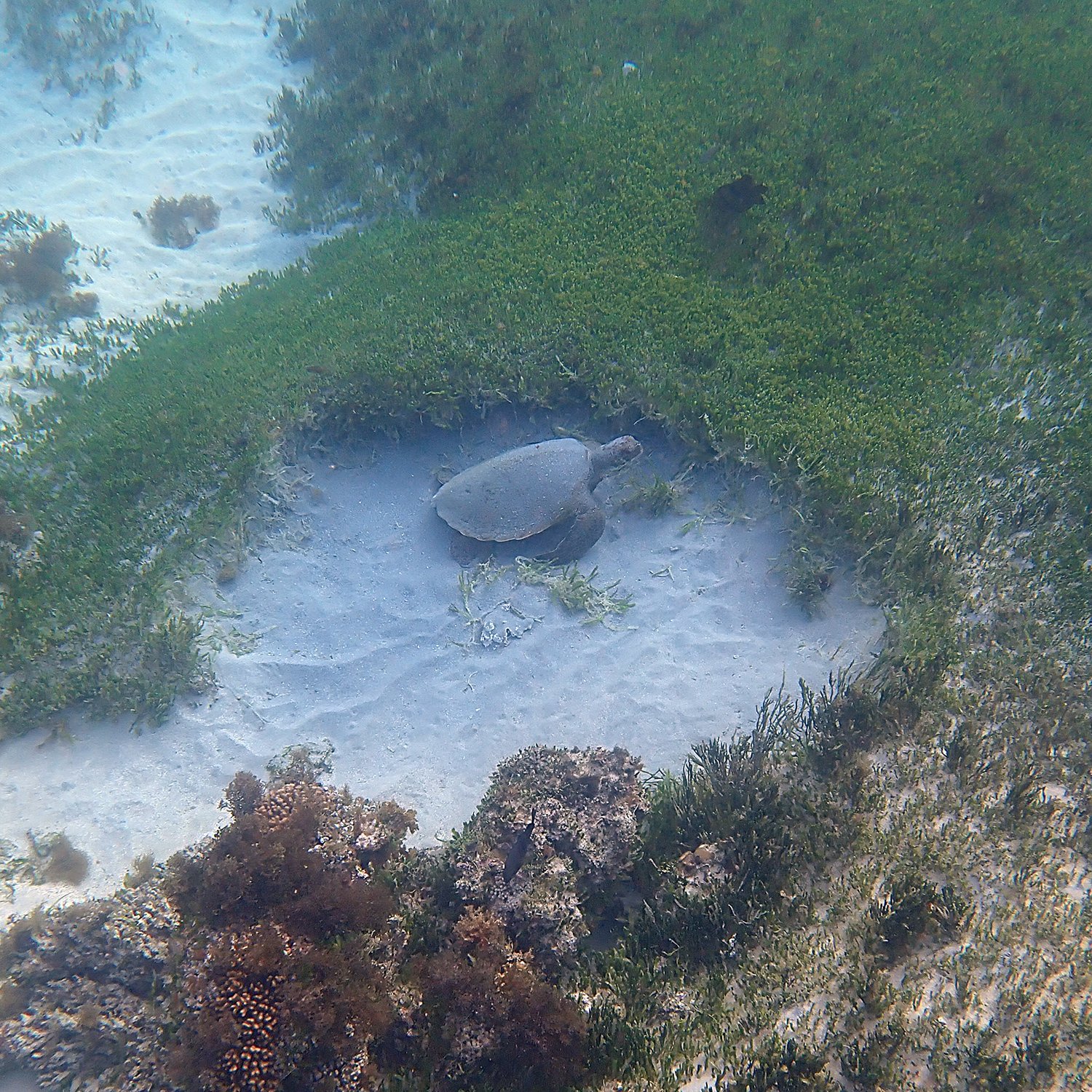


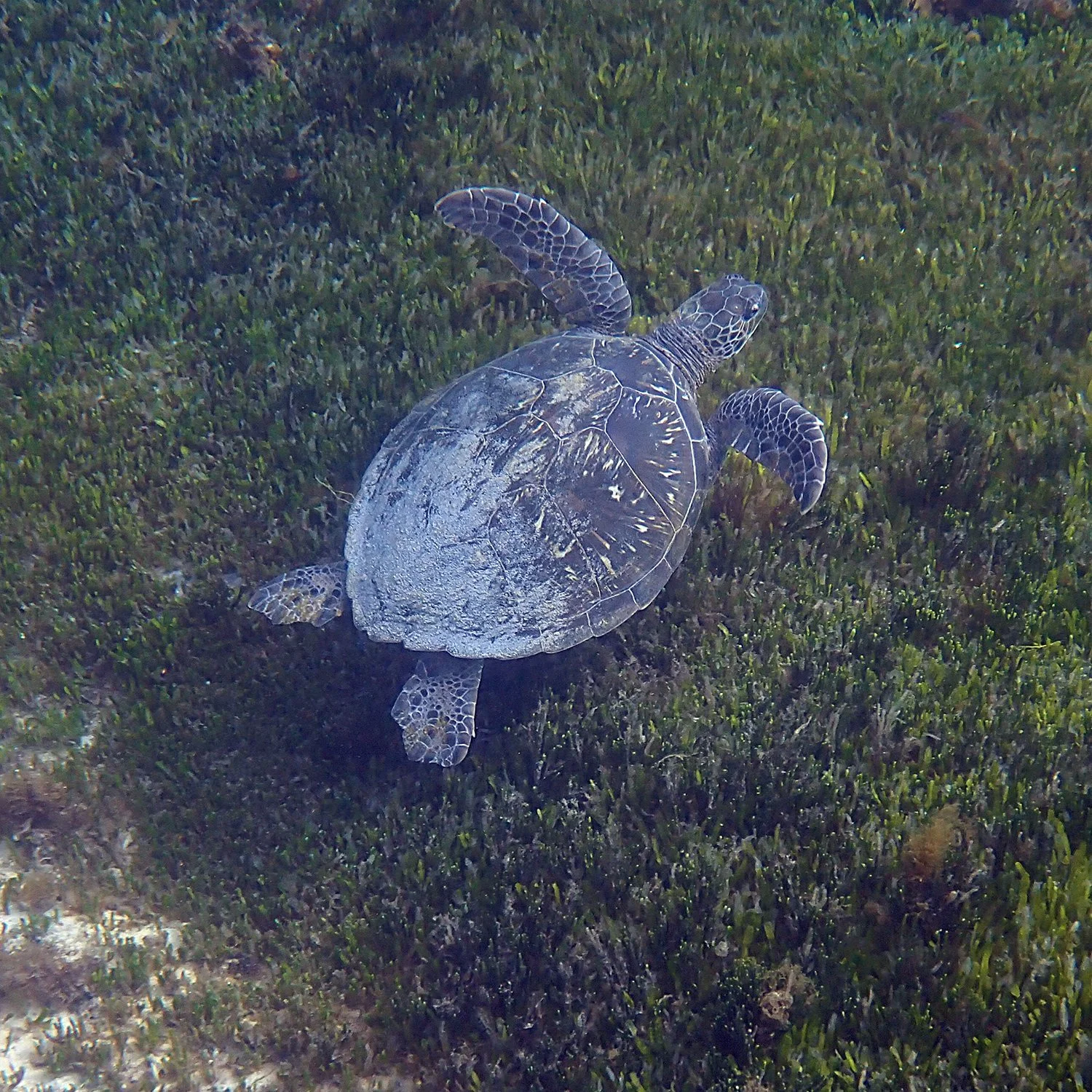
Above: Green sea turtles resting among feather Caulerpa in Kingston’s lagoon. I often see them using these dense patches, but I have yet to see one actually eating the Caulerpa.
References
Pendoley Environmental Pty Ltd. (2022). Nearshore marine habitat mapping of the Norfolk Marine Park (Final project report to the Director of National Parks; Grant Activity ID: 4-FIZ391E). https://doi.org/10.13140/RG.2.2.35188.94080
Millar, A. J. K. (1999). Marine benthic algae of Norfolk Island, South Pacific. Australian Systematic Botany, 12(4), 479–547. https://doi.org/10.1071/SB98004