• Home
    • Norf'k Ilen's Language
    • Algae
    • Corals
    • Eels
    • Everything Else
    • Kingston, Norfolk Island
    • Nudibranchs, Sea Slugs and Flatworms
    • Octopuses
    • Out On A Swim Index
    • Reef Fish
    • Sharks
    • Sea Anemones
    • Sea Stars
    • Sea Urchins and Sea Cucumbers
    • Turtles
    • Underwater
    • Videos
  • Out on a swim - blog
  • About
  • Contact + Subscribe
Menu

Norfolk Island's Reef

Discover a fragile paradise – Norfolk Island's beaches, lagoons and coral reef
  • Home
  • Explore
    • Norf'k Ilen's Language
    • Algae
    • Corals
    • Eels
    • Everything Else
    • Kingston, Norfolk Island
    • Nudibranchs, Sea Slugs and Flatworms
    • Octopuses
    • Out On A Swim Index
    • Reef Fish
    • Sharks
    • Sea Anemones
    • Sea Stars
    • Sea Urchins and Sea Cucumbers
    • Turtles
    • Underwater
    • Videos
  • Out on a swim - blog
  • About
  • Contact + Subscribe

Out on A Swim

‘Out on a swim’ is a coral reef blog that tells the stories of the characters who live under the waves and what has caught my eye when ‘out on a swim’ in the lagoons of Norfolk Island. It is also a record of the difficulties Norfolk Island’s reef faces, like many others around the world, as a result of the poor water quality that has been allowed to flow onto it.

This page shows the most recent blog posts. For the complete catalogue, visit the ‘Out on a swim index’ page.

This blog is rated in the Top 20 Coral Reef Blogs in the world.

No results found

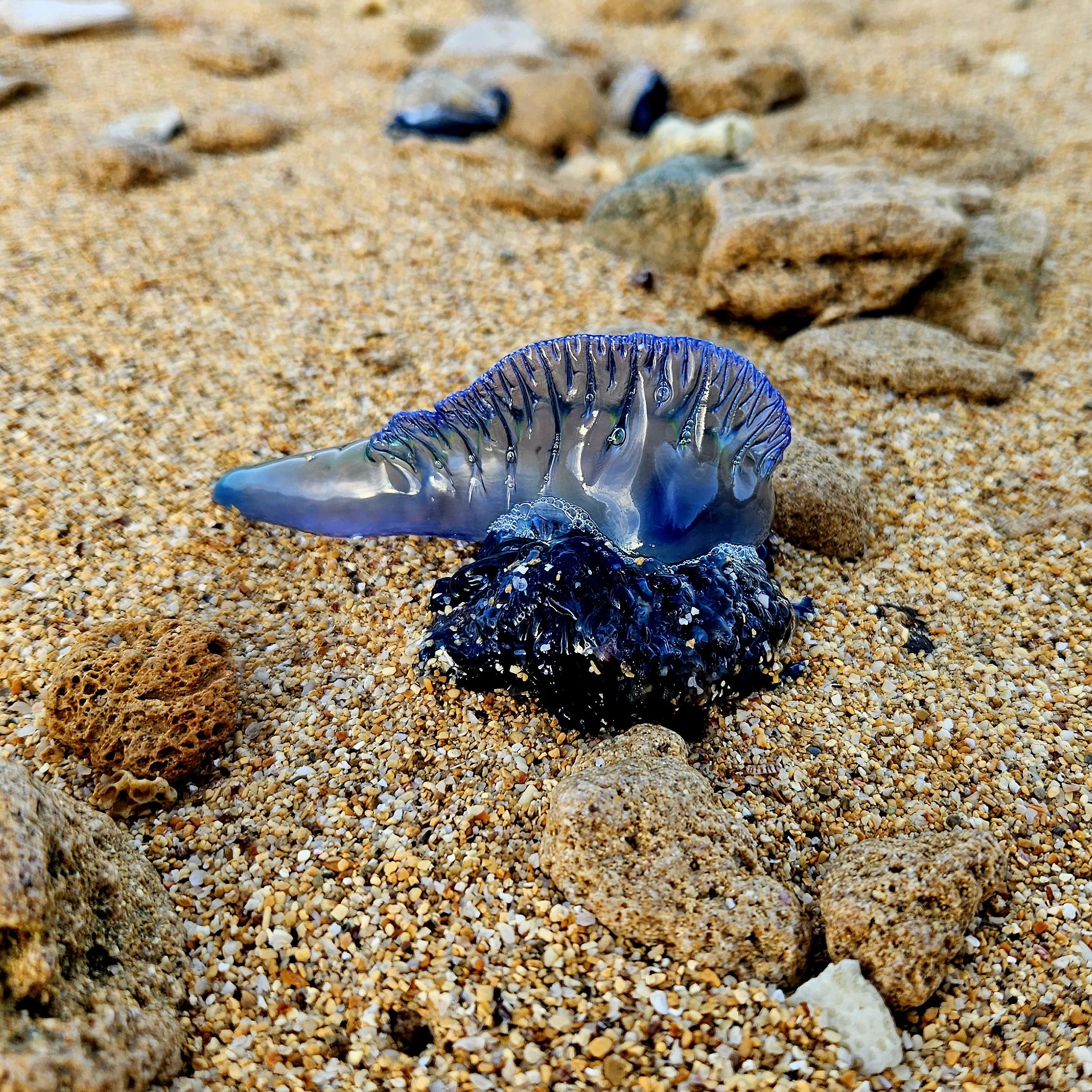
Velella velella. Emily Bay, Norfolk Island

The Elite Fleet sails in

September 19, 2026

Six years ago, I wrote the very first post on this blog about some strange little ocean travellers that had blown into Emily Bay. There were bluebottles on the beach and, underwater, more than a hundred violet sea snails, Janthina janthina, scattered across the sand. I had seen the occasional violet snail before, but never anything like that.

While trying to find out what on earth was going on, I discovered the ‘Blue Fleet’, a name used by marine biologist Sir Alister Hardy in The Open Sea in 1956 for the extraordinary collection of blue and violet creatures that spend their lives at the ocean surface. In that first post I rechristened the characters I was meeting on Norfolk Island my ‘Elite Fleet’.
Southern bluebottle, Physalia megalista

Since then I’ve seen plenty more bluebottles and occasionally another violet sea snail, but one of the better-known members of the fleet had always eluded me. Until this morning.

Among the bluebottles washed ashore were these beautiful little blue creatures with a transparent, almost glass-like sail rising from their backs – by-the-wind sailors, Velella velella.

Life at the ocean’s skin

Velella belongs to the pleuston, the remarkable community of organisms that live right at the surface of the ocean, where water meets air. Some float on or straddle that boundary, while others hang immediately beneath it. You will also see the broader term ‘neuston’ used for this surface community – the terminology has varied over the years – but the important bit is that these animals have evolved to make the ocean’s surface their home.

The ‘fleet’ is not a fixed little flotilla that cruises around the ocean together. Its familiar members include bluebottles (Physalia – ours here seem to be the southern bluebottle, Physalia megalista), by-the-wind sailors (Velella), blue buttons (Porpita), violet snails (Janthina) and blue dragons such as Glaucus. They come from quite different branches of the animal kingdom and may appear together or separately, depending on currents, winds and where their drifting lives have taken them.

They also eat each other, which rather ruins any notion of a happy little fleet sailing the seas in company. Violet snails and blue dragons are among the predators of Velella, so when I found all those Janthina back in 2020 I had actually met one of the hunters before I ever saw its prey.

Above and right, violet sea snails, Janthina janthina, Norfolk Island

So what exactly is a by-the-wind sailor?

Despite appearances, the familiar Velella we see floating at the surface is not a true jellyfish. It is a colonial hydrozoan, a relative of jellyfish and of corals within the Cnidaria. Velella is a genus containing just one recognised species, Velella velella. Like other cnidarians, Velella has stinging cells, or nematocysts, which it uses to capture tiny prey. Unlike a bluebottle, however, its sting is generally too weak to cause any significant reaction in people.

While it looks like one animal it is actually a highly integrated colony. Beneath its oval float are specialised polyps, or zooids, with different jobs. Some feed, some are involved in reproduction, and others carry the stinging cells used to capture tiny prey. The colony has a gas-filled float to keep it at the surface and that unmistakable stiff, transparent sail above it.

The name ‘by-the-wind sailor’ is quite literal. Wind catching the sail helps carry Velella across the ocean, although it does not simply travel straight downwind. The shape and angle of the sail cause it to move at an angle to the wind, and there are mirror-image forms whose sails are angled in opposite directions. What I find fascinating is that scientists have even put Velella models in wind tunnels to work out how they sail – exactly the sort of research rabbit hole I love!

Velella velella. Emily Bay, Norfolk Island

When winds and currents bring large numbers towards land, strandings can be spectacular. Recent research on the US west coast has documented repeated pulses of Velella, with wind patterns playing an important role in transporting offshore populations towards shore.

There is another twist too. Although the floating colony is not itself a jellyfish, Velella has a surprisingly complicated life cycle and produces enormous numbers of minute medusae – tiny free-swimming jellyfish-like stages only about a millimetre across. In one study, colonies released hundreds to more than a thousand of these tiny medusae during short laboratory observations. There is still plenty we do not know about what happens during parts of their life at sea.

That is perhaps what I like most about the Elite Fleet. These creatures are easy to dismiss as bits of blue stuff blown onto the beach, but they belong to an entire ecosystem sitting on one of the thinnest and strangest habitats on Earth – the skin of the ocean.

Back in December 2020 I finished my first blog post by saying I would look out for the fleet the next time the wind and currents conspired to blow them into Norfolk Island. It took nearly six years, but this morning a new member finally sailed in.


References

  • Francis, L. (1991). Sailing downwind: Aerodynamic performance of the Velella sail. Journal of Experimental Biology, 158, 117–132. https://doi.org/10.1242/jeb.158.1.117

  • Hardy, A. C. (1956). The open sea: Its natural history. Part I: The world of plankton. Collins.

  • Helm, R. R. (2021). Natural history of neustonic animals in the Sargasso Sea: Reproduction, predation, and behavior of Glaucus atlanticus, Velella velella, and Janthina spp. Marine Biodiversity, 51, 99. https://doi.org/10.1007/s12526-021-01233-5

  • Helm, R. R. (2024). Animal evolution at the ocean’s water-air interface. Current Biology, 34, R54–R58. https://doi.org/10.1016/j.cub.2023.11.013

  • Purcell, J. E., Milisenda, G., Rizzo, A., Carrion, S. A., Zampardi, S., Airoldi, S., Zagami, G., Guglielmo, L., & Boero, F. (2015). Digestion and predation rates of zooplankton by the pleustonic hydrozoan Velella velella and widespread blooms in 2013 and 2014. Journal of Plankton Research, 37(5), 1056–1067. https://doi.org/10.1093/plankt/fbv031

In Molluscs, Cnidaria, Ecosystem, Biodiversity Tags Pleuston, elite fleet, blue fleet, bluebottles, Velella, Janthina janthina
In a nutshell – where I stand on the proposed Norfolk Island Marine Park →
Featured
The Elite Fleet sails in
September 19, 2026
The Elite Fleet sails in
September 19, 2026

Nearly six years ago, my very first blog post was about the strange blue and violet creatures that live at the ocean’s surface – a group I christened Norfolk Island’s ‘Elite Fleet’. Since then I’ve seen plenty of bluebottles and the occasional violet sea snail, but never a by-the-wind sailor. Until this morning. Velella velella is not a true jellyfish, but a colonial hydrozoan with a transparent sail that lets the wind help carry it across the ocean. So what exactly is this extraordinary little creature, how does it ‘sail’, and what connects it to the rest of the fleet?

Read more →
September 19, 2026
In a nutshell – where I stand on the proposed Norfolk Island Marine Park
September 18, 2026
In a nutshell – where I stand on the proposed Norfolk Island Marine Park
September 18, 2026

I support the proposed expansion of Norfolk Marine Park and its renaming as Norfolk Island Marine Park. There is much to welcome – strong offshore protection, no mining, and recognition of the importance of sustainable local fishing. But I also have some reservations. Why does Cascade need to be removed from the Marine Park at all? How will more than 430,000 km² actually be monitored and enforced? How do we make sure Norfolk people have a genuine role in management? And, above all, how do we ensure that the enormous new park does not draw attention away from the small, stressed reef immediately beside us?

Read more →
September 18, 2026
No seagrass, but plenty of turtles
September 13, 2026
No seagrass, but plenty of turtles
September 13, 2026

Norfolk Island does not have seagrass, although one of our most conspicuous green algae is often mistaken for it. Feather and grape Caulerpa can both form striking patches across the lagoon. I take a closer look at what Caulerpa actually is, why it is so easily confused with seagrass, and where our green turtles fit into the story.

Read more →
September 13, 2026
Watching El Niño from Norfolk Island
September 6, 2026
Watching El Niño from Norfolk Island
September 6, 2026

El Niño is strengthening across the Pacific, but that does not tell us exactly what the coming months will bring to Norfolk Island. After a long wet spell, I am watching our rainfall and water supplies more closely again – and, underwater, keeping an eye on sea temperature, algae, coral recruits and the fish that turn up on the reef.

Read more →
September 6, 2026
What the world’s reefs are telling Norfolk Island
September 2, 2026
What the world’s reefs are telling Norfolk Island
September 2, 2026

Two major new coral reef reports carry a clear message for Norfolk Island: reefs can recover when pressures ease, but the time available for recovery is shrinking. Norfolk Islanders were raising concerns about water quality, runoff and the health of Emily and Slaughter Bays nearly forty years ago. Today we have much better science, a changing climate and a far clearer understanding of how closely the catchment and reef are connected. This article looks at what that means for water quality, long-term monitoring, dredging and how we manage Kingston from land to sea.

Read more →
September 2, 2026
When the map changes
August 25, 2026
When the map changes
August 25, 2026

A fish once thought to belong only to Norfolk turns up elsewhere; another appears here hundreds of kilometres beyond its known range. Cardinalfishes and a Sabre squirrelfish show how our maps of species distributions are revised.

Read more →
August 25, 2026
Endemic, native, undescribed – what do these words actually mean?
August 24, 2026
Endemic, native, undescribed – what do these words actually mean?
August 24, 2026

A Norfolk chromis that turned out not to be Chromis fumea, a blenny found nowhere else, and a tiny goby that may not yet have a name. A look at what we mean by native, endemic, undescribed and newly described – and why scientific names sometimes change.

Read more →
August 24, 2026
What’s grazing in the green stuff?
August 16, 2026
What’s grazing in the green stuff?
August 16, 2026

A proliferation of Bryopsis on the reef has brought some beautiful little underwater grazers with it. I follow the trail from sap-sucking sea slugs and egg masses to a bigger question – why is there so much Bryopsis around at the moment?

Read more →
August 16, 2026
The clam beneath Emily Bay
August 8, 2026
The clam beneath Emily Bay
August 8, 2026

I’ve seen the beautiful shells of Laciolina chloroleuca in Emily Bay for decades, but I’d never really stopped to wonder where the living animals were. It turns out they may be buried half a metre beneath the sand. A closer look at an easily overlooked clam, its extraordinary shell markings, and the hidden life beneath our lagoon.

Read more →
August 8, 2026
Reflections of an accidental marine scientist
August 1, 2026
Reflections of an accidental marine scientist
August 1, 2026

What I thought would be a steady plod towards retirement, with plenty of time spent nursing grandchildren, was abruptly upended exactly six years ago today. This is the story of how an environmental catastrophe changed the course of my life – and led me to reinvent myself. It is a reflection on how, and why, I became an accidental marine scientist.

Read more →
August 1, 2026

Latest Posts

© 2026 All rights reserved.