
When I first began photographing Norfolk Island’s reef in January 2020, I had absolutely no idea where it would lead. I simply photographed things that caught my eye. A beautiful coral, an interesting fish, something unusual growing on a rock. I would come home, upload my photos and start searching online for something that looked like what I’d photographed.
Gradually, I began noticing subtle changes in the coral-scape, so I’d take another photograph of a colony I’d already recorded to compare. Some colonies became favourites, and whenever I passed them I’d grab another quick photo.
I also began noticing patterns in fish habitats, behaviour and activity, the underwater seasons, how different algae waxed and waned, and how corals changed colour at different times of the year.
Then I began seeing the early signs of coral disease. This gave me another reason to keep returning – to follow its progression, see what happened to the affected areas afterwards, and discover what those same patches of reef looked like several years later.
Six years on, I have accidentally assembled a collection of photographs documenting what has happened to many of these individual corals and their neighbours.
Coral reefs are dynamic environments. Corals grow, compete for space, reproduce, become sick, recover and die. Storms rearrange things. Algae come and go. New organisms settle and establish themselves. Change is a normal part of reef life, and it isn’t necessarily all bad. Reefs can certainly be resilient and recover. But looking back through my photographs, I find it increasingly difficult to escape the conclusion that, gradually and inexorably, the reef I have come to know is deteriorating.
These photographs weren’t collected as part of a systematic scientific survey. They can’t tell us how much coral has been lost across the entire lagoon. But they certainly show what has happened to the individual colonies I’ve been following, and some of their stories are quite remarkable.
This is the first in a series of six blog posts drawing on just a small part of my photographic archive. Putting these articles together has been both instructive and sad. I’ve made a point of including the encouraging stories – the corals that have grown, survived or recovered – but sadly, among the sequences I’ve assembled, there are fewer of those than I would have liked. And not all the stories are about corals and algae. There is also a post about some of our charismatic individual fish, long-lived anemones, resident turtles and more.
Three old neighbours – Paragoniastrea and Montipora
6 March 2021
23 September 2026
I remember exactly why I first photographed these three Paragoniastrea colonies in March 2021. They were tucked into that encrusting Montipora, and all three were different colours! At the time, I hadn’t realised that neighbouring colonies of the same kind of coral could look so different.
I kept photographing them whenever I passed, and over the years something else became apparent. The extensive sheets of living Montipora surrounding them were gradually disappearing. By September 2026, much of that Montipora had gone, leaving exposed substrate and areas colonised by algae. But the three colourful Paragoniastrea colonies were still there, providing wonderful reference points for how dramatically their surroundings had changed.
Someone seeing this patch of reef today would have no idea how much living coral once surrounded them.
A coral that may be unique to Norfolk Island
4 June 2021
28 August 2026
These two magnificent boulder corals, sitting side by side in Emily Bay, were among the first to catch my eye when I began taking underwater photographs. In 2021, coral taxonomist Professor Andrew Baird became interested in them after finding photographs on my website. He believes they almost certainly represent an undescribed species, possibly endemic to Norfolk Island. For the moment, he suggested calling it Lobophyllia recta sensu Veron.
I’ve continued photographing it, and these images span more than five years. I still don’t know of any other colonies of this particular coral species inside the lagoon. Maybe there are some outside around the island. We just don’t know.
I’ve already told its rather interesting identification story in You may call this beauty ‘Lobophyllia recta sensu Veron’.
The coral that told me when spawning was happening
27 December 2021
11 December 2025
15 January 2023
11 July 2026
This particular coral had another interesting role. When coral spawning was underway, it was one of the places where I regularly noticed fish gathering and behaving differently. There would be a frenzy of activity as fish, mainly the omnivorous multispine damselfish (Neoglyphidodon polyacanthus) pecked at its polyps for food. In fact, there have been occasions when their behaviour alerted me to a spawning event before I’d seen any other evidence of it.
Sadly, the coral itself has deteriorated considerably since those earlier photographs. Much of what was once living coral is now occupied by algae, and the fish activity I used to associate with spawning events has been noticeably absent.
It’s one of those examples where the photographs tell two stories – the changing condition of the coral and the animals that interact with it.
Green Mountain – a very old acquaintance
23 May 2020
10 October 2026
I’ve photographed this distinctive lime-green coral in Slaughter Bay since 2020, and its changing fortunes have fascinated me. In my database I refer to it as ‘Green Mountain’.
What makes this one particularly interesting is that its documented history goes back much further than my photographs. Through some archival detective work, I discovered that it had been recorded in 1984, mapped again in 1989 and described as ‘still thriving’ in March 1992. So this is a coral that has been part of the reef for at least four decades.
My own photographs show that it has experienced periods of disease, tissue loss and recovery. It has certainly had its ups and downs, and its present condition isn’t particularly encouraging. But it is still there. I’ve written about its fascinating history and the dusty torn scrap of paper that alerted me to its longevity in The lime-green coral in Slaughter Bay – a 40-year paper trail.
Now you see them, now you don’t
31 August 2023
14 July 2026
Sometimes it’s the smaller changes that are easy to overlook. Compare these photographs from August 2023 and July 2026. The larger corals in the background are still recognisable, and at first glance the reef might not look particularly different. But look at the foreground. The beautiful little Pocillopora colony and its neighbouring Montipora have disappeared. One visit they were there; the next time I returned, both had gone.
If you hadn’t seen the earlier photograph, you would have no reason to know they had ever been there.
A Paragoniastrea losing ground
18 May 2022
Corals don’t just compete with algae. They also compete with one another for the limited space available on a reef.
I’ve been watching this Paragoniastrea since May 2022. Over the following four and a half years, the neighbouring Montipora has gradually expanded around it, encroaching on the space occupied by the brain coral. While the Paragoniastrea is still alive, its neighbour appears to be gradually gaining the upper hand.
I find these slower interactions particularly interesting. There isn’t necessarily a dramatic moment when something happens. Instead, the changes become apparent when you compare photographs taken years apart.
Growing old together
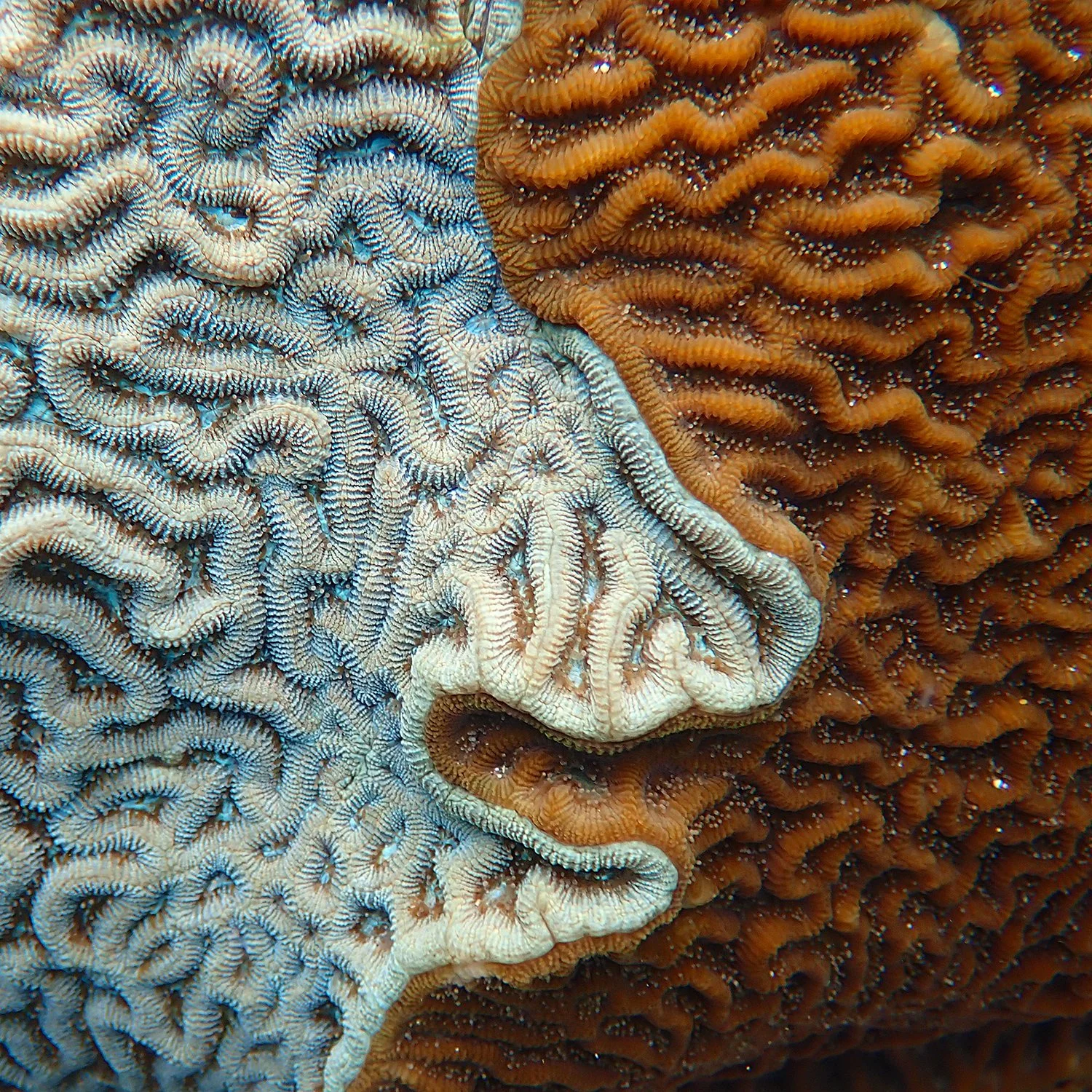
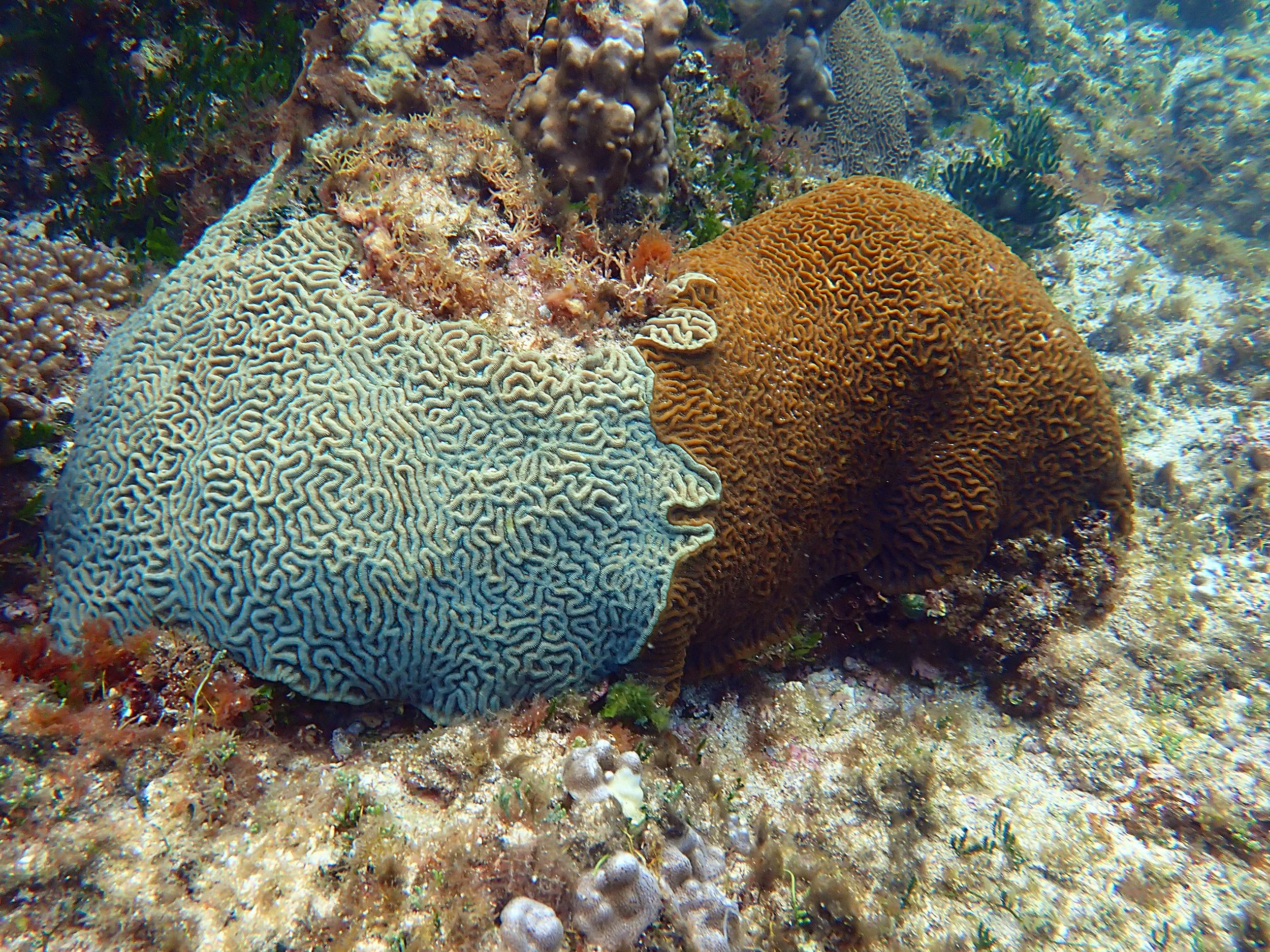
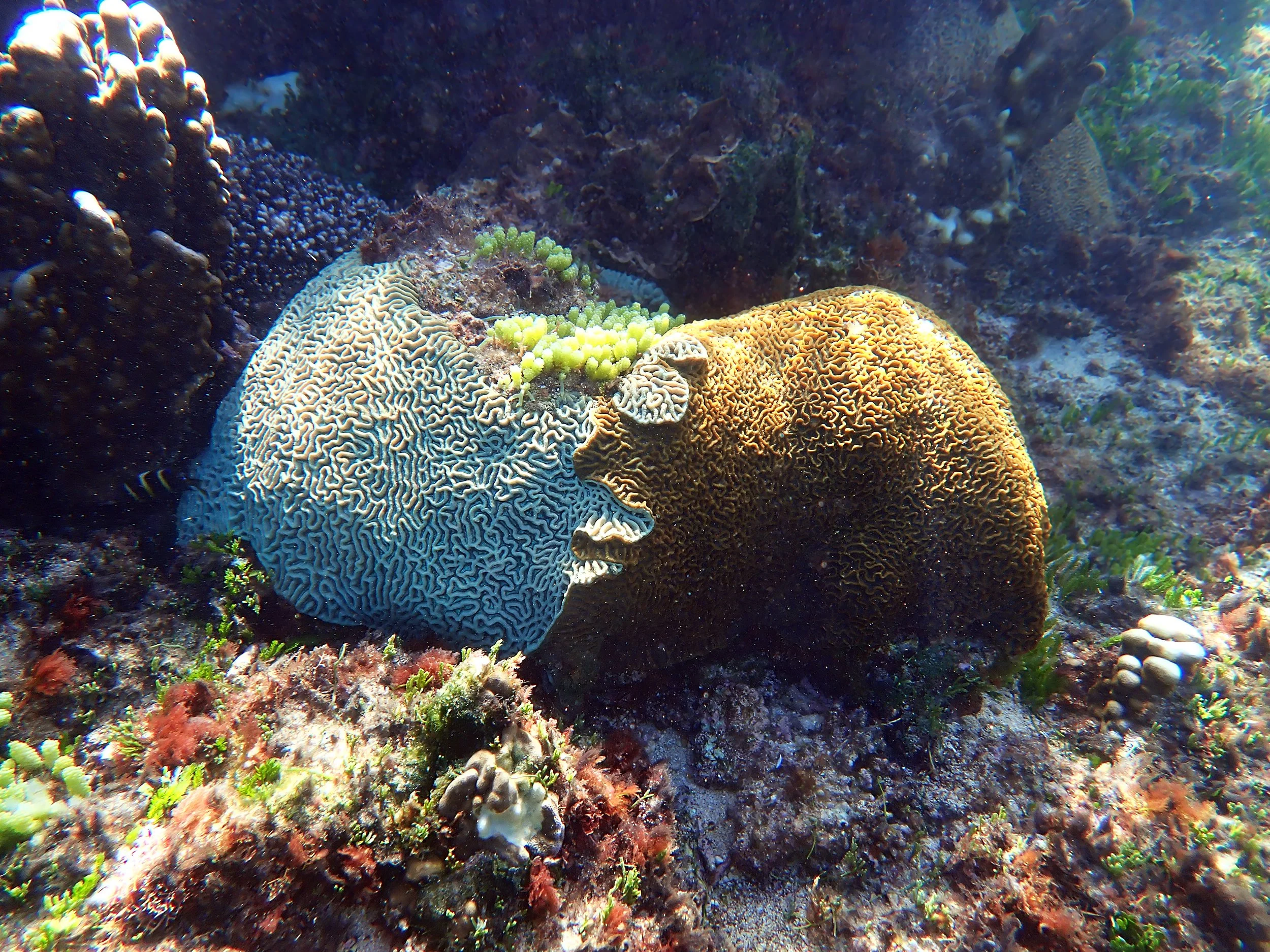
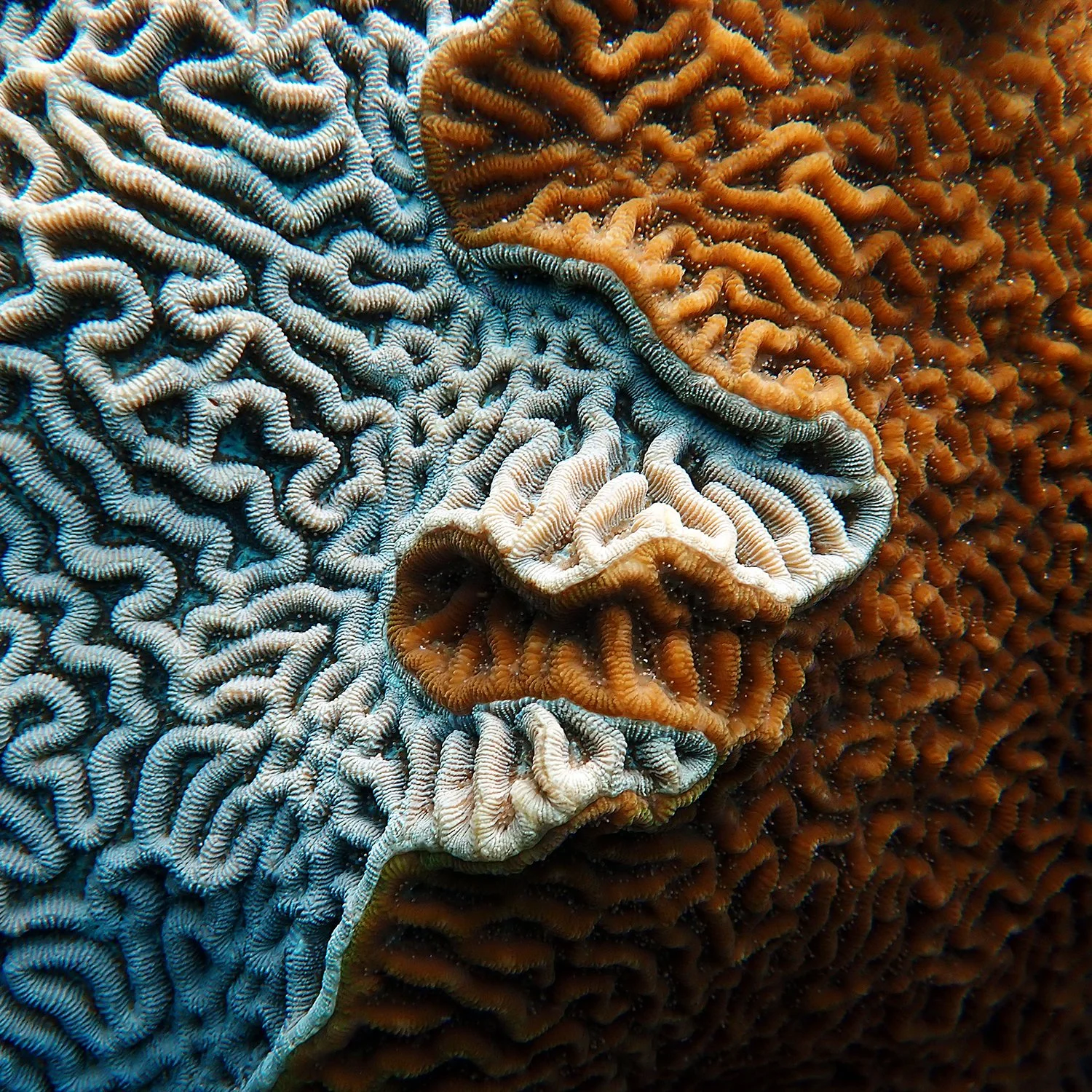
And then there are these two differently coloured Paragoniastrea corals, growing together in the most extraordinary arrangement.
I’ve been photographing them since November 2021, and what strikes me is how little their overall appearance has changed. They are remarkably slow-growing compared with some of the Acropora and Montipora colonies elsewhere in the lagoon. Research on Paragoniastrea australensis in subtropical Moreton Bay has recorded growth of around 6 mm a year. I don’t know how quickly these particular colonies are growing, but judging from my photographs, they’re certainly taking their time!
The close-up photographs show the beautiful folds and intricate boundary where the two meet. I’ve previously written about how neighbouring coral colonies can sometimes fuse, creating fascinating living mosaics. You can read more in Patchwork Corals: How Colonies Fuse to Form Living Mosaics.
These two have become another familiar landmark on my swims, quietly going about their business while everything around them changes.
Looking back
There’s a concept in environmental science called ‘shifting baseline syndrome’. In simple terms, we tend to accept the environment we first encounter as normal, without necessarily knowing what has already been lost.
My earliest photographs, taken in 2020, certainly don’t represent a pristine reef. Norfolk Island’s lagoon had already experienced a long history of environmental pressures by then. But those early photographs have become a reference point of their own. They show corals that have since disappeared, others that have grown, and some that have survived repeated setbacks. Someone visiting the lagoon today might see a perfectly ordinary-looking patch of reef without realising what occupied that same space just a few years ago.
Of course, not everything has deteriorated. Some of the corals I’ve followed have grown spectacularly, others have recovered from bleaching or physical damage, and some have barely changed at all.
Over the next few articles, I’ll share more of these individual histories – the growth, the storms, the disease and the changing algal communities. And I’ll introduce you to some of the other familiar faces I’ve been following underwater.
When I look back at that first year with my new underwater camera, I’m rather glad I kept photographing the same things. Not because I knew they would become important, but simply because I liked them enough to go back and have another look.