• Home
    • Algae
    • Corals
    • Eels
    • Everything Else
    • Kingston, Norfolk Island
    • Nudibranchs, Sea Slugs and Flatworms
    • Octopuses
    • Out On A Swim Index
    • Reef Fish
    • Sharks
    • Sea Anemones
    • Sea Stars
    • Sea Urchins and Sea Cucumbers
    • Turtles
    • Underwater
    • Videos
  • Out on a swim - blog
  • About
  • Contact + Subscribe
Menu

Norfolk Island's Reef

Discover a fragile paradise – Norfolk Island's beaches, lagoons and coral reef
  • Home
  • Explore
    • Algae
    • Corals
    • Eels
    • Everything Else
    • Kingston, Norfolk Island
    • Nudibranchs, Sea Slugs and Flatworms
    • Octopuses
    • Out On A Swim Index
    • Reef Fish
    • Sharks
    • Sea Anemones
    • Sea Stars
    • Sea Urchins and Sea Cucumbers
    • Turtles
    • Underwater
    • Videos
  • Out on a swim - blog
  • About
  • Contact + Subscribe

Out on A Swim

‘Out on a swim’ is a coral reef blog that tells the stories of the characters who live under the waves and what has caught my eye when ‘out on a swim’ in the lagoons of Norfolk Island. It is also a record of the difficulties Norfolk Island’s reef faces, like many others around the world, as a result of the poor water quality that has been allowed to flow onto it.

This page shows the most recent blog posts. For the complete catalogue, visit the ‘Out on a swim index’ page.

This blog is rated in the Top 20 Coral Reef Blogs in the world.

No results found

Snubnose dart

Winter snorkelling on our reef

August 17, 2021

This week there has been some amazing, settled winter weather, the kind that makes Norfolk Island just sparkle and sing. And underwater was no different. Low, low tides associated with a new moon and quite good visibility have meant that my swims have been a delight.

This week, I was fortunate enough to see the male snubnose dart, Trachinotus blochii, cruising with his two female companions off the Salt House with a school of mullet. I am hoping this bodes well for some bubba darts in the coming summer season!
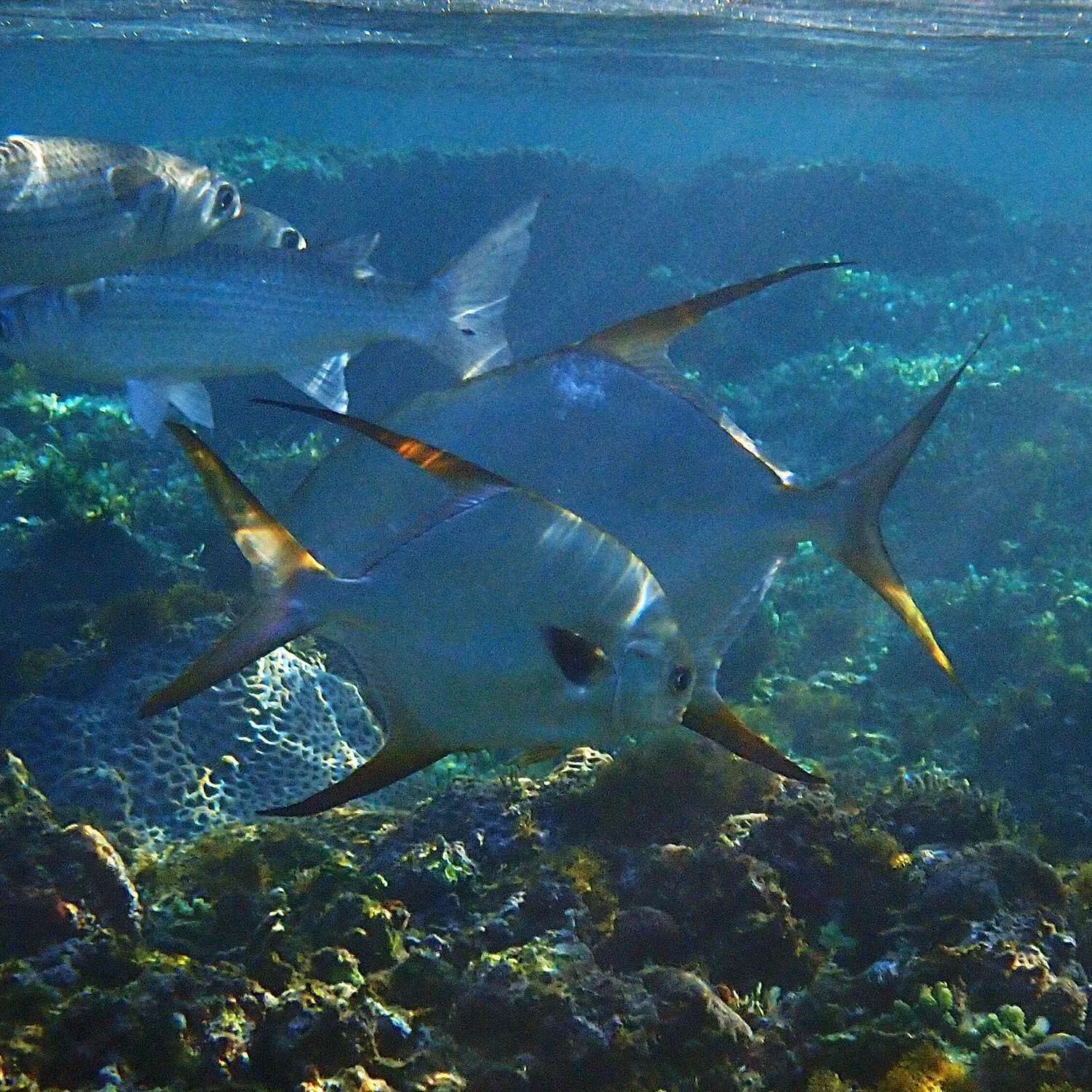
View fullsize Snubnose dart - Trachinotus blochii
Snubnose dart - Trachinotus blochii
View fullsize Snubnose dart - Trachinotus blochii
Snubnose dart - Trachinotus blochii
View fullsize Snubnose dart - Trachinotus blochii
Snubnose dart - Trachinotus blochii

Bluespine unicornfish - Naso unicornis

Other highlights included the bluespine unicornfish, Naso unicornis, posing for me in the early morning light, as only these fish can, before charging at me in a game of ‘call my bluff’. These guys are such show ponies! You can read about how unicornfish are so important to the health of a reef in an earlier blog post.

I also came nose to nose with our old resident female southern eagle ray, Myliobatis tenuicaudatus, with her distinctive stumpy tail, along with a brand new juvenile that I haven’t seen before in the shallows of Emily Bay. I photographed a pair courting inside Emily Bay back in December 2020. I wonder if this juvenile is the result (photos below).

But the one sighting that excited me beyond anything else was a teeny tiny juvenile blacktip morwong, Cheilodactylus francisi, on the Lone Pine side of the bay. This little fish, barely 1.5 to 2 cm in length, seemed unconcerned as I hovered over it trying to get a decent photo. I have only seen one of this species of fish in the bay, an adult, that lives in a very defined area, so it was a real treat to see what I have to assume is one of its progeny.

View fullsize Southern eagle ray - Myliobatis tenuicaudatus
Southern eagle ray - Myliobatis tenuicaudatus
View fullsize The new juvenile southern eagle ray
The new juvenile southern eagle ray
View fullsize This was taken in December 2020
This was taken in December 2020
View fullsize Blacktip morwong - Cheilodactylus francisi
Blacktip morwong - Cheilodactylus francisi
View fullsize Atagema spongiosa
Atagema spongiosa

I found a new species (to me) of sea slug in the bay as well, which is always exciting (photo above right), Atagema spongiosa.

And each time I was out I saw both resident green sea turtles snoozing in the channel, a couple of times within just a few metres of each other. They seem happy to take life in the slow lane for the time being and don’t swim off when I pause to observe them.

Today the weather has turned, with plenty of rain and blustery winds – more like the weather you would normally associate with winter.

That’s a wrap.

Tags snubnosed dart, Bluespine unicornfish, blacktip morwong, Atagema spongiosa, Green sea turtle, Southern Eagle Ray
← When corals go blue!The importance of sea urchins →
Featured
A shrimp storm
May 28, 2026
A shrimp storm
May 28, 2026

While setting my research cams last week, I swam into what looked like an underwater snowstorm. It appeared to be the aftermath of a mass moulting event, with large numbers of tiny, translucent shrimp-like exoskeletons drifting together near the surface.

May 28, 2026
Kingston dredging: what happens when a reef does not fit the framework
May 28, 2026
Kingston dredging: what happens when a reef does not fit the framework
May 28, 2026

This correspondence with DCCEEW is about more than one dredging proposal. It is about what happens when an ecologically distinctive place is assessed through standard tools that do not always make its most important values easy to see. I am publishing it here because that is something we need to be aware of, both on Norfolk Island and more broadly in Australia.

May 28, 2026
Kingston dredging: the project advances, the questions remain
May 24, 2026
Kingston dredging: the project advances, the questions remain
May 24, 2026

Kingston dredging is edging closer, and the paper trail is growing. This post brings together earlier correspondence with the Department and the latest media release so readers can see what has been asked, what has been answered, and what still remains unclear about the project, its rationale, and the protections proposed for the reef.

May 24, 2026
The lime-green coral in Slaughter Bay – a 40-year paper trail
May 17, 2026
The lime-green coral in Slaughter Bay – a 40-year paper trail
May 17, 2026

Green Mountain – the name I give this coral in my database – is a coral I’ve photographed for years as I swim past. Then I found its backstory in the Norfolk Island National Parks archives: a rough map, reused paper, a note in the margin – ‘still thriving’. That’s how baselines begin.

May 17, 2026
What Norfolk Island’s reef tells us about environmental blind spots
April 5, 2026
What Norfolk Island’s reef tells us about environmental blind spots
April 5, 2026

The Kingston dredging proposal on Norfolk Island raises a bigger question than dredging alone: how well do standard environmental assessment tools capture the real significance of a remote and unusual reef system like Norfolk Island’s?

April 5, 2026
Hammer coral time!
March 30, 2026
Hammer coral time!
March 30, 2026

Hammer corals have unique tentacles that are large, fleshy, and tubular; these terminate in a ‘T’-shaped, hammer-head or anchor. Beneath all these softly waving tentacles is an extraordinary skeleton structure, which helps define them as a large polyp stony coral.

March 30, 2026
Norfolk Island’s fishes: drifters, residents and the ones still missing
March 24, 2026
Norfolk Island’s fishes: drifters, residents and the ones still missing
March 24, 2026

Norfolk Island’s fish fauna reflects both connection and isolation. Some species may arrive from elsewhere as drifting larvae, some populations appear to persist locally, and some fishes known from islands on either side of Norfolk have still not been recorded here. This post looks at what old survey work, regional checklists and genetic studies suggest about that more complicated picture.

March 24, 2026
18 Jun 2025 (20)_crop.jpg
March 7, 2026
Alveopora or flowerpot coral – how to tell the difference
March 7, 2026

They look alike at first glance, but Alveopora and flowerpot corals are not the same. The easiest way to tell them apart is to count the tentacles.

March 7, 2026
Norfolk’s lagoonal reef – the 2025 report, in plain English
February 27, 2026
Norfolk’s lagoonal reef – the 2025 report, in plain English
February 27, 2026

We now have the 2025 Norfolk Island reef health report, so I’m taking the opportunity to translate it into plain English here. Sadly, it’s more of the same story in Emily and Slaughter Bays – a reef that can cope with some stress, but is being asked to cope with too much, too often.

February 27, 2026
Halimeda’s night shift – why this reef algae changes colour
February 20, 2026
Halimeda’s night shift – why this reef algae changes colour
February 20, 2026

Halimeda is a calcareous green reef alga that forms new segments overnight, shifts from white to bright green by dawn, then pales again as calcification begins. A quick look at one of the reef’s smartest algae.

February 20, 2026

Latest Posts

© 2026 All rights reserved.