
This week I photographed some beautiful bivalve shells lying on the sand in the waters of Emily Bay. I know the species – Laciolina chloroleuca – because I’ve found its shells here before. In fact, I have examples at home, shown on this post, that I collected from Emily Bay back in the 1990s.
*Please read my note about the no-take zone and collecting shells from the Kingston lagoon, below.
Over the years, whenever I’ve seen one of these empty shells, I’ve assumed they were probably the remains of an octopus meal. That seemed a reasonable enough conclusion. After all, octopuses eat molluscs and I regularly see these discarded shells around Emily.
The shells are usually found in the sort of soft sediment that is the natural habitat of Laciolina chloroleuca. After speaking with mollusc researcher Dr Richard Willan, who has been studying Norfolk Island molluscs since 1992, I now have a much better idea of what is going on beneath the sand. Laciolina chloroleuca is a member of the Tellinidae – the tellins, sunset, or wafer clams. At up to around 100 millimetres long, this is one of the larger species in what Richard tells me is the most species-rich family of bivalves in the world.
The shells themselves are very pretty – smooth, thin and pale, with pinkish-orange or rose-red rays spreading out towards the outer edge. Some also have areas of darker, smoky colouration as you can see from the photographs of the ones I collected in the 1990s. More on those in a moment.
Richard says dead shells of Laciolina chloroleuca are relatively common along the southeastern side of Norfolk Island, from Slaughter Bay through Emily Bay and towards Cemetery Bay, although my experience more recently has been that they are largely confined to Emily. But what makes the animal particularly interesting is where it lives. Like other tellinids, Laciolina chloroleuca buries deeply into the soft sediment. Richard estimates that these animals may be living about half a metre below the surface. From there, their siphons extend upwards through the sediment. The inhalant siphon works over the surface, effectively vacuuming up organic particles, while the gills act as a sieve. See below for a diagram of this mollusc family’s anatomy.
Which rather neatly explains why I have never photographed one alive.
A major disturbance – a cyclone or a particularly powerful wave surge, for example – might scour one out of the sediment and expose it at the surface. It would presumably try to rebury itself, although being dragged out of such a deep refuge would not necessarily end well. So perhaps finding a live one sitting obligingly on the sand waiting for me to photograph it is something I should not wish for too enthusiastically.
The shell’s colour pattern is fascinating in its own right. The beak is usually pale rose-pink. This is followed by an unpigmented area extending across roughly half the shell, after which numerous interrupted rose-red rays continue towards the outer margin. The interrupted nature of those rays tells us something about the way the shell was made. A bivalve grows its shell progressively at the edge of its mantle. The changing pattern therefore reflects pigment-producing mantle cells switching pigment production on and off as the shell grows.
There is another oddity. The ligament connecting its two valves is relatively weak, so when Laciolina chloroleuca dies the shells separate. Moreover, the pattern can differ between the animal’s right and left valves. Because those two valves separate so readily after death, finding both halves of the same individual is probably not something that happens very often. I’ve often looked to see if I can find matching pairs, but now I know why they’ve remained elusive! Apparently, this is unusual, because in most bivalves, pigmentation on the two valves broadly corresponds.
Then there are those darker patches.
Some of the shells I have found have smoky grey or almost black areas fanning across them. I originally wondered whether that was simply another part of the animal’s natural colour variation, but apparently this isn’t the case. In fact, Richard has not seen naturally produced ‘sooty black’ pigmentation in this species before. Instead, he thinks that the dark staining can develop after the animal has died and the shell has lain in anoxic sediment (in other words, there’s no oxygen in the sediments). Sulphur compounds in those oxygen-poor sediments interact with the shell and produce that dark colouration.
So one shell can potentially carry two different histories. The pink and red pattern is produced while the animal is alive, while the darker staining records something that happens after it dies.
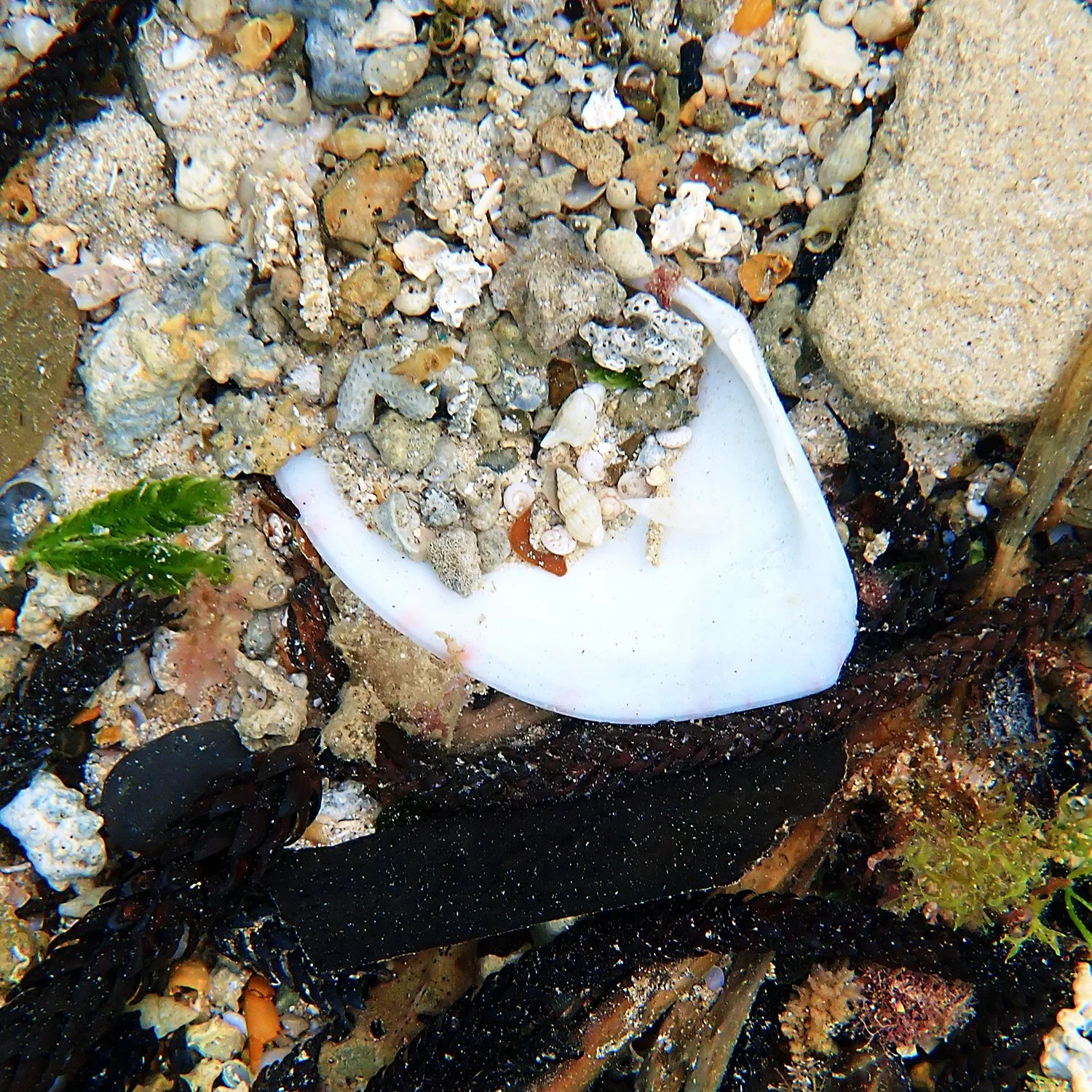
Laciolina chloroleuca shells in Emily Bay, August 2026
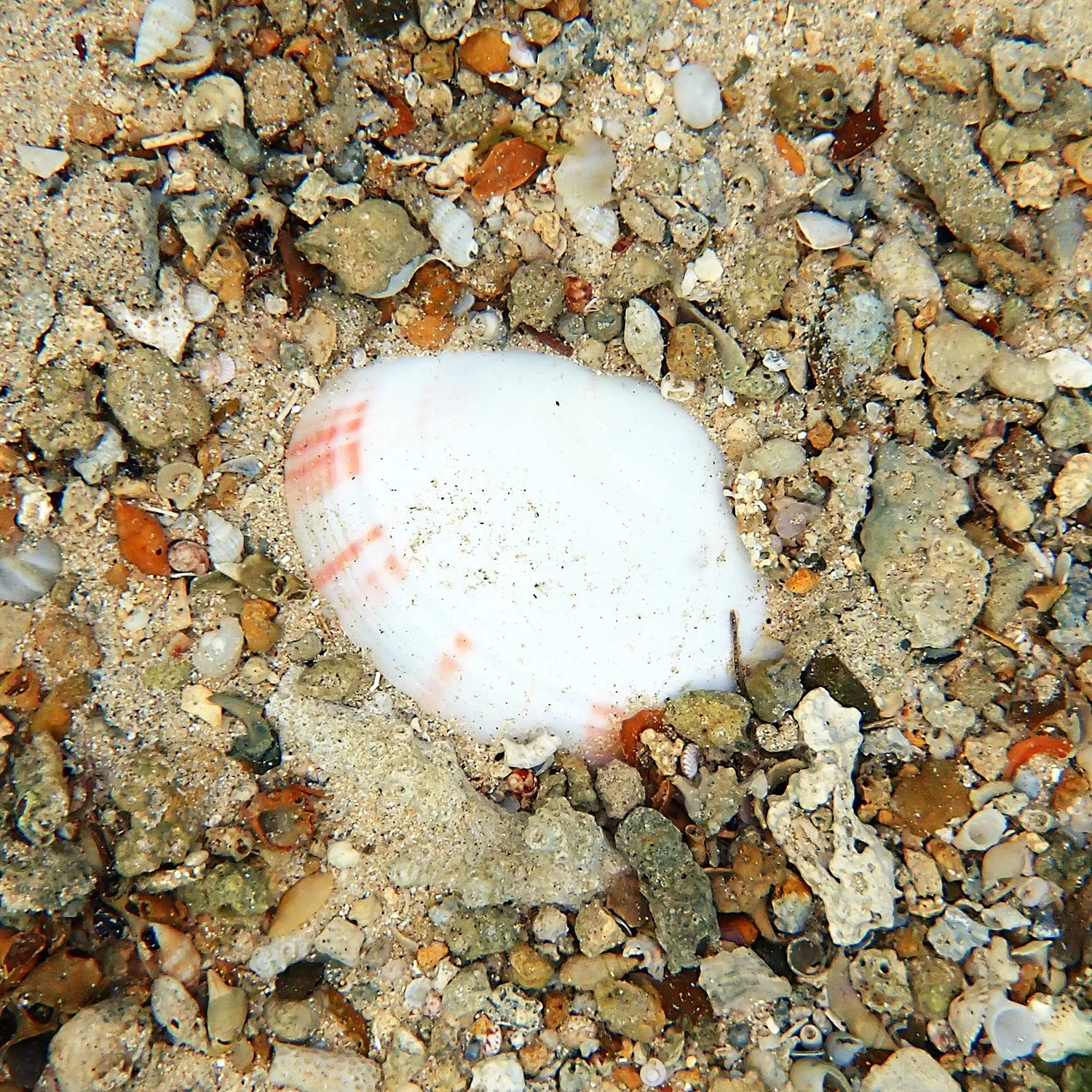
A small Norfolk Island taxonomic story
The accepted name today is Laciolina chloroleuca (Lamarck, 1818). Lamarck originally described it as Tellina chloroleuca. Norfolk Island does, however, have a small place in the species’ taxonomic history.
In 1937, Australian molluscan taxonomist Tom Iredale examined shells from Norfolk Island and considered them sufficiently different from other material to describe the Norfolk form as a separate species, Laciolina francesae. One of the Norfolk specimens he described was around 100 millimetres long.
Later taxonomic work concluded that Laciolina francesae was not a separate species after all, and it is now treated as a synonym of Laciolina chloroleuca.
Richard also thinks Iredale’s Norfolk Island reference material would almost certainly have consisted of dead shells (known by scientists as a death assemblage, or thanatocoenosis). Given the depth at which the living animals apparently occur, collecting one alive would have been quite a different proposition.
Resident or passing visitor?
Another question is whether Norfolk Island has a genuinely resident population or whether this is one of the many tropical western Pacific molluscs whose larvae occasionally arrive here on ocean currents. Richard thinks Laciolina chloroleuca is resident. His reasoning is straightforward: there have been more or less continuous records over a long period and those records involve numerous specimens. That is very different from a tropical visitor represented by one or two isolated finds before disappearing again.
He also notes that Laciolina chloroleuca occurs in the same sort of suitable soft-sediment habitat used by another Norfolk Island mollusc, our endemic Cominella norfolkensis. For the record, this rare mollusc has only been found in the Kingston lagoon and nowhere else, but it remains elusive. I need to go through my boxed shells to work out if I have any examples among the collection. Perhaps this is another story for another day.
There is no suggestion that the two animals are otherwise connected, just that habitat does not end at the surface of the reef. Different sediments support quite different communities, including animals we may almost never see. And perhaps that is what I like most about this species. I have swum over Emily Bay thousands of times. I photograph its corals, fish, algae, sea cucumbers, nudibranchs and anything else that will stay still long enough. Yet all the while, beneath what can look like an unremarkable patch of sand, there may be a large clam living completely out of sight.
So the ones I photographed this week may not be the remains of an octopus’s dinner after all. They may simply have spent years beneath the lagoon before shifting sand finally brought them back into the light.
*Please leave the shells where you find them
The older shells photographed for this post include specimens I collected from Emily Bay in the 1990s. But that should not be taken as an invitation to collect them now.
Emily and Slaughter Bays are now no-take areas, with those protections extending to the high-tide mark. The Kingston and Arthur’s Vale Historic Area is also a World Heritage area extending to that coastal boundary, where removing material is also not permitted.
So if you find Laciolina chloroleuca – or other shells – please leave them where they are.
Take photographs instead. Photograph both sides if you can and include something for scale. A shell left in place can still provide a useful record of the animals living – or once living – beneath the lagoon.
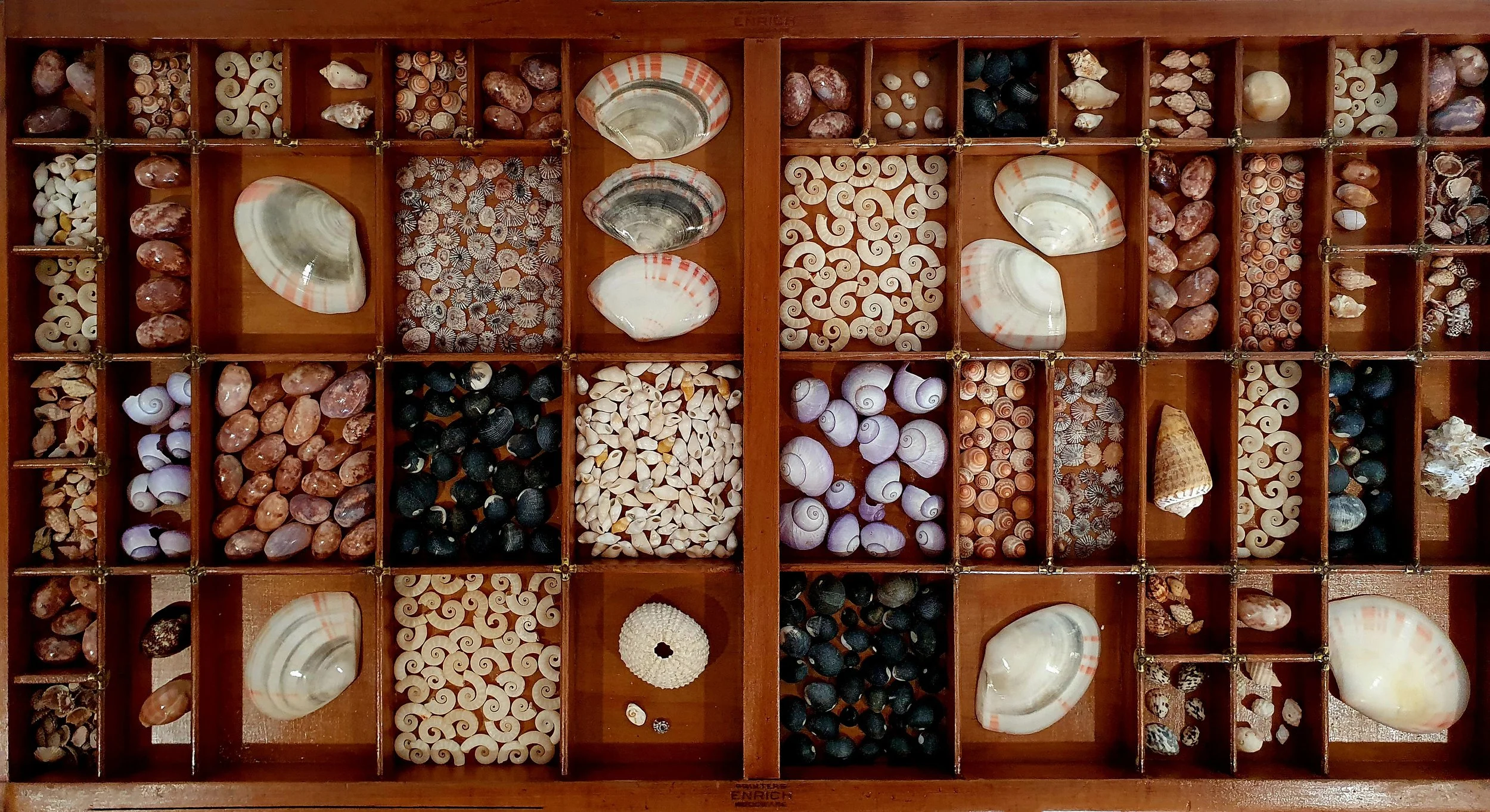
A death assemblage of shells, tests and the internal shells of the ram’s-horn squid, Spirula spirula, collected on Norfolk Island in the 1990s
The structure of a clam, taken from EduSphere Academy (Instagram @edusphereacademy1996)
Extra! For the nerds among us
Iredale’s historical diagnosis of the genus Laciolina described a shell that is:
inequilateral – the umbo is not centred
inequivalve – the two valves differ slightly
relatively smooth
somewhat inflated in the right valve [more ‘domed’]
flatter in the left valve
longer and rounded anteriorly
shorter and more beaked posteriorly
equipped with a small external ligament
furnished with relatively weak hinge teeth
characterised internally by a low pallial sinus extending approximately halfway across the valve
Richard Willan’s correspondence
From my experience going back to 1992, dead shells of Laciolina chloroleuca are indeed relatively common in the stretch from Slaughter Bay to Cemetery Bay, including the Emily Bay ‘lagoon’. Here is some information about this species for your post on this species:
At a maximum shell length of 100 mm, Laciolina chloroleuca is one of the largest species in the family of wafer clams (Tellinidae). This family itself is numerically the largest family of bivalves in the world.
All wafer clams bury deeply into soft sediments and their siphons extend to the surface of the sediment where the inhalant siphon ‘vacuums’ the sediment to extract the organic particles using its gills as a sieve. The reason that you haven’t seen a live individual (indeed nobody has!) is that they would be living buried approx. half a metre down into the sediment and only get onto the surface when they get scoured out by a major disturbance like a cyclone. Once at the sediment surface, they would try to rebury but probably die. Some smaller tellinids bury even deeper than this, but they have enormously long siphons. I don’t think the siphons of Laciolina chloroleuca are super-long judging by the impression on the shell’s interior (pallial sinus) where they are retracted. The corollary is that the specimen(s) that Iredale used to name this species (Laciolina francesae) would certainly have been dead.
The two shell valves have a relatively weak ligament connecting them and so when an individual dies, the two shell valves come apart readily.
The shell’s colouration is elaborate and interesting. The beak is almost always pale rose-pink, then there is an unpigmented zone for about half the shell’s width, then there are numerous interrupted, rose-red rays all the way out to the ventral margin. This implies that the cells of the animal’s mantle that produces these pigments is constantly ‘switching’ pigment on and off during the shell’s life. And what is particularly unusual about this species is that the pattern is different on the right and left shell valves. Normally in bivalves, the colours and patterns of pigmentation are identical on both shell valves of bivalves. None of the shells of this species I have seen have any ‘sooty black’ pigment on them. When it occurs, it indicates the shell has been lying in anoxic sediments where the sulphur in the substrate has leached into the shell’s calcium and given it this colouration. So black pigmentation is a postmortem artifact.
As regards the question whether Laciolina chloroleuca has a continuously resident population living on Norfolk Island or not, I am inclined to think it does because there are more or less continuous records and those records are of numerous specimens. So I think it’s a resident species on NI rather than vagrant populations as many other tropical western Pacific molluscan species have.
The last point is the most important ... That is Laciolina chloroleuca apparently has the same distribution on Norfolk Island as Cominella norfolkensis does. That is, it is restricted to the southeastern corner of the island because that’s where suitable sediments exist. I have not found, or heard of records, of L. chloroleuca occurring anywhere else on NI.
Sources
Huber, M., Langleit, A. & Kreipl, K. (2015). Tellinidae, in Compendium of Bivalves 2. ConchBooks.
Iredale, T. (1937). ‘Mollusca’, in ‘Middleton and Elizabeth Reefs, South Pacific Ocean’. The Australian Zoologist, 8, 232–261.
Willan, R.C., Bryce, C.W. & Slack-Smith, S.M. (2015). Historical data on the molluscs of the Kimberley region, north-western Australia. Records of the Western Australian Museum, Supplement.
Willan, R.C. Personal communication, 2026.