
Other articles in this six-part series looking back over nearly seven years
The sixth and final article in my photographic series.
Over the previous five articles, I’ve been looking back through six years of photographs documenting how Norfolk Island’s reef has changed. There have been some wonderful examples of coral growth and recovery, alongside rather more distressing sequences of disease, damage and disappearance. But throughout those six years, I’ve also been getting to know some of the animals that live here.
When you swim over the same little reef almost every day, you start recognising the regulars. Some fish have favourite territories, others appear at particular times of year, and certain animals become so familiar that I find myself checking on them whenever I’m passing. And, because I can, I’ve given quite a few of them names.
So, for this final article, I thought I’d introduce you to some of the characters I’ve come to know – some of whom are no longer with is – along with a few remarkable events I’ve been fortunate enough to photograph.
Harry, the green moon wrasse, July 2024
Harry – the boss of Emily Bay
Harry was a green moon wrasse (Thalassoma lutescens), and one of my absolute favourites.
Harry, always a character
He was the boss of the Emily Bay and channel area, a magnificent, colourful male with an extraordinary personality. Whenever I entered his territory, he’d come swimming over like an excited puppy, often circling around and around until I was quite dizzy trying to follow him with my camera. He was a real show pony!
There were times when he’d accompany me for much of my swim. I remember one particularly murky day when I couldn’t venture far out onto the reef, so I spent my time swimming along the inside reef with Harry keeping me company.
I’d been photographing him since at least November 2020, when he was already a young adult male. In July 2024, I noticed he was beginning to look a little battle-scarred and careworn, which prompted me to go back through my photographs and see how long I’d known him. Fortunately, his facial markings were distinctive enough for me to identify him in photographs taken several years apart. I’ve documented that history in Ageing colourfully. This guy!
But on 8 March 2025, something was different. Harry came swimming over as usual, but he seemed lethargic and rather pale. He stayed with me for a while before swimming away. I came home and told Brian that I thought something was wrong with Harry. That was the last time I saw him.
I kept looking for him over the following weeks and months, hoping he might reappear. But he never did. I suspect he’d reached the end of his natural life, although of course I can’t know what happened to him. It might sound rather silly to become attached to a wild fish, but after nearly five years of these encounters, I was genuinely sad to lose him.
Some months later, another terminal-phase male green moon wrasse appeared in Harry’s old ’hood. Younger, rather splendidly coloured, and accompanied more recently by a young female.
Green moon wrasses are among the reef fishes capable of changing sex from female to male, and the fully coloured mature males are known as ‘terminal-phase’ males.
So now there’s a new boss in Harry’s old territory. It will be interesting to see whether he becomes as familiar a character as his predecessor.
Harry taught me a great deal about recognising individual fish, their territories, behaviour and longevity. But perhaps the greatest pleasure was simply having this extraordinary wild animal choose to interact with me, time and again, over so many years. I still miss the old show pony.
Three snub-nose darts, 24 February 2024
A pair and a spare
Then there are my snubnose darts (Trachinotus blochii).
Norfolk Island's reef is small and intimate, and we can count the individuals of some fish species on one hand. Like our pair of snubnose darts, who always hang out together.
They are what I call ‘sometimes’ visitors. They come. They go. They seem to appear around February or March and disappear around November, although their movements aren’t entirely predictable. They usually swim together, sometimes around the Lone Pine end of Emily Bay, but more often these days in central Slaughter Bay or one of the channels leading towards the open sea.
I first photographed the original pair (for me) when they were babies (well, probably more like young teens) back in March 2020. I have no idea what sex they are, but I do know that in mid-2021 they were joined by a much larger snubnose dart, which I assumed was a male. An impressive specimen, with a streamlined body of mirrored metallic silver. It stayed with the pair for a month or so, but by October 2021, the original two were alone again.
Then, in March 2023, a third, much smaller dart appeared in the lagoon. This youngster stayed on its own for a while in the Emily Bay ‘nursery’ before finally joining the other two around February 2024.
The last time I personally saw all three hanging out together was in October 2025. By April 2026, there were just two. One of the original pair, which I’d been able to recognise over the years by a distinctive nick in its tail, had disappeared. The other original dart was now swimming with the youngster that had joined them in 2024.
We often cross paths as they process in a stately fashion across the lagoon. I love them. Always calm and collected, smooth and fluid. Very happy to pose for the camera, just going about their own business.
You can read the original story in A pair and a spare – snubnose darts on Norfolk Island’s reef.

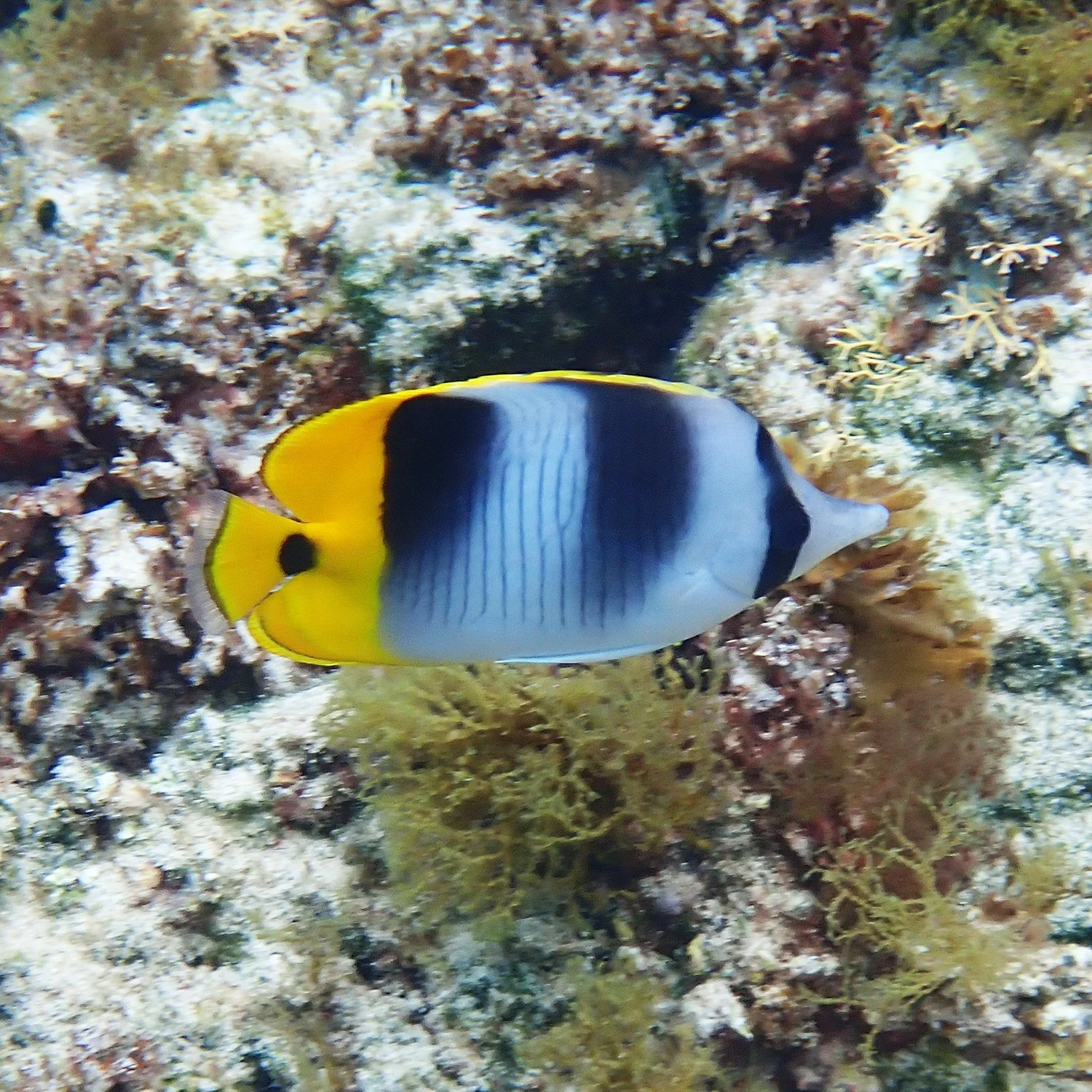


Watching the butterflyfish grow up
Two other fish I’ve become particularly fond of are rather less common in our lagoon.
I first photographed a juvenile Pacific double-saddle butterflyfish (Chaetodon ulietensis) in April 2023. Then, in April 2024, I found a juvenile eclipse butterflyfish (Chaetodon bennetti), sometimes called the bluelashed butterflyfish.
Both were new records for Norfolk Island’s reef when I added them to iNaturalist and had their identifications verified. Neither species is particularly abundant here. In fact, I know of only a handful of individuals of either species, and I’ve continued seeing these fish in the same general neighbourhoods as they’ve grown.
I’m fairly confident that the larger fish I’ve photographed more recently are the same individuals I first encountered as juveniles. Of course, I can’t prove it in quite the same way I can with Harry’s distinctive facial markings. But given how uncommon they are, and how consistently I find them in the same places, I think it’s a reasonable interpretation.
It’s one of the things I particularly love about swimming on such a small reef. You can watch individual fish grow up, learn where they hang out, and become familiar with their habits.
And occasionally, when you look back through the photographs, you realise you’ve been watching the same little fish for several years.
Haddon’s anemone, 10 March 2024
Haddon’s anemone, 6 July 2024
Haddon – my underwater barometer
Not all my familiar faces are fish.
One of my oldest acquaintances is a Haddon’s sea anemone (Stichodactyla haddoni) that lives in the middle of Emily Bay.
He’s a rather unassuming fellow, sitting in about three metres of water and frequently overlooked by swimmers heading out towards the reef. I first photographed him in February 2020, although the quality of that photograph leaves a great deal to be desired. I was still learning how to use my underwater camera!
Since then, I’ve returned to photograph him repeatedly, partly because he’s such a reliable landmark, and partly because his appearance changes so much. Haddon has a remarkable habit of bleaching and subsequently recovering his colour. Over the years, I’ve watched him become very pale before gradually returning to his familiar brownish appearance.
Sea anemones, like corals, have microscopic algae living within their tissues, and changes in those algae can affect their colour. Bleaching can occur in response to environmental stress, including elevated temperatures and changes in salinity.
What particularly interested me in 2025 was that Haddon appeared bleached unusually early in the season, following a long period of heavy rainfall. I couldn’t establish what caused it, but the sequence raised some interesting questions.
I’ve put together a substantial photographic history in Haddon’s barometer.


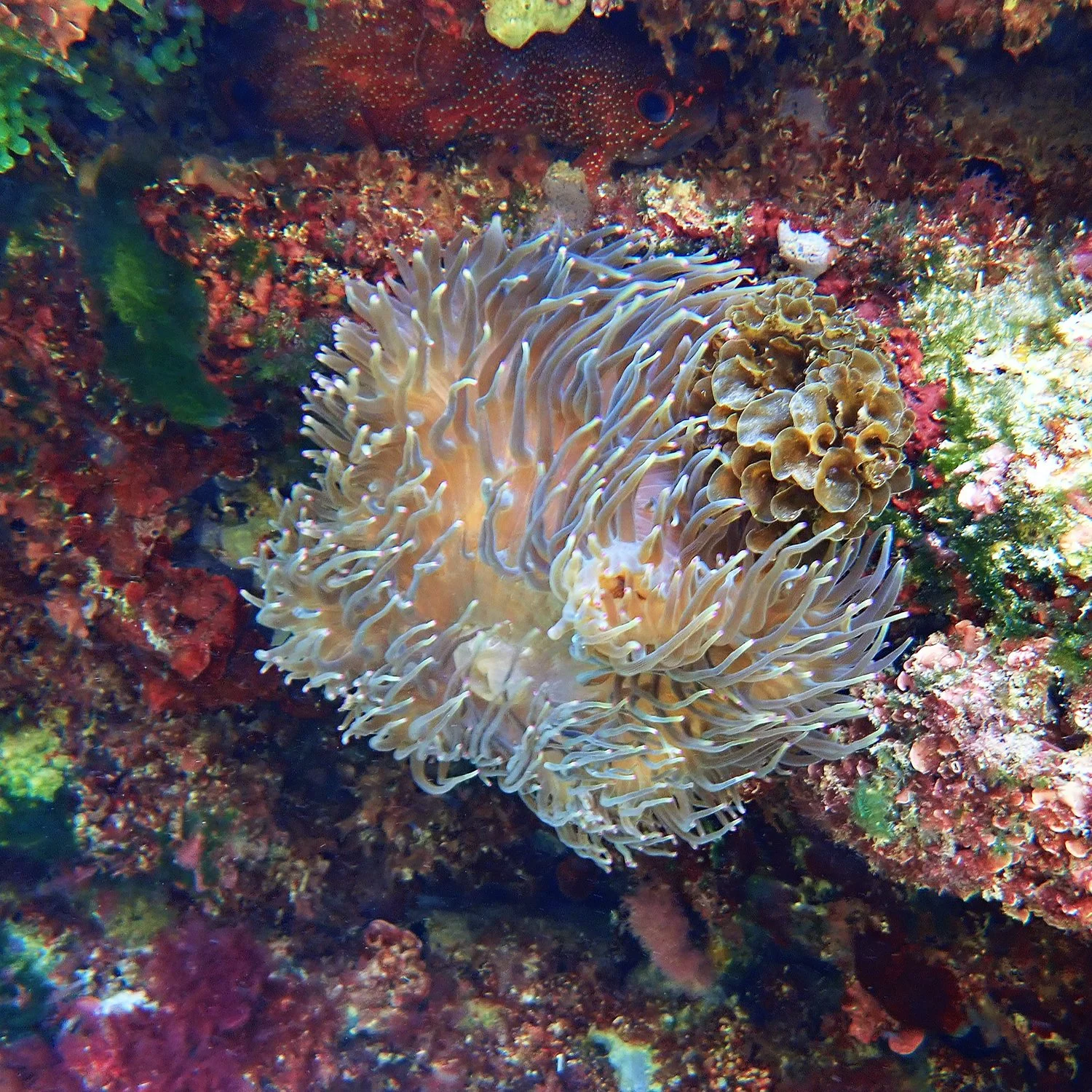
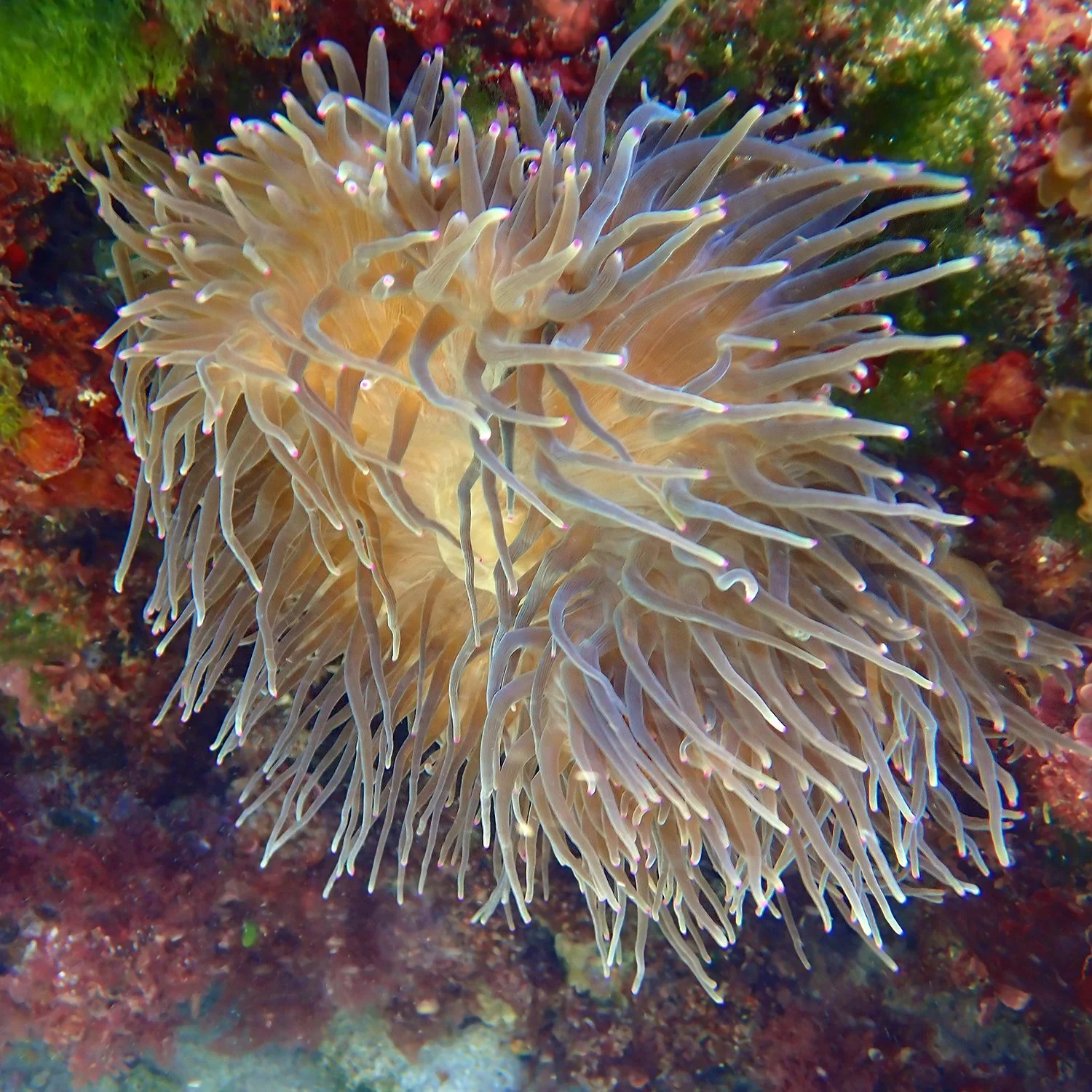
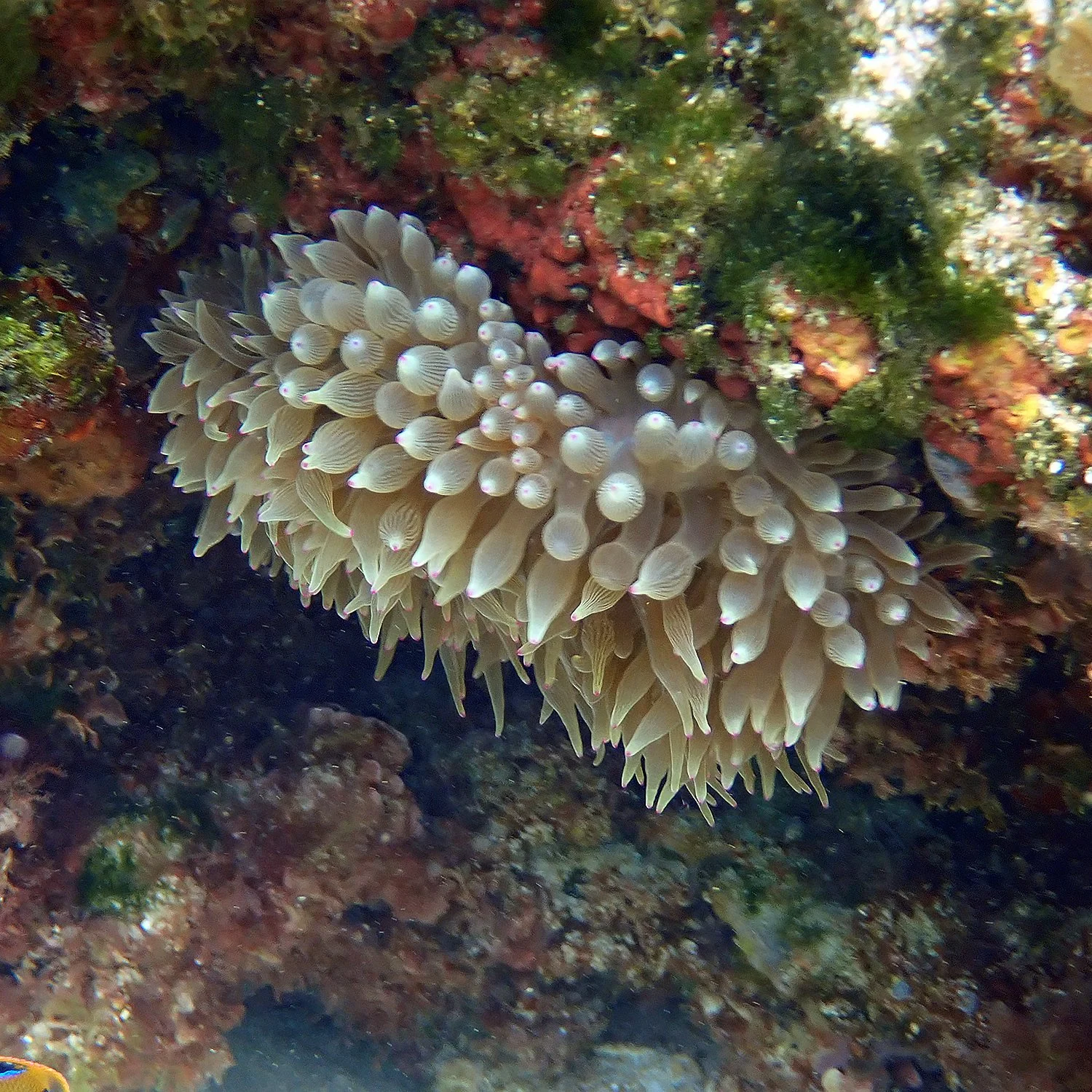
Audrey and her magnificent tresses
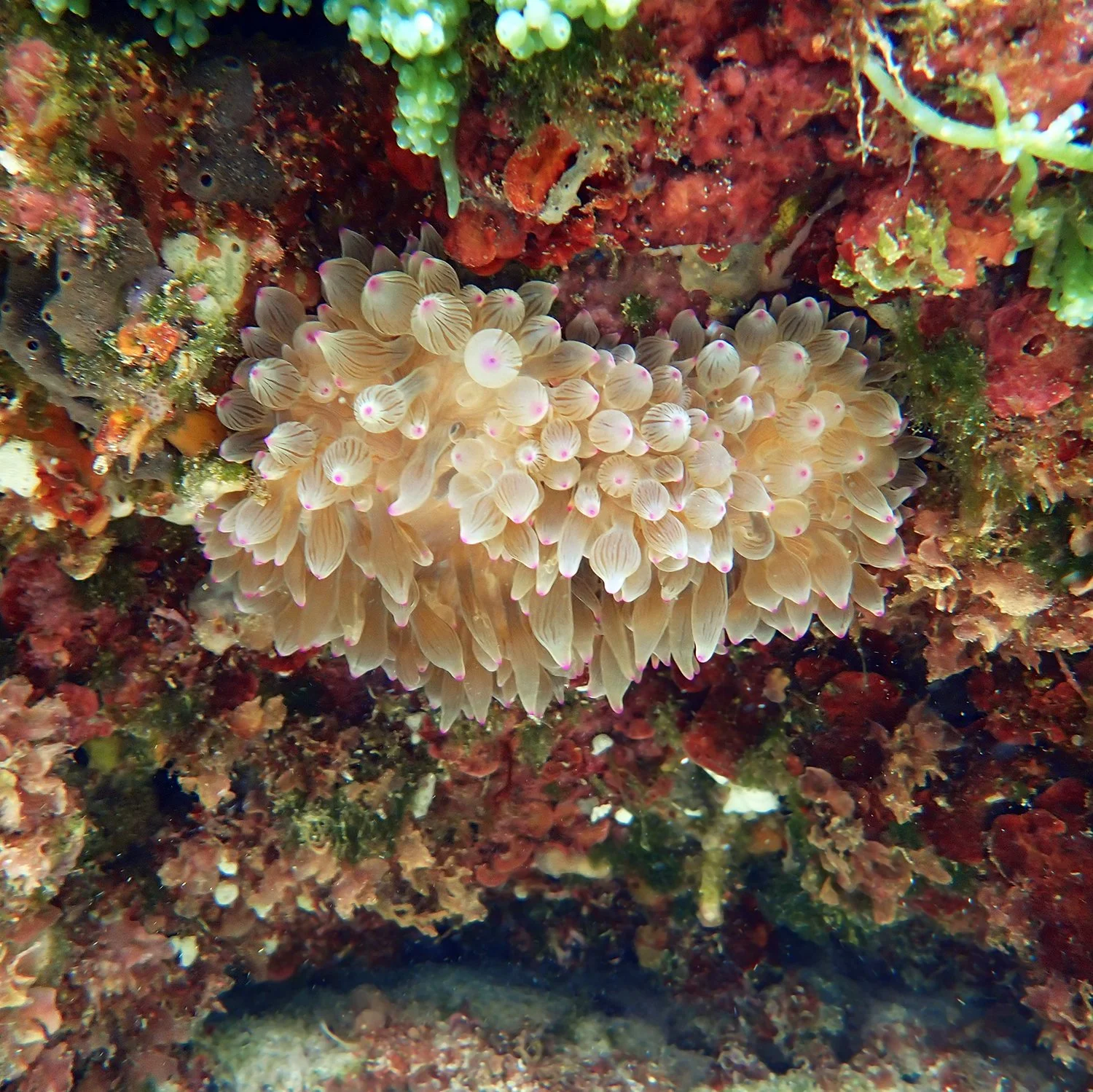
Another favourite is Audrey, a beautiful bubble-tip anemone (Entacmaea quadricolor) tucked into a corner below Lone Pine in Emily Bay. I named her after Audrey from The Lorax, because of her magnificent long tresses.
I first photographed her in 2022, and she has always been an impressive sight, sometimes expanding into a great mass of flowing tentacles, with not a bubble in sight. I’ve asked sea anemone researchers about the bubbles versus no-bubbles conundrum and was told that several factors may be involved, including light, food availability, water movement and environmental conditions.
But back in 2024 she had me scratching my head.
In July 2024, she almost looked as though she had become two anemones. When I returned later, what I thought was Audrey appeared considerably smaller than I remembered, while the ‘newer’ Audrey now had bubbles at the ends of her tentacles.
Now, sea anemones can expand and contract enormously, so size alone doesn't tell us very much. Bubble-tip anemones also reproduce sexually, with separate male and female individuals releasing their eggs and sperm into the water column. There’s no way I could tell Audrey’s sex just by looking at her, so she could very well have been a male all along! But these anemones can also reproduce asexually by dividing themselves in two, effectively producing a clone.
Had I photographed Audrey in the process of dividing? I honestly don’t know. I didn’t witness a complete division, and it’s possible that the changes were simply the result of her expanding, contracting or repositioning herself.
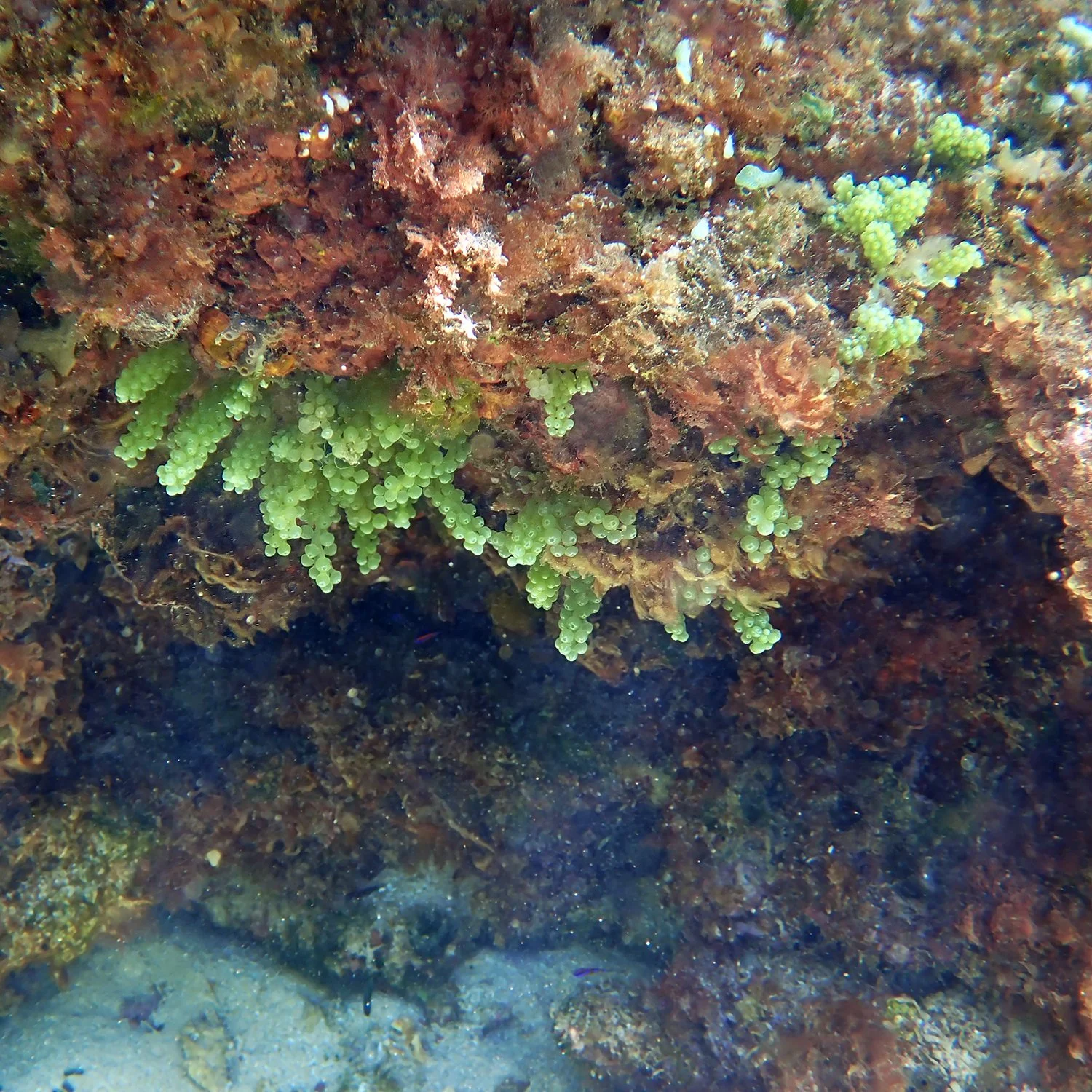
And now Audrey has disappeared altogether. One day, she was simply no longer under her familiar ledge. Did she move on to somewhere more to her liking? We know that sea anemones can relocate, so it’s certainly possible. Or perhaps she’s still tucked away somewhere I haven’t spotted.
I’ve included Audrey here because she’s another example of something I might never have noticed without repeatedly visiting the same animal.
Doris, the green sea turtle, 10 September 2022
Doris, 19 January 2025
Doris and the other turtles
Of course, no collection of my reef acquaintances would be complete without Doris.
Doris was a juvenile green sea turtle (Chelonia mydas) found desperately ill in Emily Bay in August 2022. She was emaciated, her shell was in poor condition, and she was covered in algal growth. Her rescue brought together a wonderful group of island volunteers who helped nurse her back to health over the following four months.
In January 2023, Doris was released on the opposite side of Norfolk Island, well away from the lagoon where she’d been found. But within 48 hours she was back in Emily Bay, under her familiar ledge.
So much for our carefully considered relocation plans!
I’ve written extensively about Doris, including in Doris – just one turtle?, and her story remains one of my most memorable experiences on the reef.
But Doris isn’t the only turtle I’ve photographed. Over the years I’ve assembled a substantial collection of photographs of the juvenile green turtles that visit Emily and Slaughter Bays. Some can potentially be distinguished by their facial markings, shell patterns and other features, although I haven’t yet established how many different individuals are represented.
I’ve often wondered how long particular turtles remain in the lagoon, where they travel when they leave, and whether some return regularly.
Tola, 3 October 2025
Honu, 6 April 2026
Their feeding habits have also provided a few surprises. Not long ago, I recorded a Honu, one of our lagoon regulars, eating sea anemones. I counted nine separate anemones being consumed in just four minutes of footage!
I’ve included that remarkable little encounter in No seagrass, but plenty of turtles.
There’s still so much we don’t know about the turtles using our lagoon. But every dated photograph adds another small piece to the picture.
Black-mouthed tun snail, Tonna melanostoma
Six weeks watching a snail’s eggs
And finally, something rather different.
The black-mouthed tun snail (Tonna melanostoma) is a magnificent, large marine snails, and are not something I encounter particularly often. In fact, I’d previously co-authored a short scientific paper about the species with mollusc specialist Chris Vos.
On 13 October 2022, I found a newly laid egg mass tucked beneath a small rock, only a few metres from an adult tun snail.
Naturally, I decided to photograph it. And then I went back the next day. And the next.
Before I knew it, I’d spent six weeks recording the development and changing appearance of the egg mass. The early photographs show neat rows of egg capsules, which gradually became less orderly as the weeks passed. Algal growth and wave action also affected their appearance.
I was hoping to see what happened as the embryos developed, particularly because there was so little published information about reproduction in this species. Unfortunately, the reef had other plans. After a period of wild weather and heavy swell, I returned on 25 November to find the entire egg mass had disappeared. Whether any of the embryos had already been released into the water column, I simply don’t know.
It was a frustrating ending to six weeks of observations, but the photographs still document a process about which relatively little has been documented for this species in the wild. You can see the complete sequence in The black-mouthed tun snail – diary of an egg mass.


Above: Tonna eggs, October to November 2022, Emily Bay, Norfolk Island
Six years of getting acquainted
When I began photographing Norfolk Island’s reef in January 2020, I certainly didn’t imagine that six years later I’d be poring over the facial markings of wrasses, keeping tabs on a pair of snubnose darts, checking the complexion of a sea anemone or spending six weeks photographing a snail’s eggs. I was just curious about what I was seeing.
The more familiar I became with the reef, the more things I began noticing. A fish would appear in the same place. A familiar anemone would change colour. A turtle would turn up beneath a particular ledge. Something unusual would catch my eye and send me off on another research expedition, usually involving a considerable amount of time at my computer.
These individual stories weren’t collected as part of a systematic scientific, and there’s plenty I can’t explain. They are records of real animals, in real places, over periods sometimes spanning several years, which have given me an appreciation of just how much can be learned from returning to the same little patch of reef and paying attention.
This brings me to the end of my six-part photographic series. I’ve shared stories of coral growth, competition, disease, storms, algae and the changing lives of some of the creatures that call Norfolk Island’s reef home.
There have been encouraging discoveries, some remarkable recoveries and, sadly, considerable losses.
Looking back through the photographs has reinforced something I’ve felt increasingly strongly over the years. I’m very glad I started taking them, and even more glad that I kept going back to photograph the same things. Because without those earlier photographs, so much of what I’ve witnessed would now exist only in my memory.