
In the previous four articles of this series, I’ve looked at how individual corals on Norfolk Island’s reef have grown, recovered, been rearranged by storms, and succumbed to disease. But what happens to the space they leave behind?
Well, nature doesn’t like leaving valuable real estate unoccupied, and on a coral reef there are plenty of organisms ready to move in. Among the most conspicuous are algae, which can colonise exposed coral skeletons surprisingly quickly.
Before we go any further, I should point out that algae are a perfectly normal and important part of a coral reef. In fact, at Norfolk Island’s subtropical latitude, we have a wonderful variety of them. Some are delicate and feathery, others resemble bunches of grapes, and some form quite beautiful carpets across the reef.
I’ve written previously about our seasonal Caulerpa, including how its appearance can change so dramatically during the year in No seagrass, but plenty of turtles.
And then there are the cyanobacteria, including that dark, hairy-looking Lyngbya and the reddish mats that can spread across parts of the lagoon. They aren’t actually algae, although they are often mistaken for them.
I’ve become fascinated by the underwater seasons. The Caulerpa comes and goes, the Lyngbya becomes more conspicuous as the water warms, and the reddish cyanobacterial mats tend to appear later in the summer. Some disappear almost completely for a while, then return. But there’s something else going on that is considerably less encouraging.
When coral dies, its exposed skeleton provides opportunities for other organisms to establish themselves. Algae generally cannot attach directly to an intact, healthy coral surface in the same way they can to an exposed skeleton or other suitable substrate. But a small patch of dead tissue, a broken surface or an exposed area can provide a foothold. Once algae become established, they can sometimes make it more difficult for the remaining coral to recover or for new coral to settle.
So, while a beautiful green covering isn’t necessarily a problem in itself, it pays to look at what’s underneath it.
Here are some examples from my photographic archive.
Old Gnarly’s front garden
Old Gnarly’s hole
Old Gnarly the spotted porcupinefish, May 2021
Back in 2021, I regularly visited a spotted porcupinefish, known locally as a swal doodle, whom I'd nicknamed ‘Old Gnarly’. He lived in a little cave in Emily Bay, and whenever I swam past, he’d appear at the entrance with his enormous white lips to see what I was up to. I wrote about our little encounters in Old Gnarly, the swal doodle.
But there was something else about his home that caught my eye. The algae growing around the entrance changed enormously with the seasons. Sometimes it was green and lush, sometimes covered in reddish, feathery growth, and at other times almost bare.
I kept photographing the same little patch of reef, even after Old Gnarly moved out. Looking at the photographs together, It’s fascinating to see how much the appearance of one tiny patch of reef can change over time.
This isn’t a story about coral disease or mortality. It’s simply the underwater seasons playing out around one little hole in the reef.
The green comes and goes
10 June 2021
7 August 2026
One of the things I’ve learned from photographing the same parts of the reef over several years is that not all algae behave in the same way.
Some growth seems to persist on exposed coral skeletons, changing in appearance or composition over time. Elsewhere, the green Caulerpa can appear in great profusion, covering areas of sand, rubble and other suitable surfaces, before dying back again.
Look at the differences between these photographs.
The Caulerpa is particularly interesting because its seasonal appearance can change the look of an entire patch of reef. At one time it may be a lush green carpet, and a few months later much of it has disappeared.
That doesn’t necessarily mean the reef has deteriorated when the algae are present, or recovered when they disappear. Sometimes we’re simply looking at a normal seasonal cycle. But if the Caulerpa has been growing over dead coral skeletons, its disappearance can reveal something rather different beneath.
A changing reef surface
2 January 2022
3 April 2026
26 September 2026
This foliose coral is another example of how a familiar patch of reef can change over the years.
In the earlier photographs, the coral’s broad, overlapping structure is readily recognisable. In the later images, parts of the original structure are less apparent, while sediment and algal growth occupy more of the surrounding area. I suspect sand movement may have contributed to the changes, although the photographs alone can’t establish exactly what happened.
What they do show is that the reef surface is continually being altered, and that once living coral is lost or damaged, other organisms are quick to occupy the available space. Sometimes those changes are much easier to appreciate when we look back through the photographs than when we’re actually swimming over the same area.
The changing fortunes of a Hydnophora
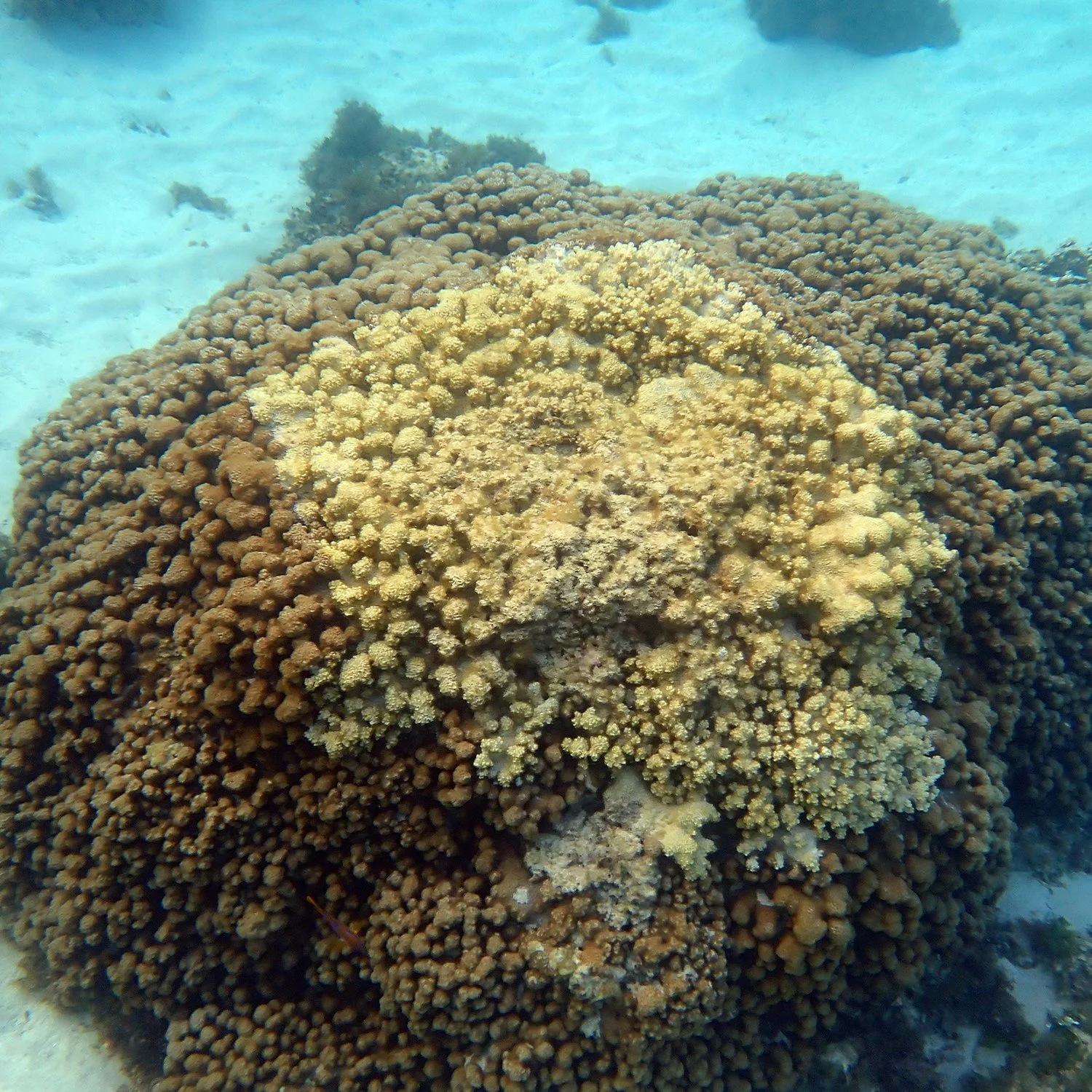
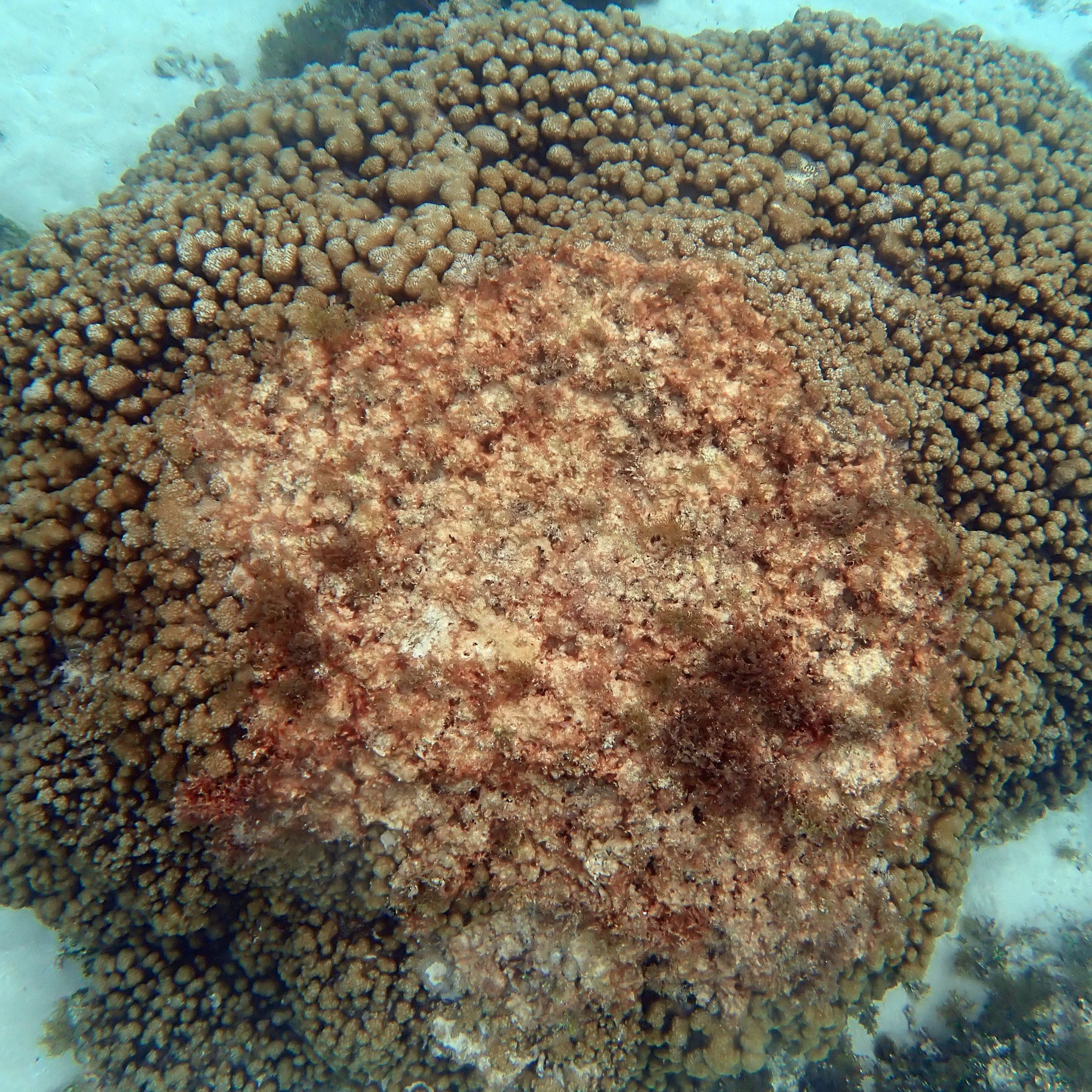
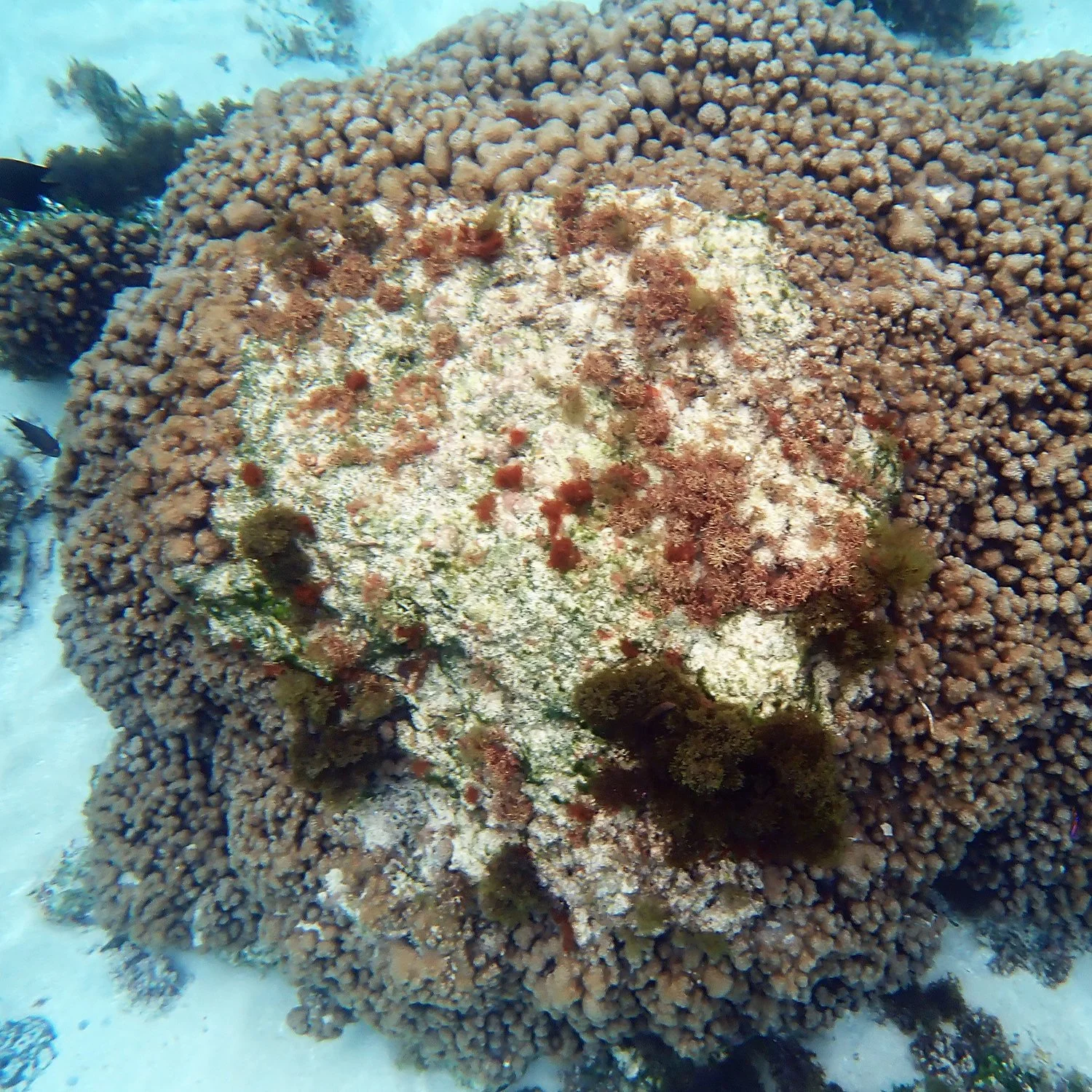
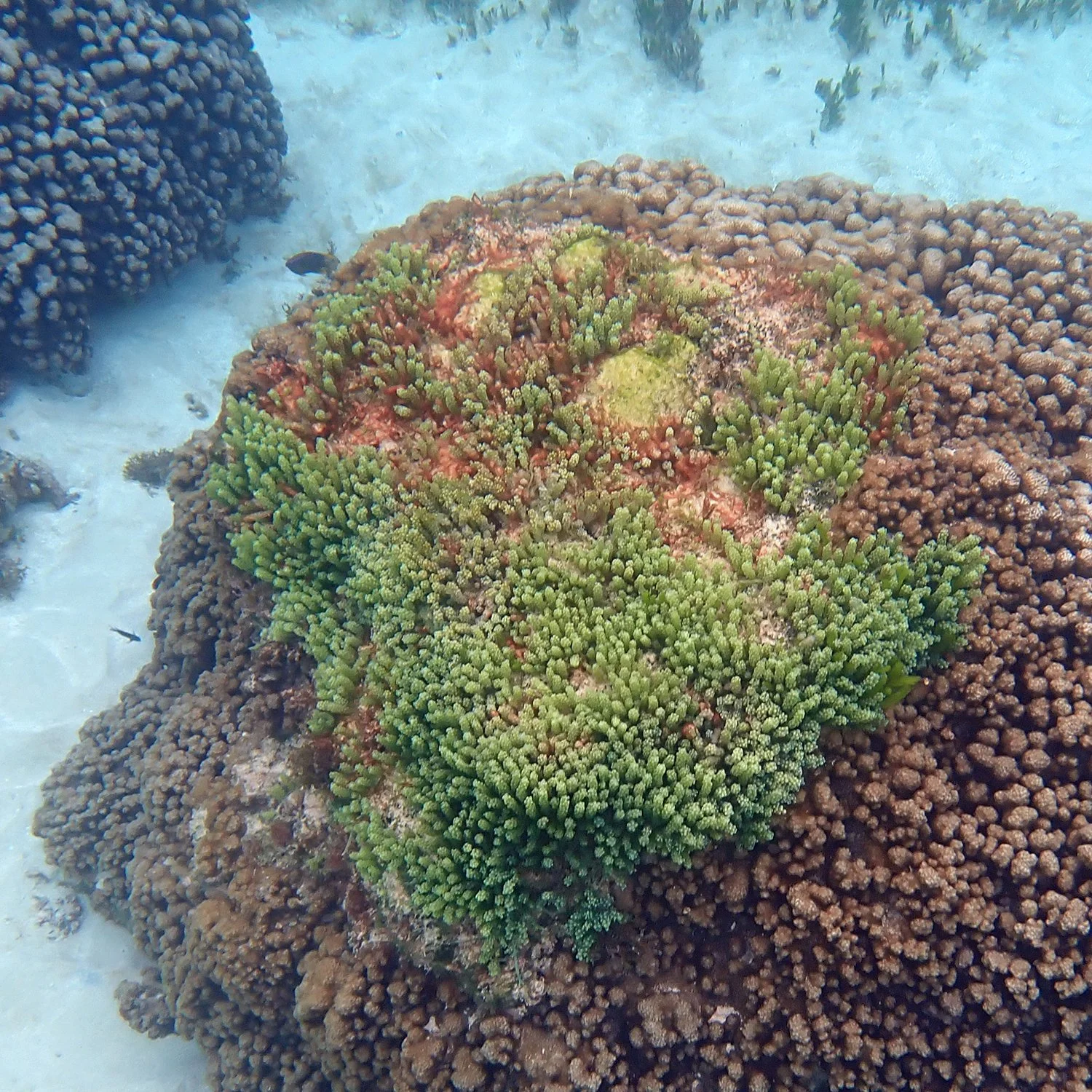
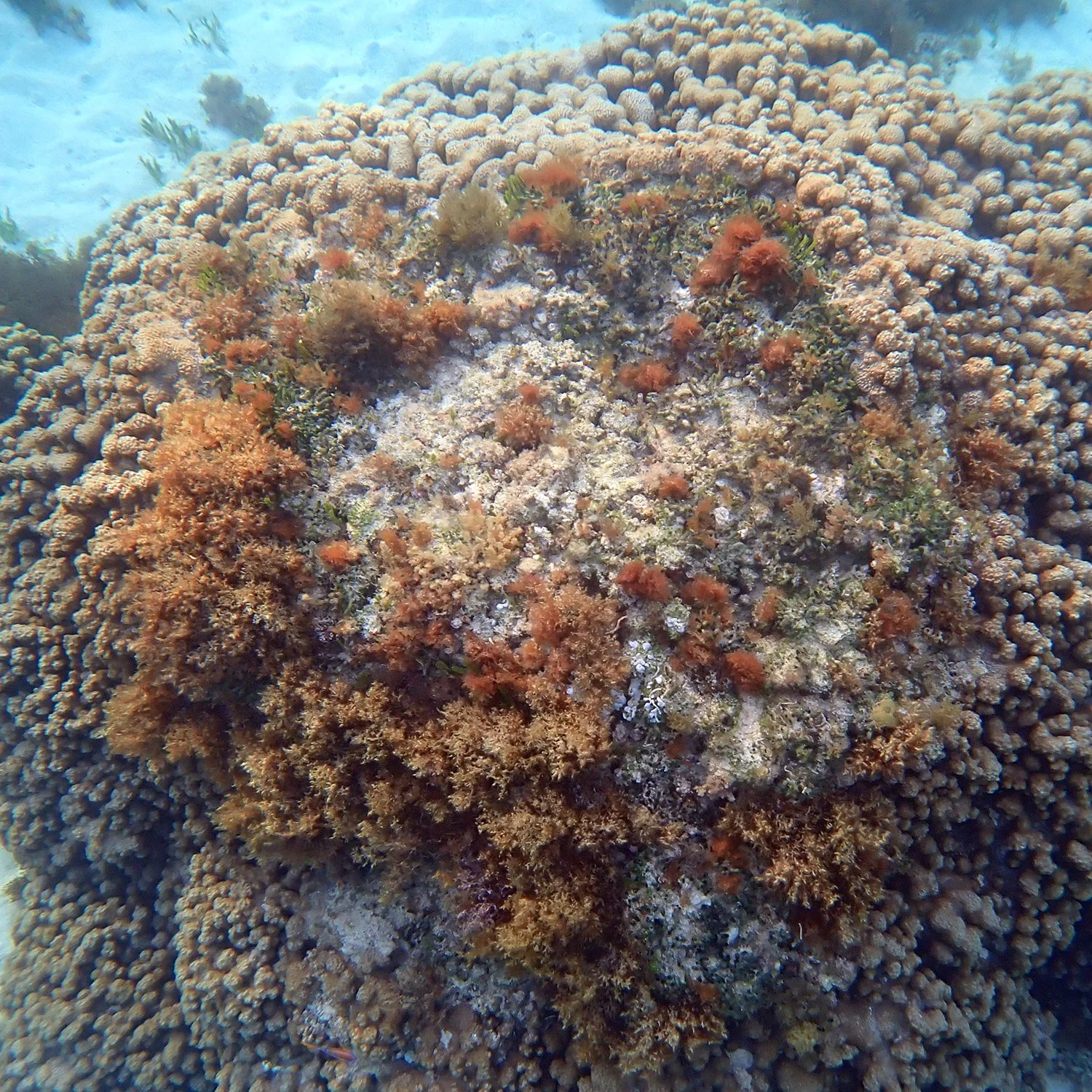
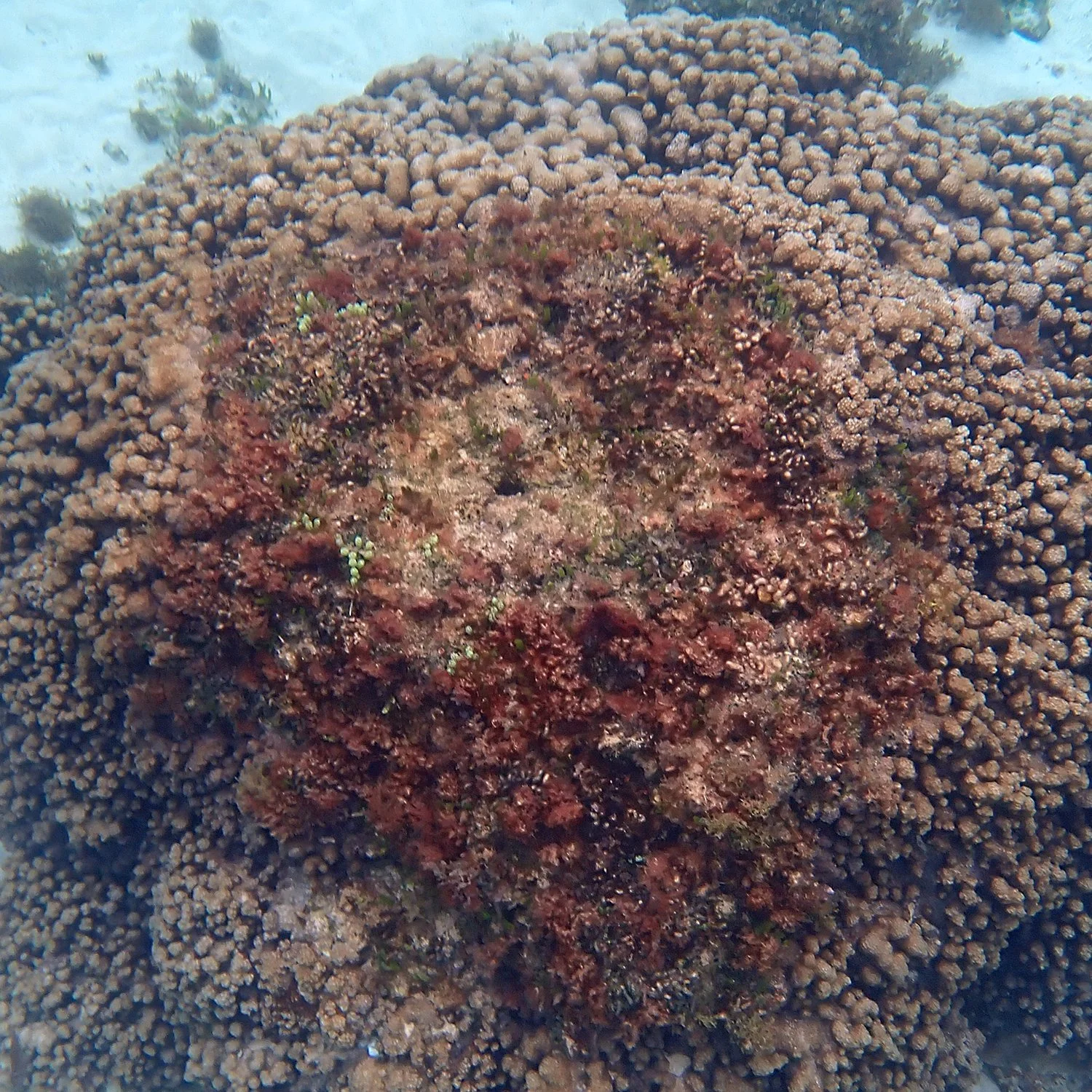
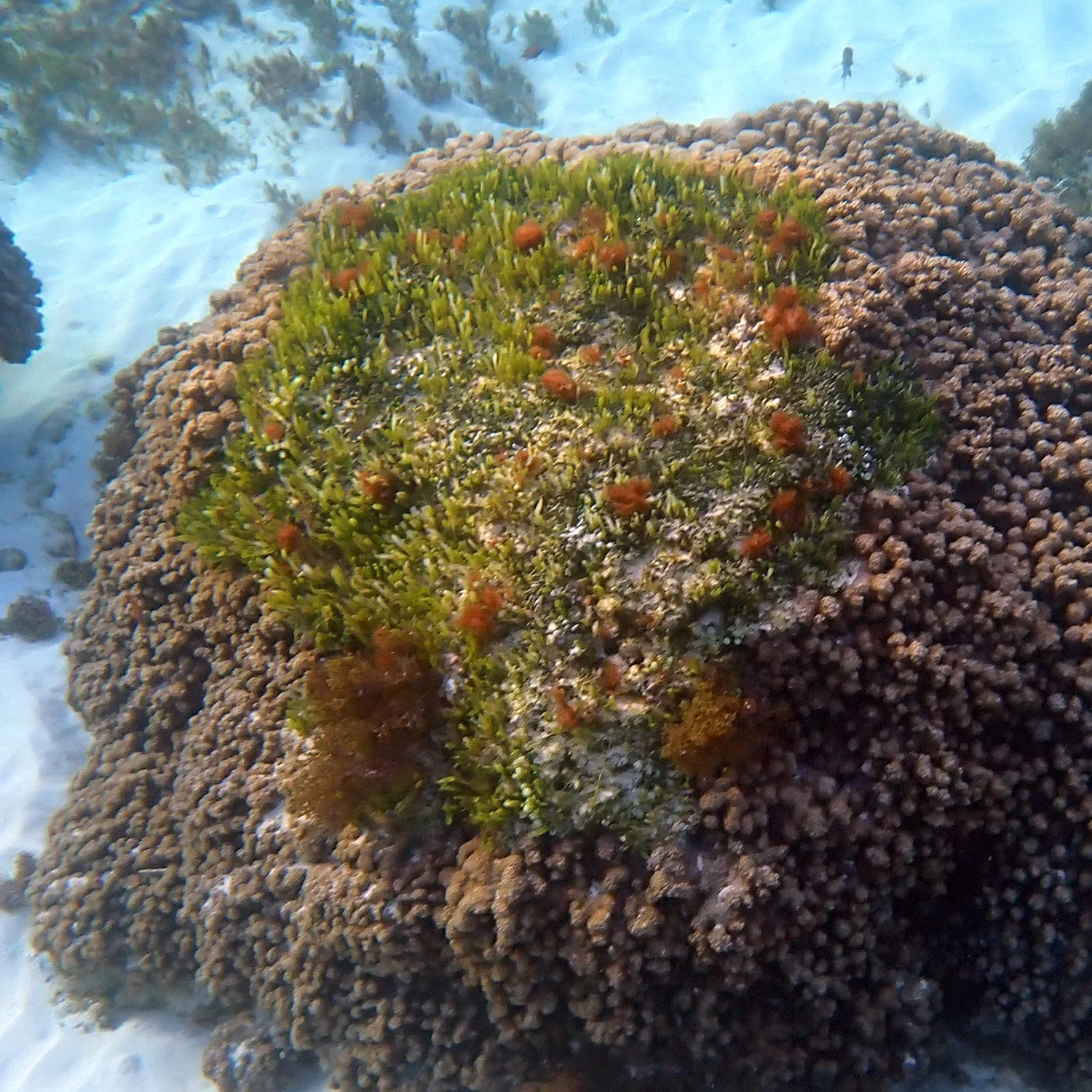
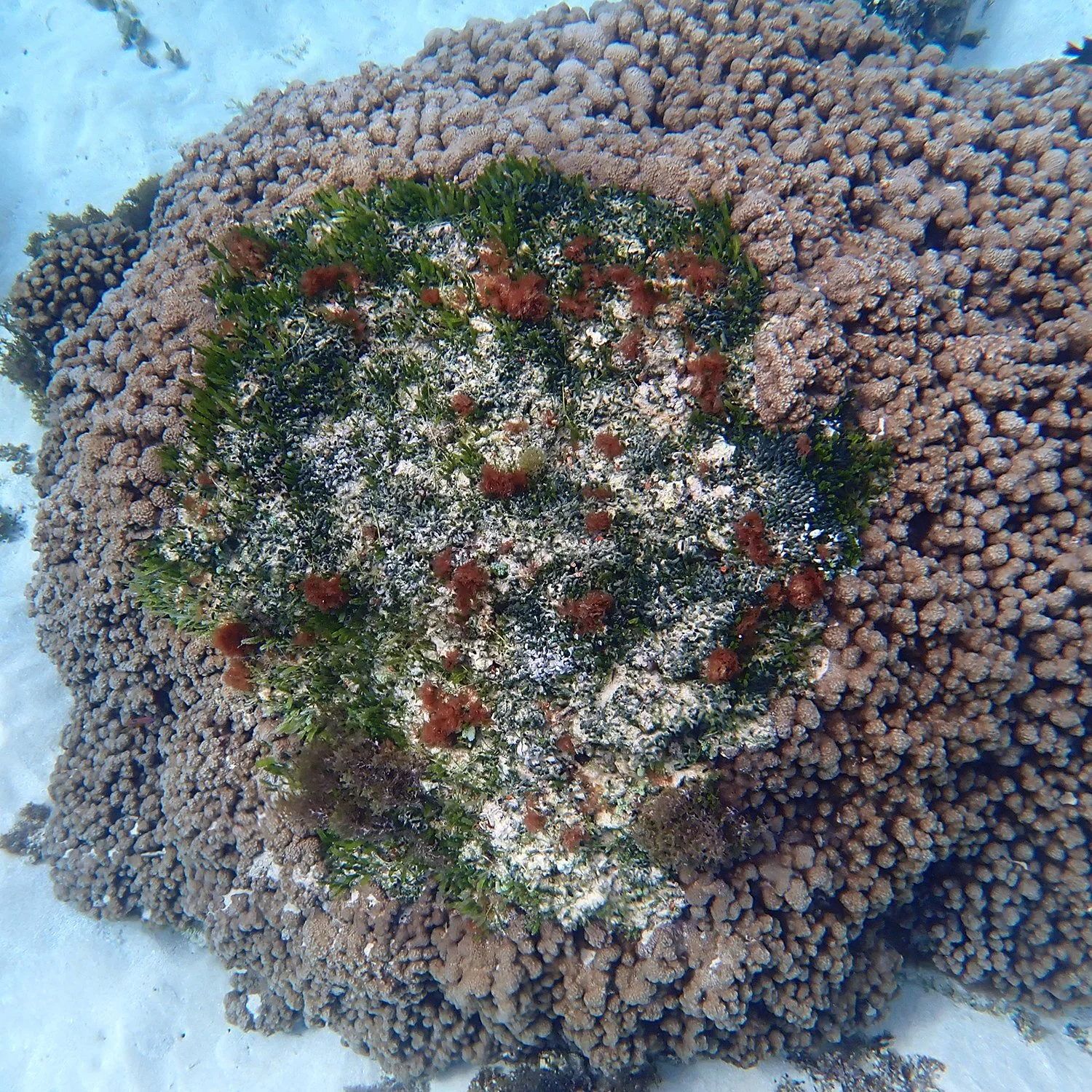
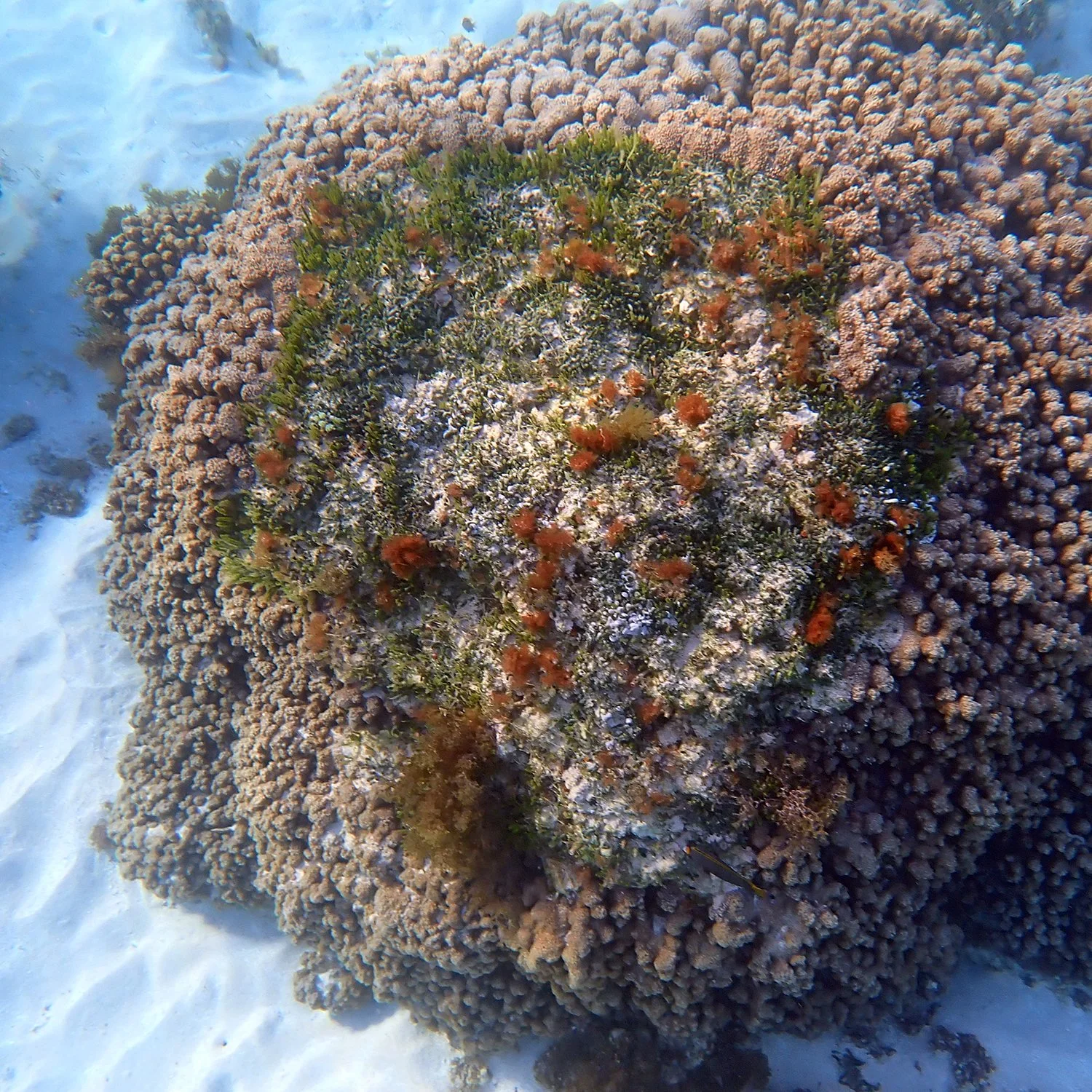
You'll recognise this Hydnophora pilosa from the previous article about coral disease. I followed an outbreak of white syndrome affecting this colony in late 2023, photographing the advancing tissue loss over several weeks.
But I kept returning after the disease had apparently stopped progressing because I was curious about what would happen to the exposed skeleton. And what a transformation!
Over the following three years, the affected area has supported an extraordinary succession of algae and other organisms. Sometimes there is a covering of reddish or brown growth cyanobacteria, while at other times the surface is dominated by green algae, including the wonderful grape-like Caulerpa that appeared in May 2025. By December, that green covering had largely disappeared, and the area looked quite different again. Then, in August 2026, green algae became conspicuous once more but this time it was the feather Caulerpa.
I've included nine photographs taken between December 2023 and September 2026 so you can see these changes for yourself.
What fascinates me is that the surrounding living coral remains recognisable throughout, while the area that lost its tissue has become home to a changing collection of other organisms.
Almost three years after the original disease outbreak, there is still no obvious recovery of living coral across that central area.
The beautiful green disguise
25 August 2024
25 April 2026
10 September 2026
This next sequence is one I find particularly disturbing, not least because it follows an incident I’ve written about previously. In July 2024, Watermill Dam discharged water into the channel leading to Emily Bay. I documented the incident at the time in Groundhog Day in Emily Bay.
About two and a half weeks later, I photographed an area of Acropora that was looking decidedly pale and stressed. Coral health researchers subsequently suggested that a virus might have been involved, although the precise cause was not established.
I continued returning to the same area just to see what would happen.
By April 2026, the coral had died, and much of the area was covered by a magnificent carpet of green Caulerpa. And it really was magnificent. Lush, healthy-looking green growth, spreading across what appeared to be a thriving underwater garden.
Except that it wasn’t.
When I returned in September 2026, the seasonal Caulerpa had died back, exposing the dead coral skeletons beneath as you can see from these three photographs.
The first shows the original distressed coral. The second is a glorious covering of Caulerpa. The third reveals what was actually beneath that green carpet.
It’s a particularly striking illustration of why we need to be careful about interpreting what we’re seeing underwater.
Caulerpa is a natural component of our reef, and its seasonal growth and decline are perfectly normal. But a beautiful covering of algae doesn’t necessarily mean that the reef beneath it is healthy. In this case, the seasonal algae had concealed extensive coral mortality.
When the seasons change
I’ve been watching these seasonal patterns for several years now.
The grape Caulerpa can be particularly conspicuous earlier in the year before declining during the cooler months. Feather Caulerpa also varies enormously, sometimes forming extensive carpets and at other times becoming remarkably sparse.
Then there’s Lyngbya, that dark brown, hairy-looking cyanobacterium which I tend to see becoming more prominent from around late September. And later in the summer, the reddish cyanobacterial mats often begin appearing.
These patterns aren’t identical everywhere. Some sheltered parts of Slaughter Bay seem to retain Lyngbya throughout much of the year, for example.
I’ve written about the seasonal behaviour of these cyanobacteria and their possible relationship with catchment runoff in A coral reef, out of balance. Temperature, light, nutrients, water movement and grazing all influence which algae flourish and when. And, of course, the water entering the lagoon from Norfolk Island’s catchment is part of that picture.
But there’s an important difference between seasonal changes in the algae growing on a reef and a longer-term change in what occupies the reef itself. A carpet of Caulerpa may come and go every year. The coral that once grew beneath it may be gone for good.
What lies beneath
Looking through these photographic sequences, I’m struck by just how easy it would be to misinterpret the appearance of a reef at any one point in time.
An area covered in green algae may look wonderfully productive. A few months later, when that algae has died back, the same area may appear rather barren. Neither photograph alone necessarily tells us what has happened. Which is why returning to the same places becomes so interesting. We can see not just which algae are present, but what was there before them. And in some of these locations, what was there before was living coral.
Algae are not the enemy. They are an essential part of the reef community, providing food, habitat and shelter for all sorts of marine life. Fish and sea urchins graze on them, and their seasonal growth is part of the normal rhythm of the reef. But there is a difference between a reef where algae and corals coexist, and one where algae are increasingly occupying the space left by dead corals.
After six years of swimming over these same patches of Norfolk Island’s reef, I’m becoming rather too familiar with the latter.