
Even after we have decided what to call a fish, there is another apparently simple question: where does it live?
This is the second of two articles looking at how we describe the fishes around Norfolk Island. In the first, I looked at terms such as native, endemic and undescribed. This time, I’m looking at where species occur – and how new records can change the maps.
Species distributions look tidy on maps and checklists. The evidence behind them is often much less tidy. A new specimen, photograph or DNA record can extend a known range by hundreds or thousands of kilometres. Repeated observations can also raise a harder question: are we simply documenting something that was always there, or are we watching the range itself change?
A quick guide to the terminology
Near endemic or regional endemic – terms used for species restricted to a relatively small geographical region rather than a single island. They are useful descriptions rather than rigid taxonomic categories.
New record – the first documented occurrence of an already described species in a particular place. It does not necessarily mean the animal has just arrived.
Range extension – a record outside the previously known geographical range of a species. The sabre squirrelfish, Sargocentron spiniferum, provides a good Norfolk example. When I first photographed one here in January 2023, it was about 750 km south of its previously documented range. Subsequent sightings have shown that the first fish was not simply a one-off.
Resident – a species with an established local presence, rather than an occasional visitor or vagrant. Establishing residency may require repeated observations rather than a single record.
Taxonomic reclassification – when the scientific name changes because our understanding of where a species belongs in the classification system has changed, without the fish itself being recognised as a different species.
Range shift – a change in where a species actually occurs over time. A range extension can be evidence of a range shift, but it can also result from better sampling or the discovery of an overlooked population.
Let’s take a look at our two cardinalfishes
When a ‘Norfolk’ fish isn’t confined to Norfolk
Norfolk Cardinalfish, Ostorhinchus norfolcensis, pair off for breeding from early September
The Norfolk Cardinalfish, Ostorhinchus norfolcensis, was described from Norfolk Island in 1888. Again, its name points to Norfolk, but its distribution does not stop here. It has long been recorded from Lord Howe Island and New Caledonia, as well as Norfolk Island. A 2010 study of Lord Howe Island’s reef fauna placed it among a small group of ‘near endemic’ fishes restricted to these southwestern Pacific islands and neighbouring areas.
And now its known range may be considerably larger again. A DNA-barcoding study published in 2025 reported Ostorhinchus norfolcensis from North Luzon in the Philippines and treated it as a new record for Philippine waters. The researchers used voucher specimens, photographs and genetic data in checking their identifications.
If that record stands – and science always leaves room for later taxonomic scrutiny – a fish once regarded as having a very restricted southwestern Pacific distribution suddenly has a record thousands of kilometres farther north.
The fish has not moved because we changed a database entry. The boundary on our map has changed because somebody found evidence outside the previously known range.
A fish that we really thought was ours
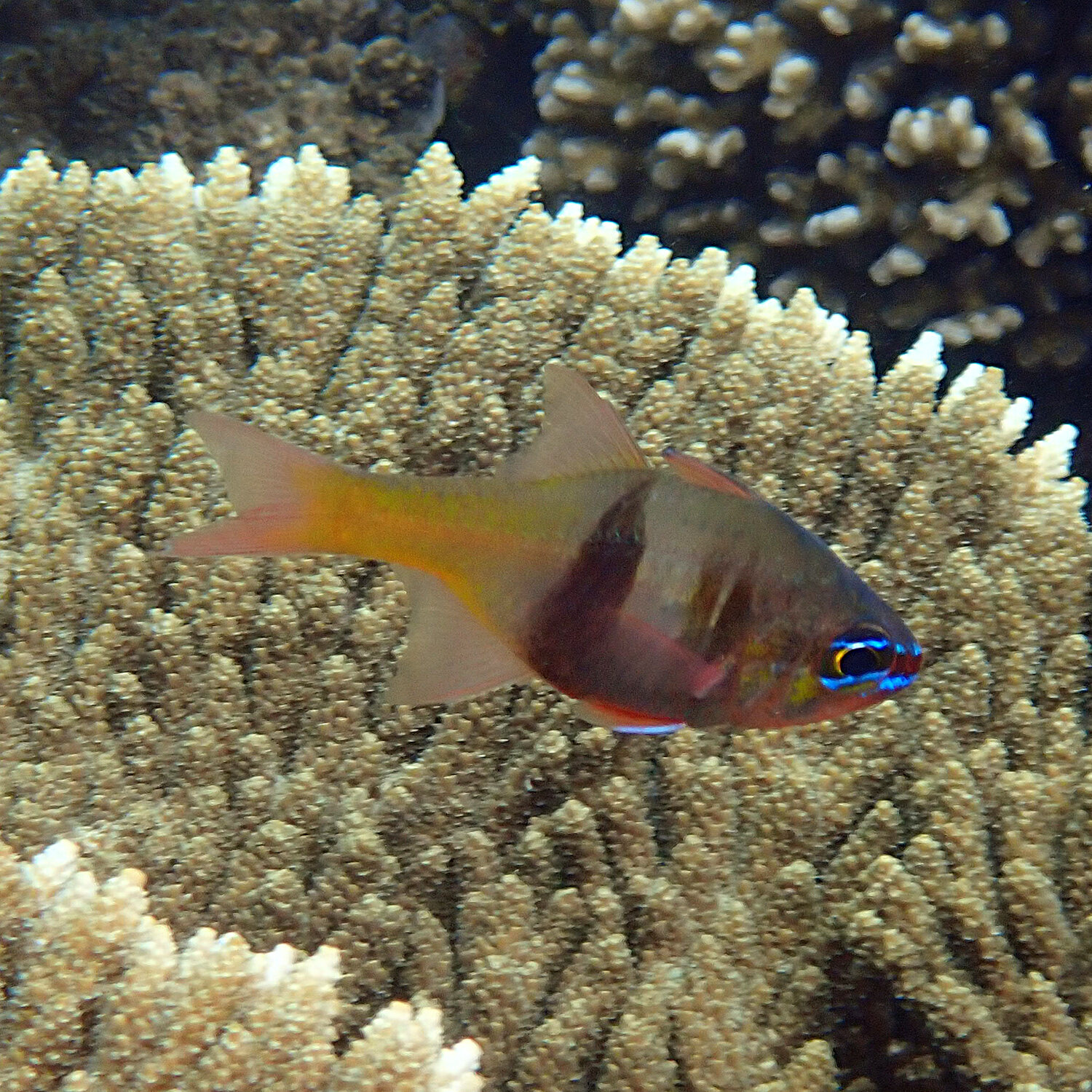
Lea’s Cardinalfish, Taeniamia leai
Lea’s Cardinalfish, Taeniamia leai, provides an even clearer historical example. It was described from Norfolk Island in 1916 as Archamia leai.
In 1983, Barry Russell reported it from the Capricorn-Bunker Group on the Great Barrier Reef and wrote that it was ‘previously known only from Norfolk Island’. It was a new record for Australia.
Curiously, a national Australian marine regionalisation published as late as 1998 still listed Archamia leai as one of two common fishes endemic to Norfolk Island, alongside the Norfolk Island blenny. By then the Australian record had already been published. So you can see that scientific knowledge does not always move neatly from a paper into every subsequent report or database.
Today Lea’s Cardinalfish is known from eastern Australia, Norfolk Island and New Caledonia. And it has undergone another sort of change as well. Archamia leai became Taeniamia leai after Thomas Fraser revised the cardinalfishes in 2013. Rather than discovering that A. leai consisted of several species, Fraser concluded that most fishes then placed in Archamia belonged in a different genus, Taeniamia. Archamia was restricted to a single species.
This is much closer to a straightforward taxonomic reclassification.
The species remained leai, but its scientific ‘address’ changed from the genus Archamia to the genus Taeniamia.
Compare that with our Chromis, which I discussed in the first article on fish names.
Chromis fumea did not become Chromis norfolkensis because somebody shifted it into another genus. Researchers concluded that the old concept of C. fumea contained several different species. One of those was then formally described as C. norfolkensis. They can both look like a chang of name when you are updating a website, but rather different science lies behind the two changes.
New to the list isn’t necessarily new to the reef
Until 2023, the sabre squirrelfish was thought to live much further north than Norfolk Island
There is one more category I encounter increasingly often: the new record.
The Sabre squirrelfish, Sargocentron spiniferum, gives me a particularly clear example of a range extension.
It is not a newly discovered species. It is a large and widespread tropical Indo-Pacific squirrelfish that has been known to science since 1775. But until recently, Norfolk Island lay well outside its documented range.
I photographed a Sabre squirrelfish, Sargocentron spiniferum, here for the first time on 21 January 2023. When I sent the observation to fish scientist Malcolm Francis, he confirmed the identification and pointed out that Norfolk was about 750 kilometres south of the species’ previously known range. I subsequently photographed it in January 2024 and January 2025, and recorded one on an underwater video camera in early February 2026.
Four records over four consecutive years make that first sighting increasingly difficult to dismiss as an isolated vagrant. Intriguingly, all four observations have been during January or February. For now, they demonstrate repeated occurrence at Norfolk Island and a substantial extension of the species’ previously documented range. They do not yet tell us whether we are seeing an established local population, repeated summer visitors or a relatively recent southward expansion of the species.
The maps are beginning to change too. The current Fishes of Australia account now includes Norfolk Island in the distribution of Sargocentron spiniferum.

Black blenny, Enchelyurus ater
Since I began systematically photographing Norfolk Island’s reef, I have recorded a growing number of fishes not previously documented as resident here. The Black blenny, Enchelyurus ater, is one example. There are butterflyfishes, wrasses, parrotfishes, goatfishes and others on that growing list.
Calling something a new record for Norfolk Island does not mean that I discovered a new species. Nor does it necessarily mean the fish only recently arrived. Perhaps it did. Fish larvae can travel enormous distances, species distributions change, and oceanographic and environmental conditions affect which larvae arrive and survive. But there is another perfectly plausible explanation for many records on an isolated reef with a comparatively limited history of intensive biological survey. And it is very simple. Nobody had documented it before.
A tiny goby tucked into a crevice, a cryptic blenny, or a fish appearing only occasionally can remain absent from a checklist while being very much present in the water.
This is one reason I am cautious about turning ‘not previously recorded’ into ‘not previously here’.
The cardinalfishes and the squirrelfish show the problem from opposite directions. A fish once thought to be restricted to Norfolk can turn up somewhere else; another can appear here well beyond its previously documented range. Neither observation, on its own, tells us that the species itself has recently moved.
Every species list is a record of what we know at a particular point in time. Around Norfolk Island, I suspect there are still quite a few amendments waiting for us underwater.
Sabre squirrelfish, 21 January 2023
Sabre squirrelfish, 8 January 2024
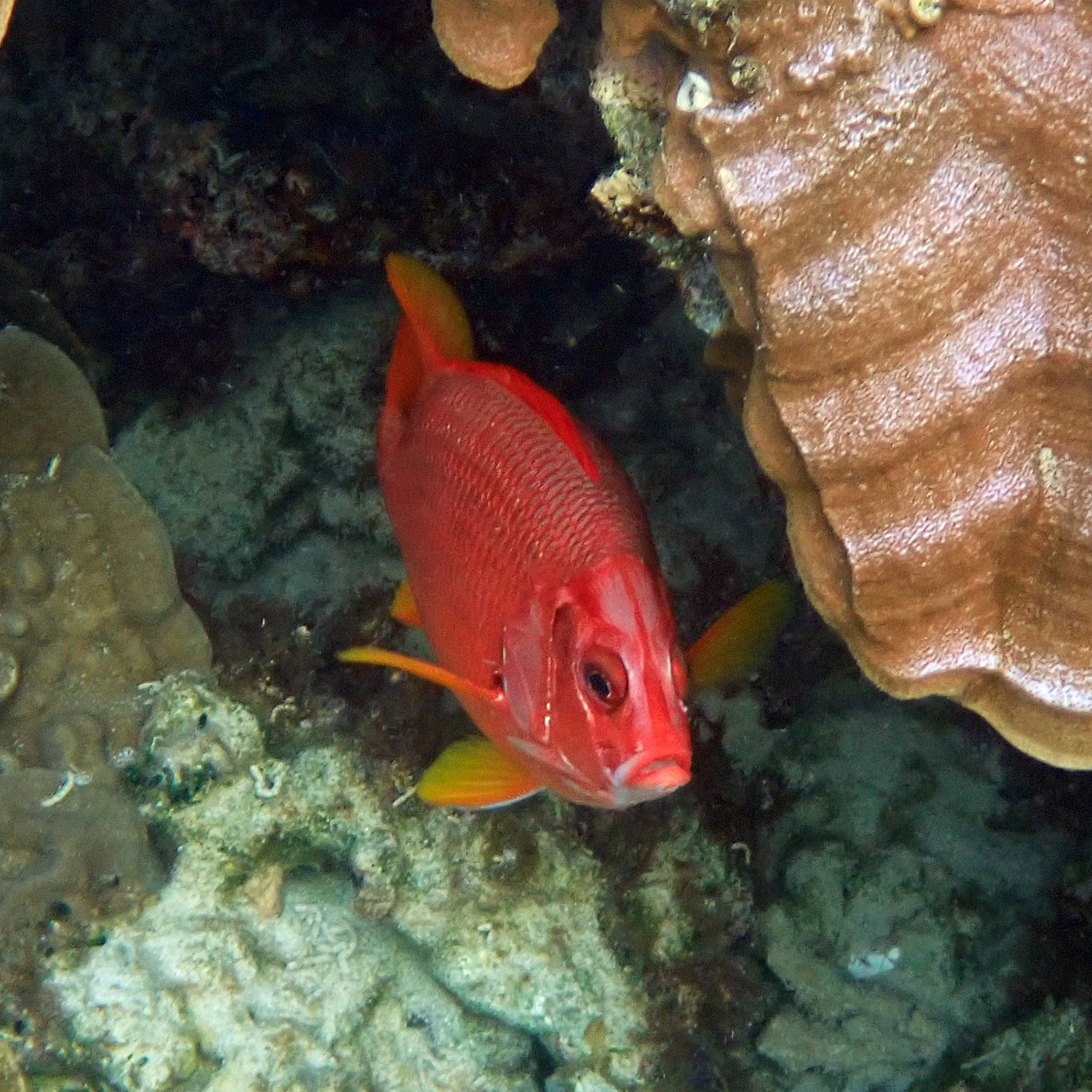
Sabre squirrelfish, 3 January 2025
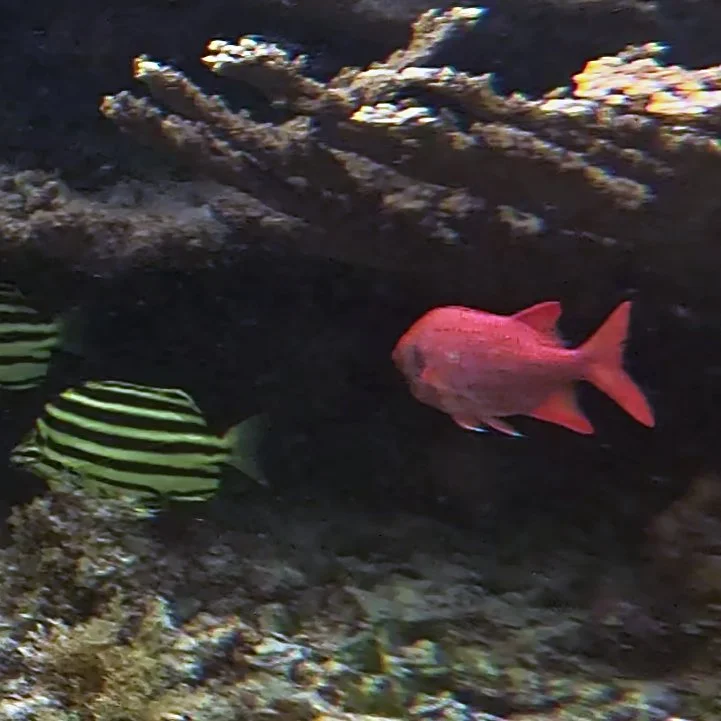
Sabre squirrelfish, screenshot from video camera, 2 February 2026
References
Allen, G. R., & Allen, M. G. (2021). Two new species of Chromis (Teleostei: Pomacentridae) from northwestern Australia and the southwestern Pacific Ocean, previously part of C. fumea (Tanaka, 1917). Journal of the Ocean Science Foundation, 38, 78–103. https://doi.org/10.5281/zenodo.5601971
Dimaquibo, A. C., Jhuang, W.-C., Huang, W.-C., Encarnacion, A. B., Villarao, M. C., Yutuc, R. V., & Liao, T.-Y. (2025). DNA barcoding of teleost fishes from North Luzon, Philippines: A dataset for ichthyofaunal diversity assessment. Scientific Data, 12, 1571. https://doi.org/10.1038/s41597-025-05758-3
Edgar, G. J., Davey, A., Kelly, G., Mawbey, R. B., & Parsons, K. (2010). Biogeographical and ecological context for managing threats to coral and rocky reef communities in the Lord Howe Island Marine Park, south-western Pacific. Aquatic Conservation: Marine and Freshwater Ecosystems, 20, 378–396. https://doi.org/10.1002/aqc.1075
Fraser, T. H. (2013). A new genus of cardinalfish (Apogonidae: Percomorpha), redescription of Archamia and resemblances and relationships with Kurtus (Kurtidae: Percomorpha). Zootaxa, 3714(1), 1–63. https://doi.org/10.11646/zootaxa.3714.1.1
Fricke, R., Kulbicki, M., & Wantiez, L. (2011). Checklist of the fishes of New Caledonia, and their distribution in the Southwest Pacific Ocean (Pisces). Stuttgarter Beiträge zur Naturkunde A, Neue Serie, 4, 341–463.
Mabuchi, K., Fraser, T. H., Song, H., Azuma, Y., & Nishida, M. (2014). Revision of the systematics of the cardinalfishes (Percomorpha: Apogonidae) based on molecular analyses and comparative reevaluation of morphological characters. Zootaxa, 3846(2), 151–203. https://doi.org/10.11646/zootaxa.3846.2.1
Russell, B. C. (1983). An annotated checklist of the coral reef fishes of the Capricorn-Bunker Group, Great Barrier Reef, Australia. Great Barrier Reef Marine Park Authority.
Historical source
Interim Marine and Coastal Regionalisation for Australia Technical Group. (1998). Interim Marine and Coastal Regionalisation for Australia: An ecosystem classification for marine and coastal environments. Version 3.3. Environment Australia.