

Myth busting – all about coral spawning!
So you’re stuck to the ocean floor. You can’t stroll over to the next suburb to find another coral to become friends with benefits, so what do you do?
Corals have evolved to get over this biological conundrum by shedding their eggs and sperm (gametes) into the water column – known as broadcast spawning. Basically, they are chucking their all out there into the universe to see what happens. Hopefully the gametes will drift around, and eventually hook up with like-minded coral gametes to make embryos.
The embryos will then develop into planula larvae, which will eventually settle on the ocean floor and start growing into adults. Australian Marine Parks has placed some settlement plates around the bays to see how many corals will settle and grow this year. The one in the images, bottom of this page, is in Emily Bay.
The only problem with this “chucking it out into the universe” is that if the guy in the next ’burb broadcasts his sperm at a different time to when you broadcast your eggs, “ne’er the twain shall meet” (thank you Rudyard Kipling, Barrack-room Ballads). It’s a bit like getting the wrong weekend for a party. You knock on the door and the host answers wearing slippers and dressing gown. “No! It’s NEXT week!”
So if you are stuck to the ocean floor, and you can’t Facetime to arrange a face-to-face rendezvous, you need to come up with a system that you and your kind can agree on, AND which gives your babies the best chance to get on in life. A bit like the massed pipe band making sure they all turn up to play on the same date, at the same venue, and using the same sheet music in order to create the best pipe sound. (It sounds sooo much better that way!)

Just some of the corals that you can see on Norfolk Island’s reef. View more on the coral page of this website.
Coral is made up of lots of polyps, and each polyp produces both sperm and eggs for the big event (so, please bring BOTH a dessert and a mains to the party!), usually once a year. (It would be just too exhausting otherwise!) So synchronous spawning for a species typically occurs once a year, too. Sometimes quite a few different species will all use the same cue, signal or code to time the release of their gametes, in which case synchronous spawning turns into a mass spawning event, but, then again, sometimes they don’t. One species may decide that one month works better for them than the next. These cues come from the environment: so like the AGM for The Widget Company Ltd is always set for the last Tuesday of the month before the end of the financial year (the cue), corals use the moonlight and the temperature of the water as theirs. Over millennia, they’ve sorted out what works best for them and theirs. (Just as some extended families always like to gather for Christmas lunch at the beginning of December to “get it out of the way”!)

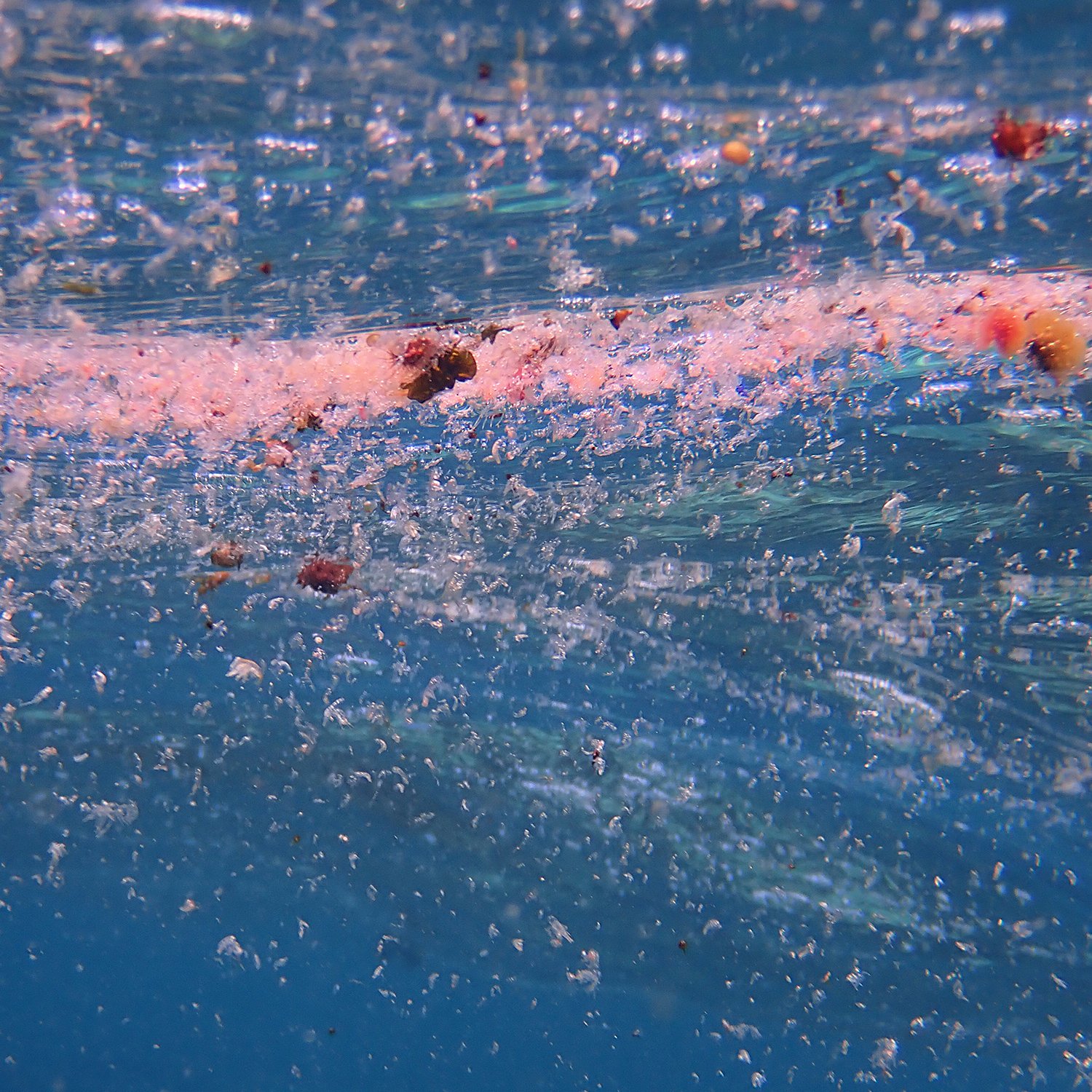
Coral spawning, as seen in Emily Bay, Norfolk Island, on 28 December 2021
So here’s the myth
In the media you will see a lot of fuss about coral spawning occurring once a year in a big bang (pun intended) sexual orgy of sperm and eggs, all washing around together in the water column. Party time central, apparently.
But the truth is a little different
For example, on the Great Barrier Reef, many different species of corals choose to release their gametes a night or two after the full moon in October on inshore reefs in a mass spawning event. However, on Lord Howe Island, or here on Norfolk Island, both of which are further south, it could be six to eight nights after the full moon towards the end of December, or more commonly in January.
On Norfolk Island on 26 December 2021, spawning occurred outside the lagoons. Inside the lagoons was the following night. Moreover, Professor Andrew Baird tells me that we should be looking out for another possible spawning event six to eight nights after the January full moon (17 and 18 January).
Meanwhile, back on the mother of all reefs, the GBR, different species of corals may choose a different time to spawn. But as long as the same species agrees on a time, it’s all good. So the string quartet may choose the following month because it seems a little busy when the massed pipers are having their party.

Coral spawn washing up on the shores of Ball Bay, Norfolk Island, 27 December 2021
Andrew puts it all so much more scientifically and clearly in his article, which I am pasting below, with his permission and my grateful thanks.
If you remember one thing …
Remember this: all corals are not created equal, and they don’t always like to party on the same night!
If you live on Norfolk Island, keep an eye out for another spawning event, which may or may not happen, from around 23 to 26 January 2022, often about two to four hours after sunset, but don’t hold me to that! Let me know if you see anything!
You can read about the coral spawning event that took place in December 2021, here: Coral Spawning, Norfolk Island 2021.
Update, 5 March 2022
Coral spawnings this season have taken place on 27, December 2021, as mentioned above; on about 28 January 2022; and on about 26 February 2022, occurring between 8 and 11 days of the full moon each time. This is similar to what happens on Lord Howe Island, 900 km away and slightly further south, but later in the season compared to the Great Barrier Reef.

Coral mass spawning explained
Professor Andrew Baird Professorial Research Fellow and Chief Investigator at the ARC Centre of Excellence, Coral Reef Studies
As adults, coral are sedentary or sessile animals, meaning that they are attached to the ocean floor. One consequence of being sessile is that they can’t move to find a mate with which to reproduce. When the time comes to breed they shed their eggs and sperm (gametes) into the water column (a phenomenon known as broadcast spawning) where these gametes basically drift until they meet the gametes of another individual of the same species and fertilization occurs. Once fertilized the embryos develop into planula larvae which can swim, but not very well, and these larvae stay in the plankton for days to month before settling on the ocean floor and growing into an adult.
An adult coral is made up of thousands of individual polyps. Each polyp only produces one batch of eggs and sperm per year and each colony generally only broadcast spawns once per year. The eggs and sperm don’t last for more than a few hours in the water column. These features of coral biology, being sedentary, only breeding once per year and the limited life of the gametes make it imperative that different colonies spawn at the same time to ensure fertilization success. This explains why there are high levels of spawning synchrony within a given coral species at any one site.
Another interesting feature of the reproductive biology of corals is multi-species synchronous spawning commonly known as mass spawning. In these events many different species spawn at the same time, up to 30 different species within a few hours on the one reef. We still don’t know why this happens. Indeed, there is no obvious advantage to different species spawning at the same time. Our best guess is that the different species all use the same environmental cues, such as temperature or moon light, to decide when to spawn. So it could be just a coincidence that they many different species spawn at the same time.
Coral mass spawning has captured the imagination of the public and some of the coverage in the media has cemented a number of myths surrounding the event. The most pervasive myth is that mass spawning only occurs on one night each year. As I mention above, each colony generally only spawns once, but on any one reef, there are thousands of colonies form hundreds of species and they don’t all spawn at the same time. Indeed, coral mass spawning would be better described as the mass spawning period. For example, mass spawning on the Great Barrier Reef typically first occurs a night or two after the full moon in October on inshore reefs, such as Magnetic Island. On every following night for at least a week there will be similar mass spawning, with a different suite of species spawning each night. A similar mass spawning period can also occur following the full moon in the following month. Indeed, if you search hard enough you will find multiple species spawning following every full moon from October to March on the Great Barrier Reef. So, far from mass spawning only occurring on one night per year there are probably dozens of nights at any one location in any one year where you can see mass spawning in action.
Another prominent and pervasive myth is that coral mass spawning only occurs at a small number of sites around the globe. For example, in the documentary Vamizi Cradle of Coral the narrator claimed mass spawning had only been observed at five other places globally. This is just not true. In 2009, my colleagues and I published a review that documented mass spawning at 28 sites around the globe, and we have since observed mass spawning at many more reefs. Mass spawning occurs throughout the Indo-Pacific Ocean, from sub-tropical reefs on Lord Howe Island to the heart of the tropics in Papua New Guinea, from the far western reaches of the Indian Ocean in the Red Sea to Tahiti in the eastern Pacific. Mass coral spawning has also been documented at multiple sites throughout the Caribbean. Indeed, we are almost certain it occurs everywhere you find species rich coral assemblages. This means that if you live near a coral reef you can almost certainly get to see mass coral spawning in the flesh on your doorstep.
A few tips for catching mass coral spawning occurring in the ocean
Most broadcast spawning corals spawn at night on or around the full moon following rapid seasonal rises in sea surface temperatures. Throughout most of the tropics in the southern-Pacific Ocean, this means the first mass spawning events occur in October or November. On Lord Howe Island this means December or January. In the Red Sea this means March or April. In Japan this happens in June or July. Most of corals spawn within a narrow window between two and four hours after sunset. Broadcast spawning corals are also far more abundant in shallow water above 10 m depth. So, the best way to ensure you see the event is to go for a snorkel around two hours after sunset.
Andrew’s article is posted with my thanks. It is also cross posted on Project Phoenix, which you can find here: coralprojectphoenix.org.

